2025-01-14: Iraq and UK Sign Major Defense and Economic Partnership

Based on an analysis of 572 X / Twitter posts by Miqrab AI on January 14, 2025, the primary focus of online conversation in Iraq was Prime Minister Mohammed Shia’ Al-Sudani’s visit to London, which culminated in a major strategic and economic partnership with the United Kingdom. This development sparked a wide range of reactions, from praise for Al-Sudani’s confident demeanor and the potential economic benefits to skepticism and criticism from opposition voices. Other significant narratives included alarm over political shifts in Lebanon perceived as undermining Shiite influence, growing concerns about a potential US military strike against Iran and its regional allies, and domestic outrage over the Iraqi parliament’s self-serving expenditures. Discussions also touched on sectarian identity, tensions on the Syrian border, and the increasing focus of US politicians on Iraqi affairs ahead of a potential Trump presidency.
Table Of Content
- 1. Iraq and UK Sign Major Defense and Economic Partnership
- 2. Political Upheaval in Lebanon Seen as Anti-Shiite “Coup”
- 3. Fears of Imminent US Strike on Iran and Its Allies
- 4. PM Al-Sudani’s Posture in London Sparks Debate
- 5. Sectarian Discourse Contrasting Shiism and Wahhabism
- 6. Parliament Criticized for Spending and Diplomatic Passports
- 7. US Political Focus on Iraqi Leaders and Potential Sanctions
- 8. Iraqi Army Secures Border Area with Syria
- 9. Somalia Seeks Iraq’s Expertise in Counter-Terrorism
- 10. Mourning the Death of Political Analyst Karim Badr
Today’s Top 10 X (Twitter) Trends in Iraq:
1. Iraq and UK Sign Major Defense and Economic Partnership
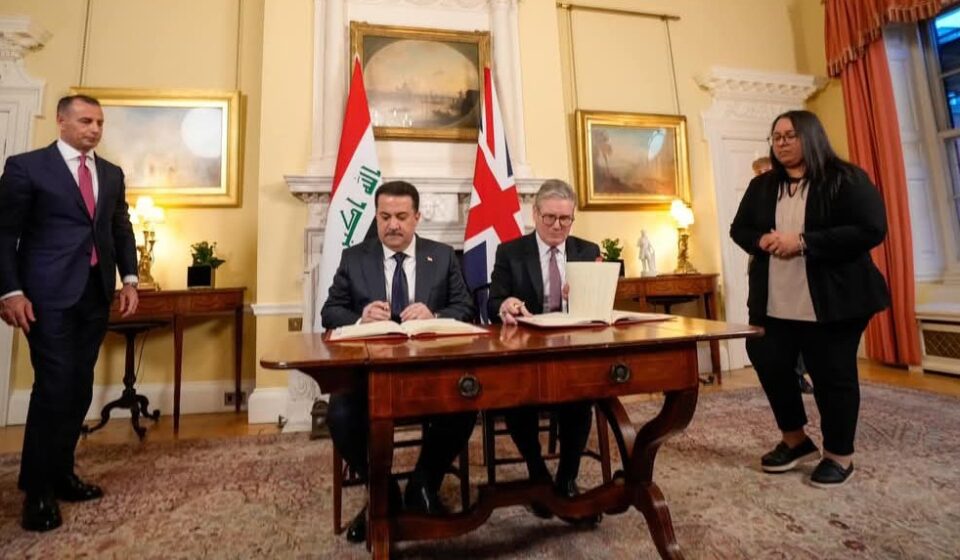
A landmark agreement between Iraq and the United Kingdom dominated conversations, with users detailing a multi-billion pound partnership and a mutual defense pact. Haider (Post Impact: 55%) reported that the two nations signed a joint defense agreement, stating, “Britain will intervene militarily in any war Iraq fights, and Iraq will enter with Britain in any war it fights.” This account and Rusly Al-Maliki (Post Impact: 19%) detailed a £12.3 billion trade and investment package covering infrastructure projects like demining, water treatment in Basra, rebuilding the Qayyarah air base, and establishing a 5G network. The agreements were framed by government supporters like Shaho Al-Qaradaghi (Post Impact: 8%) as a sign of progress that counters talk of regime change. However, critics like Faiq Al-Sheikh Ali (Post Impact: 27%) questioned the deal’s implications for Iraq’s relationship with Iran, sarcastically asking, “#What_is_this Where is the trust and Iraq in Iran?”
2. Political Upheaval in Lebanon Seen as Anti-Shiite “Coup”
Multiple accounts expressed alarm over political developments in Lebanon, framing them as a deliberate effort to sideline Shiite political power. Huruf Sumeria (Post Impact: 31%) described the situation as an “American-Zionist-Saudi coup against the will of the Lebanese people,” claiming the goal was the “exclusion of Shiites in Lebanon from the political process.” This sentiment was echoed by Omar Abdul Sattar Mahmoud (Post Impact: 16%), who spoke of the “breakdown of the Shiite duo in Lebanon.” In contrast, Salim Al-Jumaili (Post Impact: 21%) highlighted the qualifications of the new Prime Minister, Nawaf Salam, noting he is a graduate of Harvard and the Sorbonne and the former president of the International Court of Justice in The Hague.
3. Fears of Imminent US Strike on Iran and Its Allies
Speculation about a potential large-scale US military operation against Iran and its regional proxies was a significant theme. Bahaa khaleel (Post Impact: 26%) quoted the US Secretary of State as saying that stability in the Middle East requires “a decisive blow to the Iranian regime and the axis of resistance.” Meanwhile, Sufian Al-Samarrai (Post Impact: 24%) claimed that a Trump envoy told Netanyahu to sign a ceasefire deal immediately because “we have a major attack on Iran, the Shiite PMF, and the Houthis.” The post added that the envoy urged Netanyahu not to let the Gaza issue obstruct what is coming, concluding, “The storm is coming.”
4. PM Al-Sudani’s Posture in London Sparks Debate
Prime Minister Al-Sudani’s physical posture during his meeting with his British counterpart became a viral topic of discussion, eliciting both praise and ridicule. Supporters viewed it as a sign of confidence and strength. Emad Al-Musafir (Post Impact: 27%) shared a photo, noting the “confident posture of the Prime Minister.” Similarly, MP Alia Nassif (Post Impact: 15%) described it as the “session of a president who represents a strong, prestigious state.” Critics, however, dismissed the focus on appearances. Najeh Abbas Al-Mizan (Post Impact: 11%) argued, “In the eyes of the English, you are a loyalist tail,” while Dr. Qusay Shafiq (Post Impact: 13%) sarcastically asked, “Seriously, the way he sits has become a measure of the state’s prestige?!”
5. Sectarian Discourse Contrasting Shiism and Wahhabism
Several highly engaged posts featured strong sectarian rhetoric, particularly distinguishing Shiite culture from Wahhabism. Wasan Al-Shaikhli (Post Impact: 59%) shared a video clip from an old film, commenting, “This scene was before Wahhabism controlled the Arabs,” and argued that no Arab cinema would dare produce such a scene today for fear of being labeled “Magians.” The same account later posted another video with the caption, “In defiance of the Wahhabis” (Post Impact: 26%). Another user, Ali Al-Muhandis (Post Impact: 18%), emphasized Shiite identity by stating, “We are the Shiites of Ali and Hussein, the word ‘Shia’ was given to us by the Messenger of God when he said to Ali…”
6. Parliament Criticized for Spending and Diplomatic Passports
There was widespread anger directed at the Iraqi Parliament for decisions perceived as self-serving amid the country’s economic difficulties. Salam Al-Husseini (Post Impact: 12%) cited judge Dr. Wael Abdul Latif, who stated that after voting to increase their own salaries, “The Parliament allocated 54 billion to buy new cars for itself!” This was echoed by Zainab Rabie (Post Impact: 6%), who questioned the purchase during a liquidity crisis. Users like Yasser Eljuboori (Post Impact: 6%) also condemned a new law granting MPs and their families diplomatic passports for life, questioning the absence of laws benefiting ordinary citizens.
7. US Political Focus on Iraqi Leaders and Potential Sanctions
Commentators noted the increased attention Iraqi political figures are receiving from American politicians, interpreting it as a prelude to future pressure, especially under a potential Trump administration. Adnan Al-Taie (Post Impact: 26%) observed that US Congressman Joe Wilson is fixated on Iraq, posting frequent tweets about Qais Al-Khazali and Hadi Al-Amiri to energize Donald Trump. David Yassin (Post Impact: 14%) warned that upon taking office, Trump would take steps to impact the Iraqi economy and counter currency smuggling to Iran, predicting that “Iraq will face a series of strikes… not limited to the economic side only.”
8. Iraqi Army Secures Border Area with Syria
Reports circulated about tensions between the Iraqi Army and Syrian Democratic Forces (SDF) along the border. Haider (Post Impact: 13%) initially reported that Iraqi forces had advanced into the al-Yarubiyah area in Hasakah province, taking control of the Mashhaniya border post and expelling an SDF-affiliated militia. A subsequent post from the same account (Post Impact: 8%) shared a clarification from the Iraqi Armed Forces, which stated there was no tension, but that its forces had removed SDF elements from a point inside Iraqi territory to complete the construction of a concrete border wall.
9. Somalia Seeks Iraq’s Expertise in Counter-Terrorism
The visit of the Somali Minister of Internal Security to Iraq was noted by several accounts, highlighting Iraq’s growing regional role in security matters. Haider (Post Impact: 7%) reported that the Somali minister officially requested assistance from his Iraqi counterpart in the form of consultations, training, and expertise sharing to combat terrorist groups like Al-Qaeda and ISIS. Ammar Al-Hakim (Post Impact: 6%), who met with the Somali delegation, stated that Iraq has significant experience after 20 years of fighting terrorism and confirmed that Iraq is ready to provide assistance to help stabilize Somalia.
10. Mourning the Death of Political Analyst Karim Badr
Several users mourned the passing of political analyst and opposition figure Karim Badr. Wasan Al-Shaikhli (Post Impact: 8%) remembered him as “one of the best voices expressing the identity of the Iraqi Shiites.” Yousif Al_Kilaby (Post Impact: 5%) described his death as a “great tragedy” and a “new loss of a Shiite Iraqi voice known for patriotism, courage, and adherence to principles.” Dr. Haider Al-Barzanji (Post Impact: 6%), on behalf of his foundation, issued a statement mourning Badr as a prominent analyst and national figure who dedicated his life to serving his country.