2025-02-03: Al-Jolani’s Saudi Visit and Changing Image

Based on an analysis of 500 X / Twitter posts trending on February 3, 2025, Miqrab AI identified several dominant narratives circulating in Iraq. The most prominent discussion revolves around the evolving regional status of Syrian leader Ahmed al-Sharaa (Abu Mohammad al-Jolani), particularly his official reception in Saudi Arabia, which is frequently contrasted with the treatment of Iraqi officials and sparks debate about his changing public image. This is followed by a significant volume of posts expressing heightened sectarian tensions, with Iraqi Shia voices warning of external threats and Sunni figures asserting their right to engage in regional politics. Concurrently, there is a strong undercurrent of anti-Iranian sentiment, often coupled with calls for a more aggressive US foreign policy under Donald Trump. Domestic issues also feature prominently, with widespread criticism and ridicule directed at the Iraqi government for highlighting minor achievements, alongside renewed discussions about the legacy of the Ba’ath party and concerns over regional instability and its economic consequences for Iraq.
Table Of Content
- 1. Al-Jolani’s Saudi Visit and Changing Image
- 2. Heightened Sectarian Rhetoric and Regional Politics
- 3. Anti-Iran Sentiment and Support for US Intervention
- 4. Iraqi Officials’ Deference to Iran Criticized
- 5. Saudi Arabia’s Growing Regional Influence
- 6. Mockery of Baghdad Airport Bathroom Renovation
- 7. Debates on the Legacy of the Ba’ath Regime
- 8. Trump’s Middle East Policies and Assertiveness
- 9. Fears of Resurging Terrorism in Syria
- 10. Warnings of a Global Economic War Affecting Iraq
Today’s Top 10 X (Twitter) Trends in Iraq:
1. Al-Jolani’s Saudi Visit and Changing Image
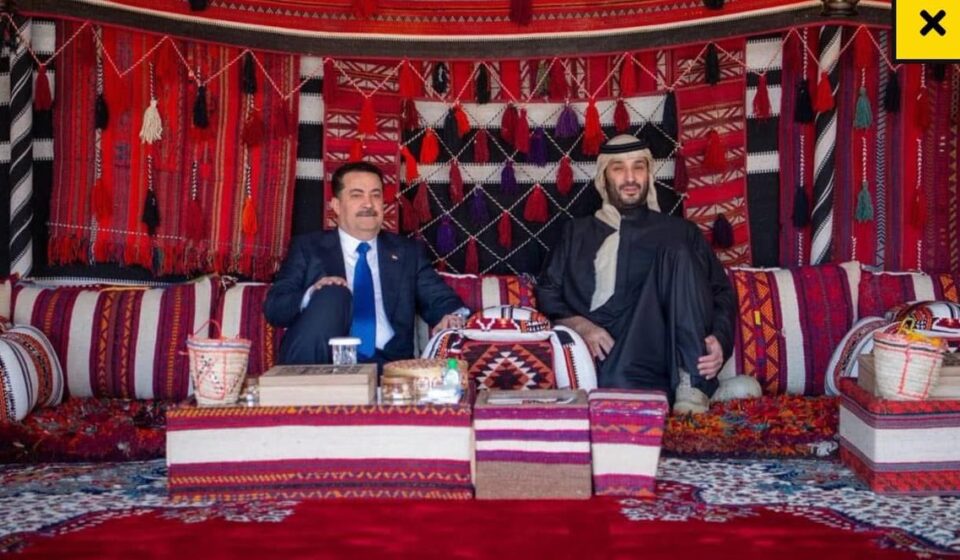
Discussions about Syrian leader Ahmed al-Sharaa (Abu Mohammad al-Jolani) dominated Iraqi social media following his official reception by Saudi Crown Prince Mohammed bin Salman. Tamara Alkhazraji 🍓 (Post Impact: 100%) sparked a major conversation by questioning why MBS received al-Jolani formally at Al-Yamamah Palace while receiving Iraqi PM Al-Sudani in a tent. This comparison fueled a broader debate about al-Jolani’s political rehabilitation. Salim Aljomaili (Post Impact: 31%) provided historical context, framing al-Jolani’s actions as a break from the “deceptive game” of the Assad regime and Iran, who he claims once sent terrorists to Iraq. Meanwhile, his physical appearance was also scrutinized, with Haydar (Post Impact: 28%) noting that al-Jolani has started trimming his beard to change the “stereotypical image” of him. Mahdi Majeed (Post Impact: 5%) commented on how media outlets are transforming his image from a terrorist to a head of state, illustrating how public perception is being shaped.
2. Heightened Sectarian Rhetoric and Regional Politics
A significant trend involved heightened sectarian discourse related to regional events. Wasan Al-Shaykhli (Post Impact: 38%) shared a “call from His Eminence Sayyid Rashid Al-Husseini to the Shi’a of Iraq” warning them, regardless of their political or religious affiliations, to “beware of the coming days and what the Arab nation conceals for you.” In another post, Wasan Al-Shaykhli (Post Impact: 17%) questioned what she sees as a double standard, asking, “Why do the Sunnis of Iraq openly support the Sunnis in Syria, while the sympathy of the Shi’a of Iraq with the Shi’a of Iran is considered sectarianism.” Conversely, Mashan al-Jabouri (Post Impact: 7%) argued that Sunni forces in Iraq have the right to express their position on events in Syria, just as the ruling Shi’a forces have engaged in regional conflicts.
3. Anti-Iran Sentiment and Support for US Intervention
A strong anti-Iranian narrative was present, often linked to hopes for intervention by former U.S. President Donald Trump. Faiq Al-Sheikh Ali/My word for history (Post Impact: 26%) posted a prayer asking God to make Trump “strike the Iranian nuclear program and overthrow the turbans” because, he claims, Iran destroyed Iraq, killed its people, and stole its wealth. This sentiment was echoed by David Yassin (Post Impact: 12%), who wrote that Trump and Israeli Prime Minister Netanyahu agreed on a policy of “maximum pressure” to dismantle Iran internally through economic sanctions and Israeli military operations. Similarly, Sufian Al-Samarrai (Post Impact: 6%) outlined a vision for a “new Middle East” that begins with “striking Iran first.”
4. Iraqi Officials’ Deference to Iran Criticized
The relationship between Iraqi politicians and Iran drew sharp criticism, particularly focusing on a visit to Tehran by Iraqi official Mahmoud al-Mashhadani. Rusly Al-Maliki 🇮🇶 (Post Impact: 10%) sarcastically commented that al-Mashhadani went to Tehran to “get Khamenei’s approval to recognize the new Syrian government,” describing Iraqi officials as “humiliated and submissive.” In contrast, Raad Hashim (Post Impact: 8%) quoted al-Mashhadani stating from Tehran that “Iran is a strong support for Iraq, and we always benefit from its consultations.” This statement was directly challenged by Ameer aldaami (Post Impact: 3%), who argued that al-Mashhadani’s subservient tone was unfitting and that it was Iraq that supported Iran, not the other way around.
5. Saudi Arabia’s Growing Regional Influence
Alongside the focus on al-Jolani’s visit, there was a broader discussion about Saudi Arabia’s expanding role as a key power broker in the Middle East. Omar Abdul Sattar Mahmoud (Post Impact: 22%) shared a video with the assertion that “Prince Mohammed bin Salman possesses the keys to the new Middle East.” This view positions Saudi Arabia at the center of regional transformations. The analysis by Rafid Jaboori رافد جبّوري (Post Impact: 3%) reinforces this, predicting that just as in his first term, Trump’s first state visit will be to Saudi Arabia, dismissing claims that US attention has shifted away from the Middle East.
6. Mockery of Baghdad Airport Bathroom Renovation
Users widely criticized and mocked Iraqi officials for presenting minor projects as significant accomplishments. The renovation of bathrooms at Baghdad International Airport became a focal point of this ridicule. _. suhair Al_jumaili (Post Impact: 9%) criticized the Minister of Transport and the airport director for posting about the opening of a renovated toilet, contrasting it with ministers in other countries who inaugurate entire airports and metro lines. Rusly Al-Maliki 🇮🇶 (Post Impact: 8%) sarcastically declared the news as a “breaking” development. In another post, he referred to it as “the most prominent event today” which might cause oil prices to rise. Yasser Eljuboori – ياسر الجبوري (Post Impact: 3%) also ironically thanked the minister and his staff for this “achievement.”
7. Debates on the Legacy of the Ba’ath Regime
Discussions resurfaced about the legacy of Saddam Hussein’s Ba’athist regime, often contrasting its brutality with current political issues. Wasan Al-Shaykhli (Post Impact: 10%) posted about Fadel al-Barrak, Saddam’s intelligence chief, describing his use of sexual assault against detainees’ families as a torture method and noting that he ultimately suffered a similar fate. In another post, she shared a document allegedly showing an order to cut out a citizen’s tongue for “attacking Saddam,” calling it a page from a “black era.” The discussion was linked to contemporary politics by Rusly Al-Maliki 🇮🇶 (Post Impact: 7%), who reported a statement from former Prime Minister Nouri al-Maliki claiming that “there are 27,000 Ba’athists in state institutions.”
8. Trump’s Middle East Policies and Assertiveness
Donald Trump’s anticipated foreign policy actions in the Middle East were a topic of significant discussion. Haydar (Post Impact: 9%) shared a video of Trump stating, “The Middle East is my office and Israel is the tip of my pen,” highlighting his unapologetic pro-Israel stance. Another post from Haydar (Post Impact: 4%) claimed Trump had directed the King of Jordan to come to Washington within eight days to discuss the transfer of people from Gaza to Jordan. However, a contrasting view was presented by Rusly Al-Maliki 🇮🇶 (Post Impact: 8%), who noted that Trump’s ambitions are being “besieged by rejection,” citing Canada and Denmark’s refusal of his territorial proposals and Egypt and Jordan’s opposition to displacing Gazans.
9. Fears of Resurging Terrorism in Syria
The changing political landscape in Syria has sparked fears among Iraqi commentators about the resurgence of terrorist tactics, particularly car bombings. Essam Hussein (Post Impact: 7%) observed that “indicators of car bombs have reappeared” after the defeat of ISIS, noting five such explosions in Syria in 60 days. He expressed concern that this “terrifying guest” could easily move to Baghdad and other Iraqi provinces. This was corroborated by Mazin Al-Eshaiker 🇮🇶 (Post Impact: 3%), who stated that after the return of sectarian rhetoric, car bombs have returned, citing a recent attack in Manbij, Syria, that killed 15 civilians.
10. Warnings of a Global Economic War Affecting Iraq
Users expressed serious concerns about the potential for a “global geoeconomic war” under a new Trump administration and its dire consequences for Iraq. Ziad Al-Hashimi (Post Impact: 4%) wrote a detailed post warning that Trump’s aggressive trade measures are raising global risk and could lead to a collapse in oil prices. He argued that Iraq, being almost entirely dependent on oil, is the “most vulnerable and fragile” country and would be the biggest loser, while the Iraqi government remains distracted by side issues. Essam Hussein (Post Impact: 9%) also commented on Trump’s tariffs, criticizing Arab and Gulf states for, in his view, passively accepting damaging economic policies.