2025-02-13: Sadr’s Post and 15th of Sha’ban Commemorations

Based on an analysis of 580 posts on February 13, 2025, Miqrab AI found that X / Twitter conversations in Iraq were dominated by religious commemorations, regional political tensions, and reflections on historical events. The highest engagement surrounded a post from influential cleric Muqtada al-Sadr, coinciding with widespread observances for the 15th of Sha’ban. Concurrently, users marked the anniversary of Grand Ayatollah Ali al-Sistani’s fatwa against ISIS and the 1991 US bombing of the Amiriyah shelter. Significant discourse focused on criticism of Iran and Hezbollah, praise for Jordan’s King Abdullah II, and speculation about the impact of the Trump administration on Iraq and the wider region. Domestic issues, including security concerns over a new general amnesty law and the resurfacing of sectarian rhetoric, were also prominent topics.
Table Of Content
- 1. Sadr’s Post and 15th of Sha’ban Commemorations
- 2. Praise for Sistani’s 2014 Anti-ISIS Fatwa
- 3. Criticism of Iran and Hezbollah’s Regional Role
- 4. Praise for Jordan’s King Abdullah II’s Leadership
- 5. Commemoration of the 1991 Amiriyah Shelter Bombing
- 6. Debate Over Trump’s Potential Impact on Iraq
- 7. Hezbollah Supporters Protest at Beirut Airport
- 8. Security Concerns Over General Amnesty Law
- 9. Sectarian Rhetoric from Political Figures Surfaces
- 10. Kuwaiti Journalist Jailed Over False News
Today’s Top 10 X (Twitter) Trends in Iraq:
1. Sadr’s Post and 15th of Sha’ban Commemorations
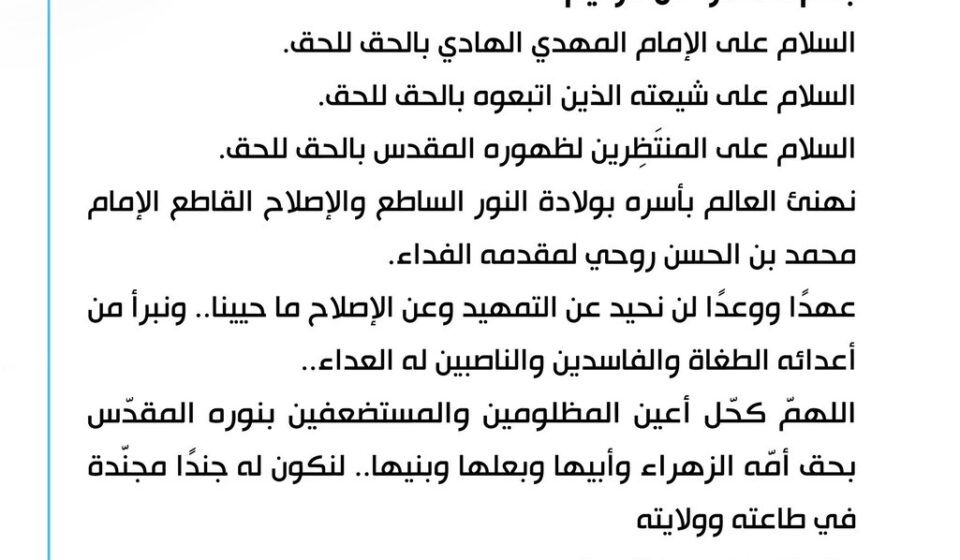
The most impactful post of the day came from Shia cleric Muqtada al-Sadr (Post Impact: 100%), who shared an image without text, generating significant engagement. This coincided with widespread online discussions about religious observances for the 15th of Sha’ban, the birth of Imam Mahdi. Accounts like Haider (Post Impact: 4%) and Wasan Al-Shaikhli (Post Impact: 3%) shared images of “million-strong crowds” celebrating the occasion in Karbala. In a related religious context, the account Abu Mzeal (Post Impact: 17%) posted an image of religious figures with the text, “Iraq was about to become Syria, but Najaf saved it.” This highlights a prevailing narrative centered on the importance of Shia religious figures and holy cities in protecting Iraq.
2. Praise for Sistani’s 2014 Anti-ISIS Fatwa
Multiple accounts commemorated the anniversary of Grand Ayatollah Ali al-Sistani’s 2014 fatwa of “Kifai Jihad” (collective duty jihad), which led to the formation of the Popular Mobilization Forces (PMF) to fight ISIS. Haider (Post Impact: 16%) and Dr. Hussein Al-Safi (Post Impact: 13%) shared images of Sistani, with the latter describing him as “The only person in the world who established an army with a single word in just one day.” PMF Media Directorate (Post Impact: 3%) and Ammar Al-Hakim (Post Impact: 3%) both released statements praising the fatwa as a historic turning point that united Iraqis and led to the defeat of terrorism. The narrative across these posts credits Sistani’s intervention with saving the nation from collapse.
3. Criticism of Iran and Hezbollah’s Regional Role
A strong anti-Iran narrative was visible across several high-engagement posts. The account Aayad Al Twfan (Post Impact: 29%) shared a video of a Lebanese Shia figure from Hezbollah who allegedly described Iran’s betrayal of the group during an Israeli attack, asking, “Who is the agent for Israel? And who gave it all the maps?” A campaign to boycott Iranian goods was promoted by Bahaa khaleel (Post Impact: 16%), who stated, “Every penny you pay to buy an Iranian product will come back to you and your family as bullets, blood, and drugs.” Meanwhile, Shaho Al-Qaradaghi (Post Impact: 15%) criticized Iranian writers for claiming they could destroy Israel while their presence in Syria and Lebanon only produced “hundreds of Captagon factories to destroy the youth.”
4. Praise for Jordan’s King Abdullah II’s Leadership
Jordan’s King Abdullah II received significant positive attention following his visit to the United States. Raad Hashim (Post Impact: 18%) shared a video of the king’s return to Amman, highlighting a “massive popular reception.” Steven Nabil (Post Impact: 7%) described the king as a “wise leader” who has maintained Jordan’s stability amidst regional turmoil by avoiding “resounding slogans and speeches.” Similarly, Ghaith Al-Tamimi (Post Impact: 2%) praised the king’s firm but calm demeanor during his meeting with President Trump, contrasting it with the “loud” and ultimately destructive approaches of leaders like Saddam Hussein or Ali Khamenei.
5. Commemoration of the 1991 Amiriyah Shelter Bombing
The anniversary of the February 13, 1991, US bombing of the Amiriyah shelter in Baghdad was a prominent topic of remembrance. Several accounts described the event as a massacre of civilians. Haider (Post Impact: 15%) posted that two American stealth aircraft bombed the shelter, killing “400 martyrs, including children, women, and the elderly,” after the US claimed it was a military command center. Othman Al-Mukhtar (Post Impact: 5%) and Aayad Al Twfan (Post Impact: 4%) also shared posts calling the event a “massacre” and a “black and painful day for every honorable Iraqi,” listing the civilian death toll and stating that such crimes do not have a statute of limitations.
6. Debate Over Trump’s Potential Impact on Iraq
The potential policies of the Trump administration towards Iraq and Iran were a subject of intense debate. Mashaan Al-Jabouri (Post Impact: 12%) recounted a conversation with political figure Faig Al-Sheikh Ali, questioning how Trump could be a savior for Iraq while simultaneously disregarding Palestinian rights. According to the post, Al-Sheikh Ali responded that he believes “Trump and his allies will intervene to smash Iran and destroy its affiliated militias.” Raad Hashim (Post Impact: 3%) also summarized Al-Sheikh Ali’s position on the matter. In a related post, Sufian Al-Samarrai (Post Impact: 15%) praised Trump for deploying new plainclothes police forces in New York to restore order after the “chaos of the failed left.”
7. Hezbollah Supporters Protest at Beirut Airport
Reports emerged of protests by Hezbollah supporters in Lebanon. Shaho Al-Qaradaghi (Post Impact: 9%) shared a video of supporters burning tires to protest a decision to deny landing permission to an Iranian plane at Beirut’s airport. The account commented on the situation with the phrase, “Burning Lebanon in defense of Iran!” Omar Abdul Sattar Mahmoud (Post Impact: 5%) also shared a video of the airport road being blocked by Hezbollah supporters for the same reason.
8. Security Concerns Over General Amnesty Law
The recently ratified General Amnesty Law has sparked security concerns, particularly in Anbar province. Azhar Al-Jumaili (Post Impact: 5%) reported the first public appearance of an alleged ISIS terrorist, Nael Nouri Hammad Rathie Al-Dhiyabi, in a Ramadi market. The post questioned whether security and intelligence agencies had removed his name from databases before his arrest and trial, or if there was an agreement in place. Separately, Haider (Post Impact: 3%) reported that the first person in Kirkuk to be included in the general amnesty was a woman convicted under Article 4 of the anti-terrorism law, noting that this article applies to terrorists or those who aid and abet them.
9. Sectarian Rhetoric from Political Figures Surfaces
Posts highlighted inflammatory and sectarian statements attributed to political and religious figures. Zeinab Al-Ghanem (Post Impact: 5%) shared a video clip of politician Issam Hussein, in which he allegedly says, “Sunni projects are like a ‘bastard’.” In another post, Shaho Al-Qaradaghi (Post Impact: 4%) quoted religious figure Yassin Al-Moussawi, who claimed, “In Iraq, there are those who do not believe in a unified Iraq, led by the Kurds who work in the circle of the Zionist entity, in addition to some Sunnis who have resorted to Erdogan.” Al-Qaradaghi criticized this rhetoric as an attempt to “incite internally and spread sedition under the cover of religion.”
10. Kuwaiti Journalist Jailed Over False News
The sentencing of Kuwaiti journalist Fajr Alsaeed was reported by several accounts. ZaidBenjamin (Post Impact: 4%) reported that the Criminal Court in Kuwait sentenced Alsaeed to three years in prison with labor for spreading false news, while acquitting her of charges related to calling for normalization with Israel. The news prompted commentary in Iraq, with Sheikh Mohammed Al-Basri (Post Impact: 2%) stating, “We need to apply this law in Iraq,” and arguing that many figures in Iraq who incite sedition under the guise of being journalists, activists, or politicians should be disciplined to maintain the country’s stability.