2025-02-26: Muqtada al-Sadr Criticizes Syrian Leader Ahmed al-Sharaa

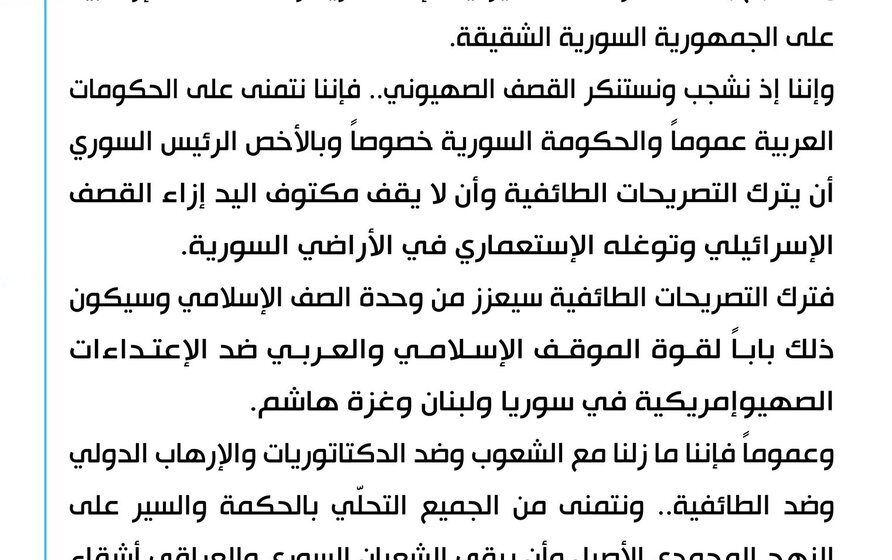
Based on an analysis of 481 X / Twitter posts on February 26, 2025, Miqrab AI identified several key narratives dominating Iraqi social media. The most prominent discussion centered on a public statement from influential cleric Muqtada al-Sadr criticizing the new Syrian leader, Ahmed al-Sharaa, for his sectarian rhetoric and inaction against Israeli military operations in southern Syria. This sentiment was widely echoed by users who mocked the new Syrian government’s inability to defend its territory, often drawing sharp contrasts with Hezbollah’s resistance in Lebanon. Another significant theme involved the implications of a phone call between the Iraqi Prime Minister and the US Secretary of State, with commentators interpreting the publicly released summary as a clear American ultimatum for Iraq to reduce Iranian influence. Discussions also covered unconfirmed rumors of the arrest of high-profile PMF leaders, analysis of Israel’s long-term strategic goals for Syria, and internal Iraqi political disputes, including criticism of religious figures and reflections on the crimes of the former Ba’athist regime.
Table Of Content
- 1. Muqtada al-Sadr Criticizes Syrian Leader Ahmed al-Sharaa
- 2. Criticism of Syria’s Inaction Against Israeli Incursion
- 3. US-Iraq Diplomatic Call and Pressure on Iran
- 4. Sectarian Commentary on Regional Conflicts
- 5. Rumors of Al-Amiri and Al-Fayadh’s Arrest in Najaf
- 6. Analysis of Israel’s Strategic Plans for Syria
- 7. Criticism of Religious Figure Mohammed al-Yaqoubi
- 8. Remembering Crimes of the Former Ba’athist Regime
- 9. Iraqi Judiciary Denies Issuing Controversial Arrest Warrants
- 10. Speculation on Former PM Mustafa al-Kadhimi’s Return
Today’s Top 10 X (Twitter) Trends in Iraq:
1. Muqtada al-Sadr Criticizes Syrian Leader Ahmed al-Sharaa
The most impactful story of the day was a statement from influential Shiite cleric Muqtada al-Sayyid Muhammad al-Sadr (Post Impact: 100%) addressed to the new Syrian leader, Ahmed al-Sharaa (also known as Abu Mohammad al-Jolani). In his post, al-Sadr urged al-Sharaa to “leave the sectarian statements” and not “stand idly by in the face of Israeli colonialism in Syrian lands.” The message was widely shared and analyzed by other users. Accounts like Shaho Al-Qaradaghi (Post Impact: 14%) and Haidar (Post Impact: 8%) amplified the statement. Commentator Omar Al-Janabi (Post Impact: 2%) interpreted al-Sadr’s post as a signal that Iraq will continue its non-recognition of the new Syrian government and will stand against it.
2. Criticism of Syria’s Inaction Against Israeli Incursion
Following Israel’s military incursion into southern Syria, numerous Iraqi accounts criticized the new Syrian government for its perceived weakness and inaction. Ahmad Al-Thawaq (Post Impact: 21%) posted a scathing message to al-Jolani, stating that the “Latama” (a derogatory term for Shiites) have crushed his terrorist groups and were the first to strike Israel. Issam Hussein (Post Impact: 7%) argued that al-Jolani’s followers have turned from “mujahideen into latama” because their enemy is not Shiite. Others, like Wasan Al-Shaikhli (Post Impact: 5%) and Hassan Al-Kaabi (Post Impact: 5%), drew direct comparisons, questioning why southern Lebanon did not fall for years while southern Syria fell in hours. Omar Abd al-Sattar Mahmoud (Post Impact: 19%) posted a picture of al-Jolani with the sarcastic caption, “When he said we don’t do latm🙃”.
3. US-Iraq Diplomatic Call and Pressure on Iran
A statement released by the U.S. Embassy Baghdad (Post Impact: 5%) about a phone call between US Secretary of State Marco Rubio and Iraqi Prime Minister Mohammed Shia’ Al Sudani sparked significant discussion. The statement emphasized the need to reduce “malign Iranian influence” and for Iraq to achieve energy independence. Iraqi commentators interpreted this as a direct ultimatum. Rusly Al-Maliki (Post Impact: 9%) claimed the US Secretary of State clearly gave Sudani a choice: “We or Iran.” Mashaan Al-Jabouri (Post Impact: 5%) predicted that the Iraqi government cannot escape Iran’s grip, which will inevitably lead to further US sanctions. Others like Hisham Ali (Post Impact: 4%) also summarized the key US demands detailed in the call.
4. Sectarian Commentary on Regional Conflicts
A strong narrative on X/Twitter involved framing regional conflicts through a sectarian lens. Mahdi Majeed (Post Impact: 18%) posed a question asking why Israel bombs weapon depots of Sunni organizations in Syria but not those of Shia organizations in Iraq. He concluded that Israel perceives Sunni groups as a direct threat, while claiming Iran-backed Shia factions have “not killed an Israeli cockroach and only harmed their own people.” This theme of contrasting capabilities was also present in posts by Wasan Al-Shaikhli (Post Impact: 5%) and Hassan Al-Kaabi (Post Impact: 5%), who compared the quick collapse of southern Syria under the new government to the years-long resistance of Hezbollah in southern Lebanon.
5. Rumors of Al-Amiri and Al-Fayadh’s Arrest in Najaf
Unconfirmed reports circulated about an incident at Najaf Airport involving prominent leaders of the Popular Mobilization Forces (PMF). Hiba Alnnayib (Post Impact: 13%) posted a video with a caption citing “sources from inside the airport” that claimed Hadi al-Amiri and Faleh al-Fayyad had been arrested. Similarly, Rusly Al-Maliki (Post Impact: 8%) referenced the “incident at Najaf airport,” urging the Iraqi Ministry of Interior to provide a clarification “before the Americans release it” and put the Iraqi side in an embarrassing position. Al-Maliki also shared a photo purportedly from the event.
6. Analysis of Israel’s Strategic Plans for Syria
Political analysts on X/Twitter discussed Israel’s long-term strategic objectives in the region, particularly concerning Syria. Omar Abd al-Sattar Mahmoud (Post Impact: 20%) shared a segment from his show “Political Lenses,” claiming that “Israel plans to assassinate al-Sharaa.” A more detailed analysis came from Liqaa Maki (Post Impact: 6%), who argued that Israel has been planning to fragment Iraq and Syria since 1955. Maki suggests that Israel is now attempting to create a Druze entity in southern Syria to serve as a buffer zone, while using its support for the SDF in the north to keep Damascus preoccupied. He warned that the new Syrian government must not ignore these plans and should seek defensive alliances.
7. Criticism of Religious Figure Mohammed al-Yaqoubi
Internal disputes within the Shiite religious establishment were highlighted by user Wasan Al-Shaikhli (Post Impact: 8%), who targeted cleric Mohammed al-Yaqoubi. In one post, the user shared an image claiming that Grand Ayatollah Ali al-Sistani’s office considers al-Yaqoubi a “liar” and not a legitimate Marja’ (source of emulation). A subsequent post from the same account (Post Impact: 4%) praised Mohammed Redha al-Sistani, the Grand Ayatollah’s son, as the “crown of the Hawza” for standing up to al-Yaqoubi’s followers. The posts indicate ongoing tensions and rivalry between clerical factions in Iraq.
8. Remembering Crimes of the Former Ba’athist Regime
Several accounts focused on recalling atrocities committed during the Ba’athist era, specifically highlighting the alleged crimes of a former security officer named Khairallah Hammadi. Fadhil Abu Ragheef (Post Impact: 7%) and Ahmad Akhu Mza’al (Post Impact: 5%) shared a video of Hammadi, accusing him of overseeing executions where victims were killed by explosives attached to their hearts. The National Security Service was also cited by Emad Al Musafir (Post Impact: 3%) as holding Hammadi responsible for the forced displacement of families from the city of Balad to the Nukrat al-Salman prison in 1980.
9. Iraqi Judiciary Denies Issuing Controversial Arrest Warrants
Multiple accounts reported on the Iraqi Supreme Judicial Council’s denial of arrest warrants that had been circulating on social media. The fabricated warrants named Syrian leader Ahmed al-Sharaa, former US President Donald Trump, and US Congressman Joe Wilson. Accounts such as Mashaan Al-Jabouri (Post Impact: 2%), Shaho Al-Qaradaghi (Post Impact: 2%), and Steven Nabil (Post Impact: 2%) shared the official statement which declared the documents “forged.” However, Othman Al-Mukhtar (Post Impact: 4%) expressed skepticism, pointing out that the judiciary had previously announced a warrant for Trump, suggesting the denial reflects a “state of confusion” within the political system.
10. Speculation on Former PM Mustafa al-Kadhimi’s Return
Commentators discussed the return of former Prime Minister Mustafa al-Kadhimi to Baghdad and its potential political implications. Citing the Associated Press, Hiba Alnnayib (Post Impact: 3%) reported that al-Kadhimi was invited back by political leaders to help manage the economic crisis, leveraging his positive relationships with the United States and Saudi Arabia. Salam Al-Hussaini (Post Impact: 2%) analyzed this move, suggesting that Iran may see al-Kadhimi as a useful intermediary to ease US sanctions, while the current government, facing severe economic pressure, is compelled to welcome his assistance despite past disagreements.