2025-03-07: Heavy Rains Cause Widespread Flooding Across Baghdad

Based on an analysis of 462 posts by Miqrab AI, the top trending topics on Facebook in Iraq on March 7, 2025, were dominated by severe weather and its consequences, particularly the widespread flooding in Baghdad which sparked intense public criticism of the country’s infrastructure. Other significant narratives included reports of a violent massacre of Alawites in Syria, which drew comparisons to the Speicher massacre, strong political commentary from public figures like MP Mustafa Sanad, and a high-profile corruption scandal in Wasit where a whistleblower faced death threats. Official communications from Prime Minister Al-Sudani and religious leader Muqtada al-Sadr also garnered significant attention, alongside public ridicule directed at the wife of the Karbala governor for her remarks about the city’s streets amid the floods.
Table Of Content
- 1. Heavy Rains Cause Widespread Flooding Across Baghdad
- 2. Reports of Mass Killings of Alawites in Syria
- 3. MP Mustafa Sanad’s Sharp Political Statements
- 4. Whistleblower Threatened After Exposing Corruption
- 5. Karbala Governor’s Wife Criticized for Remarks Amid Floods
- 6. Communications from Muqtada al-Sadr’s Office
- 7. Officials and Security Forces Respond to Flooding
- 8. Prime Minister Al-Sudani’s Official Activities
- 9. Weather Reports Explain Severity of Rain and Humidity
- 10. Iraqi Political Figures React to Syrian Conflict
Today’s Top 10 Facebook Trends in Iraq:
1. Heavy Rains Cause Widespread Flooding Across Baghdad
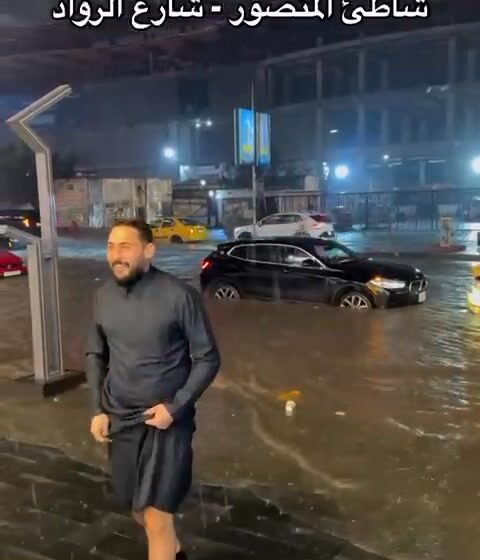
Heavy rainfall led to severe flooding across Baghdad and other Iraqi cities, paralyzing traffic and inundating homes and streets. Numerous pages shared videos and images of the deluge, with citizens expressing anger and sarcasm over the state of the infrastructure. The page Set Ashwaq Om al-Qanounia (Post Impact: 74%) posted a video of a flooded area in Mansour, sarcastically commenting, “Why go to Lebanon and Turkey? This is a resort in Mansour and without a visa.” Al-Khuwa al-Nadhifa (Post Impact: 26%) attributed the crisis to “dilapidated infrastructure and poor maintenance of sewage networks.” Other pages like Iraqeen W Bas (Post Impact: 32%) and Baghdad (Post Impact: 11%) also documented the flooding, showing submerged tunnels and vehicles, highlighting the immediate and disruptive impact of the storm on the capital.
2. Reports of Mass Killings of Alawites in Syria
A significant story circulating on Iraqi Facebook pages involved reports of a massacre of Alawite civilians in Syria, with many commentators drawing direct parallels to the 2014 Speicher massacre in Iraq. Irfaa Sawtak – Erfaa Sawtak (Post Impact: 27%), citing the Syrian Observatory for Human Rights, reported that Syrian security forces “executed 90 Alawite civilians” in areas like Baniyas and Latakia. Salem Mashkour (Post Impact: 29%) made a direct comparison, stating, “From the Iraqi Speicher to the Syrian Speicher… The identity of the perpetrator is the same… The identity of the victim is the same.” Likewise, Ahmed Althawaq (Post Impact: 5%) condemned the killing of “more than 1700 Alawite civilians, most of them women and children,” at the hands of those he called “Bani Umayya,” linking the violence to historical sectarian persecution.
3. MP Mustafa Sanad’s Sharp Political Statements
MP Mustafa Sanad generated significant engagement with two strongly worded posts criticizing government policies and international relations. In a highly impactful post, Mustafa Sanad – Mustafa Sanad (Post Impact: 70%) declared an unspecified entity an “official enemy,” blaming the “misguided government” for granting it “trillion-dinar contracts and projects to use them to support evil and exterminate the vulnerable.” In a separate video post, Mustafa Sanad – Mustafa Sanad (Post Impact: 53%) questioned the potential consequences of American sanctions on Iran’s energy supply to Iraq, asking, “What if the Americans implement their punishment by cutting off Iranian gas to Iraq?” These posts reflect a narrative of deep distrust in both domestic governance and foreign influence.
4. Whistleblower Threatened After Exposing Corruption
A story of a whistleblower facing severe repercussions for exposing corruption gained massive traction through a single, high-impact post. Haider al-Hamdani (Post Impact: 100%) reported on an employee in Wasit province who was transferred and received death threats after uncovering alleged corruption valued at 600 billion Iraqi dinars. The post, titled “Reprimand and transfer with a death threat,” stated that the case escalated to the point where the Minister of Justice personally intervened to ensure the employee’s protection, highlighting the dangers faced by those who challenge corruption within state institutions.
5. Karbala Governor’s Wife Criticized for Remarks Amid Floods
The wife of the Karbala governor became a subject of widespread criticism and ridicule after her public statements were contrasted with the reality of flooded streets in the province. Al-Khuwa al-Nadhifa (Post Impact: 28%) reported that citizens were responding to her claim that Karbala’s streets are “better” than those in America by posting photos of their own waterlogged neighborhoods. Her comments were also mocked on other pages, such as Khabar Ajel (Post Impact: 5%), which quoted an interview where she said the governor’s favorite meal is fried tomatoes. Salem Mashkour (Post Impact: 3%) sarcastically posted a video of the flooding with the caption, “The governor’s wife, peace be upon her, was right. Hahahahaha.”
6. Communications from Muqtada al-Sadr’s Office
The official channels associated with the Sadrist movement were active in sharing statements and updates from Muqtada al-Sadr. The Private Office of His Eminence Sayyid Muqtada al-Sadr (Post Impact: 22%) published a post that al-Sadr had made on the “X” social media platform. The same page also shared al-Sadr’s answers to religious questions for the month of Ramadan (The Private Office of His Eminence Sayyid Muqtada al-Sadr, (Post Impact: 18%)) and updates on nightly Ramadan prayers in Najaf. Meanwhile, the page for Saraya al-Salam – Central Media Directorate (Post Impact: 16%) shared a tribute video describing him as a “role model for the honorable and the leader of the truthful.”
7. Officials and Security Forces Respond to Flooding
As cities flooded, pages shared updates on the official response from government bodies and security forces. The Government Palace (Post Impact: 11%) reported that by 2:25 AM, most of the floodwaters in Baghdad had been cleared thanks to major efforts by the Baghdad Municipality and security services. Journalist Steven Nabil (Post Impact: 10%) highlighted the governor of Wasit supervising drainage work late at night, noting his sentiment that no official should sleep while streets are flooded. In Baghdad, heroic actions were also spotlighted; both the The Media Office of the Minister of Interior (Post Impact: 3%) and Iraqi Ministry of Interior (Post Impact: 3%) announced that the Minister of Interior honored traffic officers who rescued a citizen whose car was submerged in a flooded tunnel.
8. Prime Minister Al-Sudani’s Official Activities
The official page of Prime Minister Mohammed Shia’ Al-Sudani shared several updates on his governmental and ceremonial duties. In one post, Engineer Mohamed Shia Al-Sudani (Post Impact: 16%) commemorated the 16th anniversary of the passing of Sayyid Abdul Aziz al-Hakim, praising his legacy of jihad and his role in building a democratic Iraq. Another lengthy post from Engineer Mohamed Shia Al-Sudani (Post Impact: 12%) detailed his chairing of a meeting of the Higher Committee for Water, which addressed agricultural water management, river negotiations with upstream countries, and environmental protection for the marshlands. He also hosted wounded members of the security forces for an Iftar meal during Ramadan, as detailed in a separate post (Engineer Mohamed Shia Al-Sudani, (Post Impact: 6%)).
9. Weather Reports Explain Severity of Rain and Humidity
In parallel with posts showing the flooding, several pages provided meteorological context for the severe weather event. Telescope Iraq (Post Impact: 11%) reported that humidity in Baghdad reached 99%, indicating the air was almost completely saturated with water vapor. This information was also shared by Nafs Iraq (Post Impact: 10%). Later, Telescope Iraq (Post Impact: 7%) provided rainfall data from the General Authority for Meteorology, stating that a station in southern Baghdad recorded 72 millimeters of rain, equivalent to 72 liters of water per square meter, which helps explain the scale of the subsequent flooding.
10. Iraqi Political Figures React to Syrian Conflict
The escalating violence in Syria prompted varied reactions from Iraqi political figures, reflecting different stances on the new leadership there. The Tactical Cell (Post Impact: 7%) shared statements from Israel’s defense minister labeling Syrian leader Ahmed al-Sharaa (formerly Abu Muhammad al-Jolani) a “jihadist terrorist” who is committing massacres. In Iraq, Al-A’dhamiya News (Post Impact: 3%) reported that Khamis al-Khanjar, head of the Sovereignty Alliance, condemned “attempts to destabilize Syria.” In contrast, the Ninawa page (Post Impact: 3%) accused al-Khanjar of attacking the people of the Syrian coast and siding with al-Jolani’s elements, illustrating the divisive nature of the Syrian conflict among Iraqi politicians.