2025-03-30: Sunni Defiance Over Eid and Street Prayers

Based on an analysis of 618 X / Twitter posts trending in Iraq on March 30, 2025, Miqrab AI identified several key narratives. The most dominant conversation centered on the significant controversy surrounding the date of Eid al-Fitr for Sunni Muslims. The decision by the Sunni Endowment, led by Mishaan al-Khazraji, to declare Monday as Eid, diverging from Saudi Arabia and other nations, sparked widespread defiance and accusations of political submission to the Iraqi government and Iranian influence. This resulted in many Sunnis performing Eid prayers in public streets and squares after mosques were reportedly closed, leading to harsh criticism against Prime Minister Mohammed Shia’ al-Sudani’s administration and calls for Khazraji’s resignation. Other discussions included critiques of Iraqi infrastructure projects in comparison to those in Saudi Arabia, commentary on regional political tensions, and reactions to statements by former US President Donald Trump regarding Iran.
Table Of Content
- 1. Sunni Defiance Over Eid and Street Prayers
- 2. Calls to Oust Sunni Endowment Head Mishaan al-Khazraji
- 3. Accusations of Foreign Influence and Sectarianism
- 4. Criticism of Baghdad Metro Project
- 5. Calls for Muslim Unity Amid Eid Disagreement
- 6. Religious Arguments on Moon Sighting Independence
- 7. Support for Sunni Endowment’s Decision for Unity
- 8. Turkey’s Alleged Alliance with Iran Against Israel
- 9. Trump’s Renewed Threats Against Iran
- 10. Official Greetings from Iraqi Leadership
Today’s Top 10 X (Twitter) Trends in Iraq:
1. Sunni Defiance Over Eid and Street Prayers
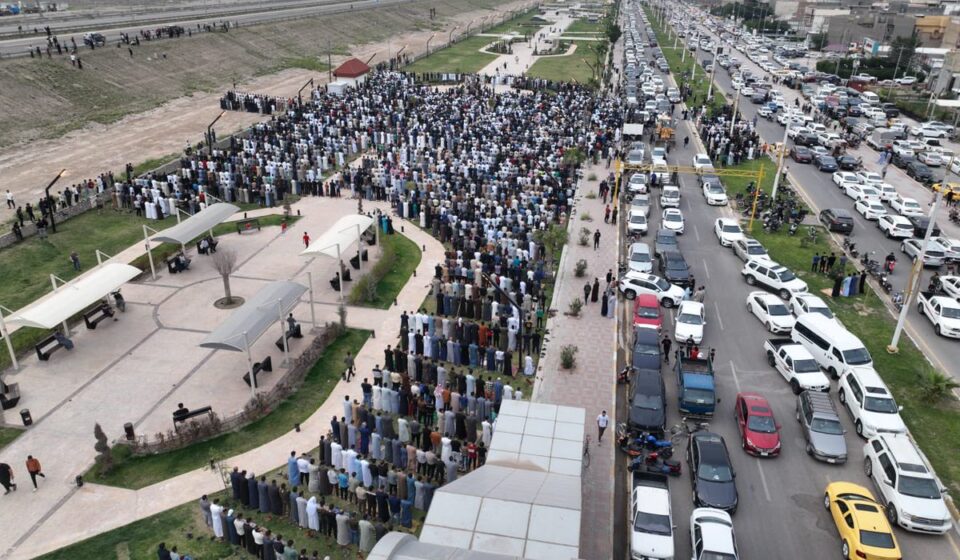
A major topic of discussion was the widespread defiance by Sunni Muslims against the official Eid al-Fitr date set by the Iraqi Sunni Endowment. After the Endowment, led by Mishaan al-Khazraji, declared Monday as Eid, many Sunnis chose to follow the announcement from Saudi Arabia and celebrate on Sunday. This led to reports and videos of worshippers performing Eid prayers in public streets and squares in cities like Fallujah and the Adhamiyah district of Baghdad, allegedly because mosques had been closed. Steven Nabil (Post Impact: 70%) shared a photo from Fallujah, commenting, “History will write that during the era of the Iraqi Sunni Endowment, Muslims prayed in public streets.” Mashaan Al-Jabouri (Post Impact: 29%) described the street prayers as a moment where “faith triumphs over submission,” while Mustafa Al-Dulaimi (Post Impact: 12%) said the “lions of the Sunnis” had made their voices heard against the decision.
2. Calls to Oust Sunni Endowment Head Mishaan al-Khazraji
The controversy surrounding the Eid date fueled intense criticism and direct calls for the resignation of Mishaan al-Khazraji, the head of the Sunni Endowment. Critics accused him of politicizing a religious occasion and causing unprecedented division among Iraqi Sunnis. Mashaan Al-Jabouri (Post Impact: 24%) penned an open letter to Prime Minister Mohammed Shia’ Al Sudani, stating that under his government, mosques were closed to Sunni worshippers for the first time in history and that the “dismissal of Mishaan al-Khazraji is a necessary step” to absolve the government of responsibility. Similarly, Haider Al Mulla (Post Impact: 12%) advised Khazraji to resign, stating he had “caused social division through mismanagement.” Mustafa Al-Dulaimi (Post Impact: 4%) promoted a hashtag demanding his removal, reflecting a sentiment that Khazraji no longer represents the Sunni community.
3. Accusations of Foreign Influence and Sectarianism
The disagreement over the Eid date was heavily interpreted through a political and sectarian lens, with accusations of foreign influence from multiple sides. Issam Hussein (Post Impact: 23%) suggested that the Sunni community’s belief that the Eid decision was driven by an “Iranian desire” was a “dangerous indicator” of their readiness to support anti-Iran extremist groups. In contrast, Mahdi Majeed (Post Impact: 15%) praised Sunnis for rejecting what he termed “Iranian orders” and asserting their freedom. On the other hand, those who celebrated Eid on Sunday were accused of following a foreign agenda. Haider (Post Impact: 15%) derisively referred to those who followed Saudi Arabia’s sighting as members of the “Saudi community in Iraq,” while Wasan Al-Sheikhli (Post Impact: 22%) suggested this proved their subservience to Saudi Arabia.
4. Criticism of Baghdad Metro Project
A high-impact post drew critical comparisons between Iraqi infrastructure projects and those in neighboring Saudi Arabia. Dr. Qusay Shafiq (Post Impact: 67%) shared a video of a high-speed electric train in Saudi Arabia, which travels at 300 km/h between Mecca and Medina. He sarcastically contrasted this with the planned Baghdad suspended metro, which he noted has a price tag of one billion dollars, urging fellow Iraqis to observe the difference in the quality and ambition of national projects.
5. Calls for Muslim Unity Amid Eid Disagreement
In the midst of the contentious debate, several prominent accounts issued messages calling for unity and goodwill. Salih Muhammad al-Iraqi (Post Impact: 37%), a page associated with Muqtada al-Sadr, wished followers days filled with “obedience, faith, loyalty, and love for the homeland.” Abu Azrael (Post Impact: 26%), who mentioned he was personally fasting on Sunday, questioned the discord, asking, “O nation of Muhammad… when will you unite and leave the hatred between you?” Faig Al-Sheikh Ali (Post Impact: 15%) also expressed dismay at the online arguments and insults exchanged between those who celebrated Eid on Sunday and those who continued to fast, chastising both groups for their divisive behavior.
6. Religious Arguments on Moon Sighting Independence
Some commentators argued that determining the start of Eid is a matter of personal religious conviction rather than a strict requirement to follow institutional decrees. Faig Al-Sheikh Ali (Post Impact: 24%) stated that fasting and breaking the fast are issues in which a Muslim is not obligated to emulate their religious authority, suggesting that individuals can rely on their own sighting of the crescent moon or on astronomical calculations. Similarly, Mahdi Majeed (Post Impact: 6%) invoked the Prophetic tradition, “Fast upon its sighting and break your fast upon its sighting,” to argue that the crescent was visible in Iraq and that Sunday was correctly observed as Eid by many Sunnis.
7. Support for Sunni Endowment’s Decision for Unity
While criticism of the Sunni Endowment was widespread, a counter-narrative emerged supporting its decision to declare Monday as Eid. Supporters framed the move as an assertion of Iraqi sovereignty and religious independence. The account Haider (Post Impact: 16%) claimed there was “great popular support” for Mishaan al-Khazraji’s decision, praising him for having “liberated the Iraqi Sunni decision from dependency on neighboring countries.” In a detailed explanation, Dr. Hussein Al-Safi (Post Impact: 10%) argued that the Endowment rightly resisted pressure from Sunni political parties to follow Saudi Arabia, noting that countries like Egypt and Jordan also did not declare Sunday as Eid. He presented the decision as a victory for the Hanafi school of thought and a confirmation that Iraqi Sunnis are not followers of others.
8. Turkey’s Alleged Alliance with Iran Against Israel
A discussion on regional geopolitics was sparked by a post alleging deepening coordination between Turkey and Iran. David Yassin (Post Impact: 14%), citing an “intelligence analysis,” claimed that Turkish President Erdoğan’s recent rhetoric was a “public call to destroy Israel” and that this escalation was happening in “direct coordination with Tehran.” The post further alleged that Israeli and Western intelligence services had monitored encrypted communications and unannounced meetings between Turkish officials and elements of the Iranian Revolutionary Guard, signaling a potentially significant shift in regional alliances.
9. Trump’s Renewed Threats Against Iran
Statements made by former US President Donald Trump regarding Iran were shared across several Iraqi accounts, reviving conversations about his potential future foreign policy. Shaho Al-Qaradaghi (Post Impact: 5%), Omar Abdul Sattar Mahmoud (Post Impact: 4%), and Raad Hashim (Post Impact: 3%) reported on an NBC interview in which Trump threatened severe military action. They quoted him as saying that if a nuclear deal is not reached with Iran, it would face “a bombing like they have never seen before.” This prompted discussions on the potential for renewed conflict in the region.
10. Official Greetings from Iraqi Leadership
Amid the public holiday, Iraqi political leaders issued official Eid al-Fitr greetings to the nation. Prime Minister Mohammed Shia’ Al Sudani (Post Impact: 7%) extended his wishes for peace and security and reaffirmed his administration’s commitment to its government program, including reconstruction and development. Ammar Al-Hakim (Post Impact: 3%), head of the National Wisdom Movement, also congratulated the Iraqi people and the wider Islamic world, taking the opportunity to call on the international community to take “immediate and firm action to stop the Israeli aggression on steadfast Gaza.”