2025-04-19: Outrage Over Potential Visit of Syrian Leader Ahmed al-Sharaa

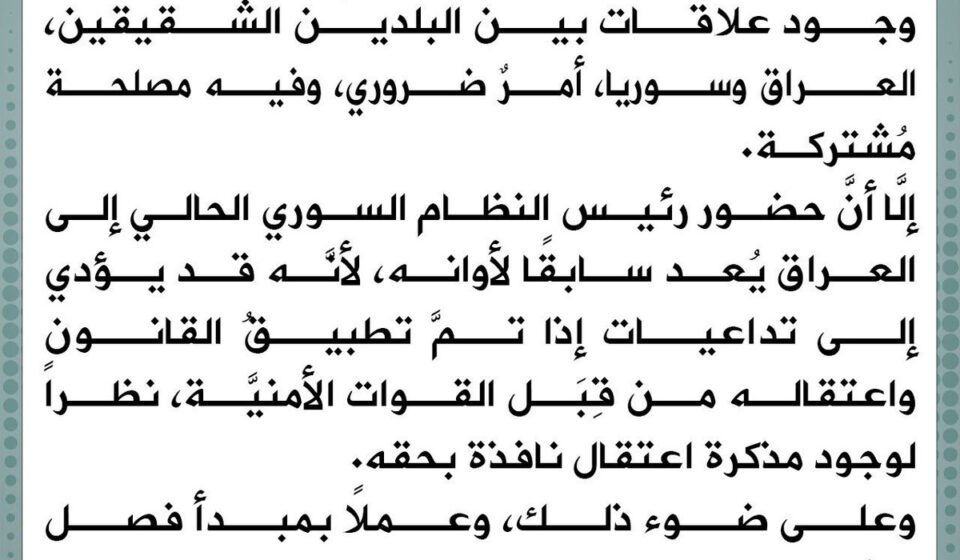
Based on an analysis of 440 X/Twitter posts trending on April 19, 2025, Miqrab AI found that online conversations in Iraq were dominated by political and security matters, both domestic and regional. The most significant narrative revolved around the vehement opposition to a potential visit by Syrian leader Ahmed al-Sharaa (formerly Abu Muhammad al-Jolani), with prominent figures threatening his arrest. This controversy directly fueled a secondary major trend: widespread support for Major General Yahya Rasool, who was reportedly sidelined after speaking out against al-Sharaa. Other key topics included outrage over the killing of an Iraqi teenager in Germany, which was framed as a sectarian attack, and discussions about the ongoing U.S.-Iran negotiations, with Iraqi politicians highlighting the government’s mediating role in promoting regional stability.
Table Of Content
- 1. Outrage Over Potential Visit of Syrian Leader Ahmed al-Sharaa
- 2. Support for Major General Yahya Rasool After His Removal
- 3. Murder of Iraqi Teenager in Germany Sparks Anger
- 4. Iraq’s Role in U.S.-Iran Negotiations Discussed
- 5. Recalling Atrocities of the Ba’ath Regime
- 6. Shifting Regional Alliances and Saudi-Iranian Relations
- 7. Analysis of an Imminent Military Strike on Iran
- 8. Political Leaders Extend Easter Greetings to Christians
- 9. New Economic Agreements with Oman and China
- 10. Ammar Al-Hakim Outlines Iraq’s Political Path Forward
Today’s Top 10 X (Twitter) Trends in Iraq:
1. Outrage Over Potential Visit of Syrian Leader Ahmed al-Sharaa
A major controversy erupted across Iraqi social media concerning a potential visit by Syrian leader Ahmed al-Sharaa, formerly known as Abu Muhammad al-Jolani. The highest-engagement post on this topic came from Qais al-Khazali (Post Impact: 100%), the leader of Asa’ib Ahl al-Haq, who issued a stern warning that al-Sharaa would be arrested upon arrival in Baghdad due to an active judicial warrant. Dr. Hussein Al-Safi (Post Impact: 25%) echoed this, quoting al-Khazali’s statement that “al-Jolani dreams of entering Baghdad only in a coffin.” Similarly, journalist Muna Sami – Muna Sami (Post Impact: 25%) drew parallels between al-Sharaa and former ISIS leader Abu Bakr al-Baghdadi, arguing that if one is considered a terrorist, the other must be as well. Accounts like Haider (Post Impact: 18%) highlighted al-Khazali’s call for the Iraqi government to respect the judiciary’s decision and arrest the “dangerous international terrorist.”
2. Support for Major General Yahya Rasool After His Removal
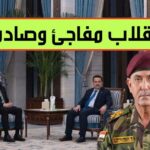
There was a significant wave of support for Major General Yahya Rasool, the former spokesperson for the Commander-in-Chief of the Armed Forces, following reports of his removal from his position. Journalist Muna Sami – Muna Sami (Post Impact: 74%) posted a widely shared tribute, claiming the Al-Sudani government was sacrificing Rasool, a man with 36 years of service, “for the sake of a Daeshi terrorist,” referencing his outspoken stance against Ahmed al-Sharaa. Political analyst Yousif Al-Kilaby (Post Impact: 13%) praised Rasool with the hashtag #You_are_our_pride, stating, “In the time of domestication, the rooster that tries to wake the sleepers is slaughtered!” Other accounts, such as Wasan Al-Sheikhli (Post Impact: 12%) and Huroof Sumeria (Post Impact: 12%), shared photos of the Major General, describing him as brave, honorable, and a representative of free people.
3. Murder of Iraqi Teenager in Germany Sparks Anger
Widespread grief and anger were expressed by Iraqi social media users following the death of a 15-year-old Iraqi boy in Hamburg, Germany. The account Haider (Post Impact: 67%) reported that the Iraqi community in Germany was in mourning after four Syrian individuals allegedly attacked the boy with a knife for “sectarian reasons” before throwing him from the eighth floor. The post noted that German police have arrested the suspects. Essam Hussein (Post Impact: 21%) strongly condemned what he described as a “Ba’athist monkey” who defended the four Syrian killers and accused the victim’s family of being “Wilai” (loyal to Iran). In a follow-up post, Haider (Post Impact: 11%) shared images from a vigil held by the Iraqi community, criticizing another blogger for mockingly labeling the diverse gathering of Sunnis and Shias a “Wilai demonstration.”
4. Iraq’s Role in U.S.-Iran Negotiations Discussed
The second round of U.S.-Iran negotiations, held in Italy, was a significant topic of discussion, with a focus on Iraq’s role. MP Alia Nassif (Post Impact: 28%) praised the talks’ success, stating that the Iraqi government played a “pivotal role” in avoiding regional conflict and that Prime Minister Mohammed Shia’ Al Sudani is leading Iraq “to safety.” In contrast, journalist Rafid Jaboori (Post Impact: 11%) expressed skepticism about the outcome after the four-hour round of talks mediated by Oman in Rome, noting that “with this slowness and this method, it does not seem that things are heading towards an agreement.” Ammar Al-Hakim (Post Impact: 6%) shared a video noting that the late Iraqi political leader Aziz al-Iraq was the first to call for an Iranian-American dialogue.
5. Recalling Atrocities of the Ba’ath Regime
Several highly engaged posts revisited the history of Saddam Hussein’s Ba’athist regime, focusing on its brutal practices. The account Dr. Hussein Al-Safi (Post Impact: 22%) shared a story about Fadel Al-Barrak, the former head of intelligence under Saddam, alleging he executed 550 high school students in one day after finding an anti-Saddam slogan on a blackboard. The post details Al-Barrak’s eventual fate, being killed by Saddam himself, describing the ruling family as “a barbaric family from the age of ignorance.” Another account, Aayad Al Twfan (Post Impact: 9%), quoted a former IRGC commander describing the rapid collapse of Iranian forces after the battle to liberate Faw during the Iran-Iraq war.
6. Shifting Regional Alliances and Saudi-Iranian Relations
Changing dynamics in the Middle East, particularly concerning Saudi Arabia and Iran, were a topic of discussion. The account Haider (Post Impact: 18%) shared what it described as the “most circulated picture in Iran,” showing Saudi officials lining up to shake hands with Iranian President Masoud Pezeshkian in Tehran. This visual representation of diplomatic rapprochement was a point of interest. On the same theme, politician Ammar Al-Hakim | عمار الحكيم (Post Impact: 5%) expressed happiness with the ongoing dialogues in the region and renewed calls for closer Saudi-Iranian ties, highlighting its positive impact on regional stability.
7. Analysis of an Imminent Military Strike on Iran
Alongside discussions of diplomacy, a counter-narrative emerged suggesting that a military confrontation with Iran is inevitable, regardless of negotiations. Analyst David Yassin (Post Impact: 13%) posted a detailed thread asserting that the question is not “if” but “when” a strike will occur, claiming that “operational orders are ready” for a “forced restructuring of Iran’s nuclear infrastructure.” He suggested that a B-2 flight over Yemen was a signal and that GBU-57 bombs were tested on a target geographically similar to Iran’s Fordow and Natanz facilities. Adding to this perspective, Rusly Al-Maliki (Post Impact: 6%) drew a historical parallel to Israel’s 1981 strike on Iraq’s Tammuz reactor, predicting Israel may strike Iran unilaterally despite any US-Iran agreements. Sufian Samarrai (Post Impact: 8%) stated bluntly, “No nuclear bomb for Iran, and the wise understand.”
8. Political Leaders Extend Easter Greetings to Christians
Several prominent Iraqi political figures took to X / Twitter to extend greetings to the Christian community on the occasion of Easter. Raghad Saddam Hussein (Post Impact: 11%) wished Iraqi Christians at home and abroad well, stating, “Our strength is in our diversity and the unity and cohesion of our people.” Former Prime Minister Mustafa Al-Kadhimi (Post Impact: 3%) wrote a message emphasizing the holiday’s theme of renewal and hope, calling it a reminder of “our ability to forgive, renew, and restore hope.” From the Kurdistan Region, President Nechirvan Barzani (Post Impact: 4%) and Prime Minister Masrour Barzani (Post Impact: 4%) also shared greetings, reaffirming the region’s commitment to coexistence and tolerance.
9. New Economic Agreements with Oman and China
News of new economic and infrastructure agreements with foreign partners was shared on the platform. The account Haider (Post Impact: 10%) reported on an Iraqi-Omani agreement for Omani teams to equip, prepare, and operate the new Karbala International Airport for a period of 15 months, with the first phase set to open this year. In a separate post, Haider (Post Impact: 6%) also announced that China’s state-owned company SEPCO has signed an agreement with Iraq to establish four petrochemical plants in the industrial city of Karbala.
10. Ammar Al-Hakim Outlines Iraq’s Political Path Forward
Ammar Al-Hakim, leader of the National Wisdom Movement, shared his comprehensive perspective on Iraq’s current state and future in a series of posts. In a post from the “Baghdad Diwan,” Ammar Al-Hakim | عمار الحكيم (Post Impact: 5%) described Iraq as witnessing “unprecedented development,” political calm, and improved regional relations. He stressed that the upcoming elections will be “pivotal” for enhancing stability and rejected any attempts to postpone them. In another meeting with party leaders, Ammar Al-Hakim | عمار الحكيم (Post Impact: 5%) reiterated the importance of the moderate approach of his Al-Hikma movement, the positive impact of regional dialogues, and expressed his hope for the participation of all political forces, including the Sadrist movement, in the upcoming elections.