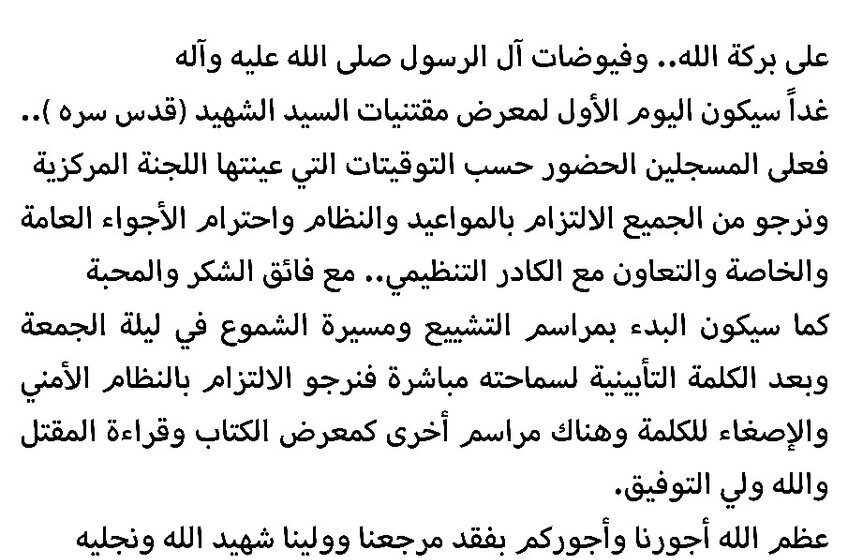
2025-04-28: Sadrist Movement Commemorates Martyrdom of Mohammed Sadiq al-Sadr

Based on an analysis of 375 trending X / Twitter posts by Miqrab AI on April 28, 2025, the primary narratives in Iraq revolve around escalating domestic political and sectarian tensions, alongside significant regional developments. The most engaged-with content centered on a statement from the office of Sadrist leader Muqtada al-Sadr, indicating continued mobilization of his base. This was followed by a fierce backlash against the potential visit of Syrian President Ahmed al-Sharaa to Baghdad, and widespread controversy over leaked audio of politician Khamis al-Khanjar allegedly using derogatory sectarian language. Other prominent themes included an alleged assassination plot against Prime Minister Mohammed Shia’ Al Sudani, the economic and strategic fallout from a major explosion at Iran’s Bandar Abbas port, and polarized commemorations of Saddam Hussein’s birthday, highlighting the country’s deep-seated political and social divisions.
Table Of Content
- 1. Sadrist Movement Commemorates Martyrdom of Mohammed Sadiq al-Sadr
- 2. Backlash Over Potential Visit of Syrian President to Baghdad
- 3. Controversy Surrounding Khamis al-Khanjar’s Leaked Audio
- 4. Alleged Assassination Plot Against PM Al-Sudani Surfaces
- 5. Major Explosions at Iran’s Bandar Abbas Port Stir Speculation
- 6. Shia Groups Feel Abandoned by Religious Authorities
- 7. Sectarian Rhetoric Contrasts Shia and “Umayyad” Actions
- 8. Polarized Commemorations of Saddam Hussein’s Birthday
- 9. Widespread Power Outages Across Europe Attract Attention
- 10. The Political and Legal Future of Former Speaker Al-Halbousi
Today’s Top 10 X (Twitter) Trends in Iraq:
1. Sadrist Movement Commemorates Martyrdom of Mohammed Sadiq al-Sadr
The most impactful post of the day came from Saleh Mohammed al-Iraqi (Post Impact: 100%), a page associated with Sadrist leader Muqtada al-Sadr, which shared an image of al-Sadr without text, generating massive engagement. This coincided with other Sadrist-affiliated accounts preparing for the 27th anniversary of the martyrdom of Grand Ayatollah Mohammed Sadiq al-Sadr and his two sons. The Martyr Sadr Shrine Foundation (Post Impact: 4%) announced that the “color of mourning” now covers the “site of martyrdom” in preparation for the anniversary on the 4th of Dhu al-Qa’dah. Similarly, accounts like Sabah Al-Saadi (Post Impact: 4%) and Alaa Alabadi (Post Impact: 4%) shared posts encouraging followers to wear black and mourn, emphasizing the continuity of al-Sadr’s reform project and the “grievance of his heir, Muqtada.”
2. Backlash Over Potential Visit of Syrian President to Baghdad
A potential visit by Syrian President Ahmed al-Sharaa (formerly known as Abu Mohammad al-Jolani) to Baghdad for an Arab summit has sparked outrage and threats from several influential accounts. Dr. Hussein Al-Safi (Post Impact: 49%) directly threatened al-Sharaa, stating, “You will not escape God’s punishment, O killer of Alawite children… By God, you will not enter Baghdad and leave safely, I swear.” Abu Azrael (Post Impact: 41%) criticized Iraqi Prime Minister Mohammed Shia’ Al Sudani’s handling of the protocol, asking, “For God’s sake, what are you doing to us?” and cursing the “cowardly Daesh of Syria.” Meanwhile, Sufian Samarrai (Post Impact: 32%) posted a picture of al-Sharaa questioning his Arab identity according to the ideologies of Al-Qaeda and Nusra. Falah Al-Mashal (Post Impact: 3%) criticized Iraqi MPs who threatened to arrest al-Sharaa, calling their statements “chaotic” and reminding them they are a legislative body, not a judicial or executive authority.
3. Controversy Surrounding Khamis al-Khanjar’s Leaked Audio
Leaked audio attributed to Sunni politician Khamis al-Khanjar, in which he allegedly used the term “Shroogiyyah” (a term often used pejoratively for Shiites from southern Iraq), has fueled sectarian tensions. In response, Emad Al Musafir (Post Impact: 29%) issued a warning to Shia politicians: “Either you discipline al-Khanjar, or the Shroogiyyah will discipline him in their own way.” Conversely, Mashaan al-Jabouri (Post Impact: 8%) reported that the Iraqi Fiqh Council condemned the “systematic targeting and distortion campaigns” against al-Khanjar. This defense was criticized by Zeinab Al-Ghanem (Post Impact: 7%), who questioned how a religious body could support what she called “destructive sectarian rhetoric.” Issam Hussein (Post Impact: 6%) accused al-Khanjar of wanting to bring “cockroaches of terrorism” back to Iraq’s provinces and called for his removal from the political scene.
4. Alleged Assassination Plot Against PM Al-Sudani Surfaces
A video clip circulated widely alleging that Prime Minister Mohammed Shia’ Al Sudani’s personal guard claimed he was asked to carry out an assassination attempt against the prime minister. Yasser Eljuboori (Post Impact: 22%) shared the video with the headline: “The Prime Minister’s personal guard: They asked me to assassinate Al-Sudani.” However, the claim was met with skepticism by others. HIBA Alnnayib (Post Impact: 7%) dismissed the story as propaganda, suggesting Al-Sudani was creating “election advertisements” to portray himself as a target. She implied his only real adversaries who would want him eliminated are “Al-Maliki and Iran.”
5. Major Explosions at Iran’s Bandar Abbas Port Stir Speculation
A massive explosion at Iran’s strategic Bandar Abbas port captured significant attention, with many accounts speculating on its cause and consequences. Shaho Al-Qaradaghi (Post Impact: 14%) shared a video of a man crying while searching for his missing brother at the port. Analyst David Yassin (Post Impact: 13%) suggested the incident was not accidental but a “Silent Grid Op” by Israel, describing it as a covert operation to dismantle critical infrastructure. Quoting economic expert Ziad Al-Hashimi, Rusly Al-Maliki (Post Impact: 4%) and Ziad Al-Hashimi (Post Impact: 4%) detailed the “catastrophic” economic impact on Iran, with losses in the billions of dollars and severe disruption to 70% of its trade. Sufian Samarrai (Post Impact: 4%) also reported that Iranian media estimated the losses at over $3 billion.
6. Shia Groups Feel Abandoned by Religious Authorities
A widely shared post highlights the plight of Shia refugees from Syria who are currently displaced in Lebanon. The account Hayder (Post Impact: 28%) shared a video of the refugees expressing painful words of reproach, stating that the wider Shia community and its religious authorities have abandoned them while focusing on the mobilization for Gaza. The refugees claim they have been without water for five months and feel compelled to return to their homes in Syria. They lament that if anything happens to them upon their return, the responsibility lies with the “Shia religious authorities who left us.”
7. Sectarian Rhetoric Contrasts Shia and “Umayyad” Actions
Amid rising political tensions, sectarian rhetoric has become more prominent on the platform. Hassan Alkaaebi (Post Impact: 19%) posted a series of provocative questions contrasting the behavior of Shiites with that of “Bani Umayya” (a historical pejorative sometimes used for certain Sunni groups). He asked his followers: “Have you ever seen or heard of a Shiite who beheads? … desecrates graves? … eats human flesh? … blows himself up among civilians?” He attributed all these actions to “Bani Umayya” and concluded with the assertion that “the disaster is that all these crimes begin with the call of ‘Allahu Akbar’.”
8. Polarized Commemorations of Saddam Hussein’s Birthday
April 28th, the birthday of former President Saddam Hussein, continues to be a day of division in Iraq, as reflected on social media. Supporters commemorated the day with praise, such as Um Omar (Post Impact: 9%) who posted a video tribute with the words, “May you be well, alive and dead, my master.” The account {The Iraq Platform} (Post Impact: 5%) described his birthday as the day of “pride, dignity, courage, and heroism.” In stark contrast, Ghaith Al-Tamimi (Post Impact: 7%) referred to the date as the “anniversary of the birth of the most dangerous weapon of mass destruction on Earth.”
9. Widespread Power Outages Across Europe Attract Attention
News of extensive power outages in several European countries was a notable topic of discussion. Both Sufian Samarrai (Post Impact: 8%) and Rusly Al-Maliki (Post Impact: 8%) reported that parts of Spain, Portugal, and France were “plunged into darkness.” They noted that European authorities were investigating the cause, with a cyberattack being considered a possibility. Samarrai added that the outages caused significant disruption, prompting people to rush to store water, bread, canned goods, and coal.
10. The Political and Legal Future of Former Speaker Al-Halbousi
The ongoing saga of former Parliament Speaker Mohammed al-Halbousi continues to be a subject of political commentary. Ezzat Alshabandar (Post Impact: 12%) sarcastically commented on Al-Halbousi’s recent acquittal on some charges, contrasting it with the Federal Court’s prior decision to remove him from office. He called on politicians to demand an investigation into those who initially accused Al-Halbousi of forgery and corruption. In a sign of his continued political activity, Mohammed Al-Halbousi (Post Impact: 4%) posted about his meeting with the current Speaker, Mahmoud al-Mashhadani, where they discussed the political situation and the map of alliances for the upcoming parliamentary elections.