2025-05-04: Commemoration of Mohammed Sadiq al-Sadr’s Death Anniversary

Based on its analysis of 522 posts trending on May 4, 2025, Miqrab AI found that key themes on X / Twitter in Iraq included the commemoration of the 27th anniversary of the death of Grand Ayatollah Mohammed Sadiq al-Sadr, a widespread and divisive debate over media freedom following the suspension of a popular TV program, and significant regional developments, particularly the reported Houthi missile attack on Israel’s Ben Gurion Airport. Domestic conversations also focused heavily on political sectarianism, criticism of the government’s foreign economic policies, and allegations of high-level corruption being concealed by top officials.
Table Of Content
- 1. Commemoration of Mohammed Sadiq al-Sadr’s Death Anniversary
- 2. Suspension of TV Program “Al-Haq Yuqal” Sparks Outrage
- 3. Houthi Missile Attack on Ben Gurion Airport
- 4. Widespread Debate on Political Sectarianism in Iraq
- 5. Praise for Houthi Leader Abdul-Malik al-Houthi
- 6. Iran-Saudi Tensions Over Call to Politicize Hajj
- 7. Tensions with Kuwait Over Insults and Border Disputes
- 8. Criticism Directed at Syrian Opposition Leader al-Jolani
- 9. PMF Portrayed in Positive Security and Humanitarian Roles
- 10. Allegations of a High-Level Corruption Cover-Up
Today’s Top 10 X (Twitter) Trends in Iraq:
1. Commemoration of Mohammed Sadiq al-Sadr’s Death Anniversary
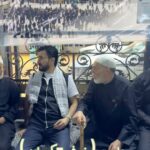
The 27th anniversary of the passing of Grand Ayatollah Mohammed Sadiq al-Sadr and his two sons was the most prominent topic, driven by a post from his son, the influential cleric Muqtada Al-Sadr (Post Impact: 100%), who shared a commemorative image. The event was widely marked by followers who shared tributes and recollections of his legacy. For instance, Safaa Al-Asadi (Post Impact: 2%) shared aerial footage of the large crowds gathered for the occasion, noting that the number of visitors caused “unprecedented shock to the corrupt.” Similarly, Dr. Ali Mohsen Al-Tamimi (Post Impact: 2%) shared an anecdote illustrating the late Ayatollah’s humility and ethics, reinforcing his revered status among his supporters.
2. Suspension of TV Program “Al-Haq Yuqal” Sparks Outrage
The decision by Iraq’s Media and Communications Commission to suspend the TV program “Al-Haq Yuqal” (The Truth Be Told), hosted by Adnan Al-Taie, triggered a major debate on freedom of speech. Critics condemned the move, which coincided with World Press Freedom Day. Rusly Al-Maliki (Post Impact: 10%) and Iyad Al-Anbar (Post Impact: 10%) both shared the news with dismay, with Al-Anbar sarcastically remarking, “The truth must not be told.” Srwa Abdulwahid (Post Impact: 2%) called the decision a violation of the law and an example of the commission’s “selectivity.” Conversely, supporters of the decision celebrated it as a victory against sectarianism. Dr. Hussein Al-Safi (Post Impact: 3%) described it as an “intisar (victory) for moderate Iraqi media over sectarian media,” while Haidar (Post Impact: 3%) stated the program had become “a platform for spreading sectarianism and sedition.”
3. Houthi Missile Attack on Ben Gurion Airport
A major regional story capturing attention in Iraq was the reported Houthi missile attack on Ben Gurion Airport in Israel. Accounts widely shared the news, often with a tone of approval for the action against Israel. Muna Sami (Post Impact: 10%) posted a succinct and defiant message: “In the name of #Yemen.. #Ben_Gurion airport is not safe.” Rusly Al-Maliki (Post Impact: 3%) reported that a Houthi hypersonic missile hit the airport after Israeli air defenses failed to intercept it. In response, discussions turned to Israel’s likely retaliation, with Mahdi Majeed (Post Impact: 3%) citing a source from the Israeli army that “devastating strikes” on Houthi sites in Yemen would be launched within hours.
4. Widespread Debate on Political Sectarianism in Iraq
Beyond specific events, a broader conversation about the destructive role of sectarianism in Iraqi politics was prevalent. Haider Al Mulla (Post Impact: 17%) posted a graphic stating, “The sectarian does not believe in a homeland… he believes in his ‘share’!” and added the hashtag #الوطن_للجميع (The homeland is for everyone). Najeh Abbas Al-Mizan (Post Impact: 4%) questioned why the Iraqi parliament does not pass a law criminalizing sectarianism and dependency on foreign powers, similar to the law against normalization with Israel. In a similar vein, Ibrahim AlSumaidaie (Post Impact: 3%) described sectarianism as a political agreement among elites who use it to deceive a “herd of ignorant people” and enrich themselves.
5. Praise for Houthi Leader Abdul-Malik al-Houthi
Amid news of the Houthi attacks on Israel, there was a current of praise for the group’s leader, Abdul-Malik al-Houthi. Dr. Hussein Al-Safi (Post Impact: 17%) conducted a poll asking his followers for the most fitting description of al-Houthi, offering laudatory titles such as “Master of the Arabian Peninsula,” “The Brave Arab Leader,” and “Supporter of the Oppressed.” This reflects a narrative among some social media users in Iraq who view al-Houthi as a figure of resistance and Arab strength. This sentiment was echoed by Hassan Al-Kaabi (Post Impact: 2%), who shared an image comparing al-Houthi favorably to another regional leader.
6. Iran-Saudi Tensions Over Call to Politicize Hajj
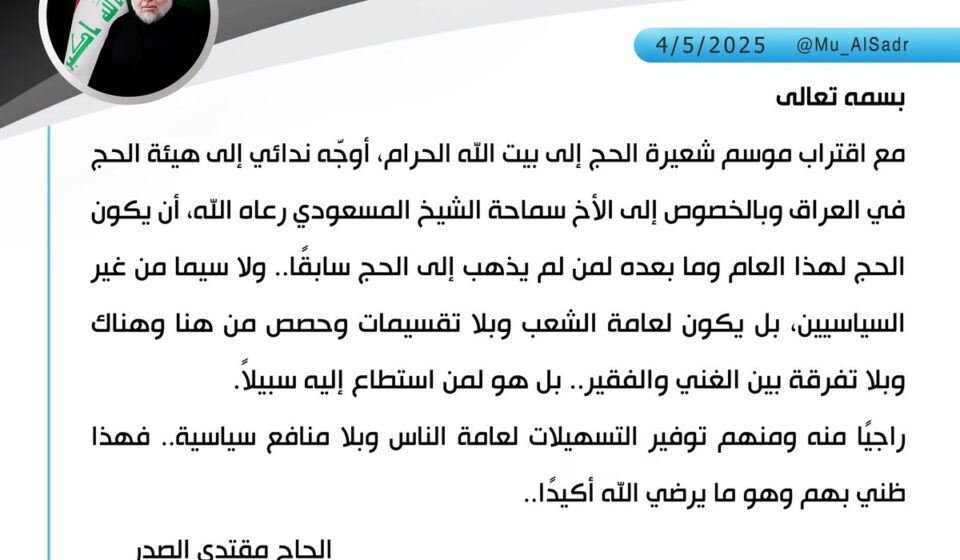
A call by Iran’s Supreme Leader Ali Khamenei to politicize the annual Hajj pilgrimage stirred concerns about renewed tensions between Iran and Saudi Arabia. Analyst Liqaa Maki (Post Impact: 9%) noted that this was the first such call since the 2023 reconciliation, viewing it as a “prelude to straining the relationship with Riyadh again” and questioning the wisdom of this strategy given the potential for a wider conflict with Israel. Similarly, Dr. Hussein Al-Muayyed (Post Impact: 3%) heavily criticized Khamenei, accusing the Iranian regime of hypocrisy for promoting “Islamic unity” while being the primary source of “the wave of abhorrent sectarianism” in the region.
7. Tensions with Kuwait Over Insults and Border Disputes
Anger towards Kuwait flared up following a viral video in which a Kuwaiti individual allegedly insulted Iraqis and made accusations of corruption. Aayad Al Twfan (Post Impact: 9%) challenged Iraqi political figures to respond to the claims that they received “billions,” arguing their silence was an admission of guilt and a betrayal of the country. Abu Darandash Al-Askari (Post Impact: 7%) shared the video with a derogatory comment. These sentiments tied into broader concerns about national sovereignty, with Rusly Al-Maliki (Post Impact: 5%) asserting in a separate post that “Khor Abdullah is part of Iraq” and its waters are as sacred as its land.
8. Criticism Directed at Syrian Opposition Leader al-Jolani
Syrian opposition leader Ahmed al-Sharaa, known as al-Jolani, was the subject of harsh criticism from several Iraqi accounts. Sufian Samarrai (Post Impact: 8%) accused al-Jolani of killing people based on their sectarian identity and deliberately tarnishing the reputation of Sunnis, vowing that his end would be “uglier than Hassan [Nasrallah]’s.” In a post linking regional figures to domestic issues, Zeinab Al-Ghanem (Post Impact: 6%) referenced the glorification of figures like al-Jolani as evidence of a sectarian “incubator for terrorists” that refuses to acknowledge its role in the atrocities committed by ISIS in Iraq.
9. PMF Portrayed in Positive Security and Humanitarian Roles
The Popular Mobilization Forces (PMF), or Hashd al-Sha’abi, were featured in several posts highlighting their positive contributions to security and civilian life. The account Haidar (Post Impact: 7%) reported that PMF forces intervened to help two tourists who were stranded in a sandstorm near the ancient city of Hatra in Nineveh, providing them with assistance and a vehicle to reach Mosul. In a separate security update, the same account, Haidar (Post Impact: 7%), announced that the PMF’s Tarmiyah regiment had successfully killed three ISIS militants on the outskirts of Baghdad, showcasing the group’s ongoing counter-terrorism operations.
10. Allegations of a High-Level Corruption Cover-Up
A statement by acting Parliament Speaker Mahmoud al-Mashhadani about a major corruption file sparked accusations of a cover-up among political elites. Falah Al-Mashal (Post Impact: 4%) quoted al-Mashhadani as saying, “There is a corruption file that, if we release it, the system will collapse,” and questioned why the head of the legislature would conceal such information. Ameer aldaami (Post Impact: 2%) expressed frustration that this revelation passed without a significant public reaction, concluding that it proves the political class is a product of a “corrupt people.”