2025-06-18: Muqtada al-Sadr Issues Statement on Regional Conflict

Based on an analysis of 1,195 X / Twitter posts trending in Iraq on June 18, 2025, Miqrab AI identified several key narratives dominated by the escalating military conflict between Iran and Israel. Discussions centered on the role of the United States, with intense focus on former President Donald Trump’s statements and potential actions. The conflict has deeply polarized Iraqi social media, with prominent accounts expressing either staunch support for Iran and its allies or strong opposition and celebration of the strikes against the Iranian regime. This regional turmoil is also amplifying domestic political and sectarian tensions within Iraq, as figures debate the country’s alignment and the actions of Iran-backed militias. Other significant topics include analysis of war propaganda, the official positions of religious institutions, and specific controversies involving Iraqi militia figures.
Table Of Content
- 1. Muqtada al-Sadr Issues Statement on Regional Conflict
- 2. Trump’s Statements and Role in Iran-Israel War
- 3. Deep Iraqi Polarization Over Iran-Israel Conflict
- 4. US Political Infighting Over Iran Policy
- 5. Iranian Propaganda and Official Statements
- 6. Sunni Political Leader Criticizes Government Partners
- 7. Allegations Against Militia Figure Abu Azrael
- 8. Najaf Hawza Declares Support for Khamenei
- 9. Praise for Analyst Dr. Ahmed Al-Sharifi’s Patriotism
- 10. Recalling Iranian Stance on 2003 Iraq War
Today’s Top 10 X (Twitter) Trends in Iraq:
1. Muqtada al-Sadr Issues Statement on Regional Conflict
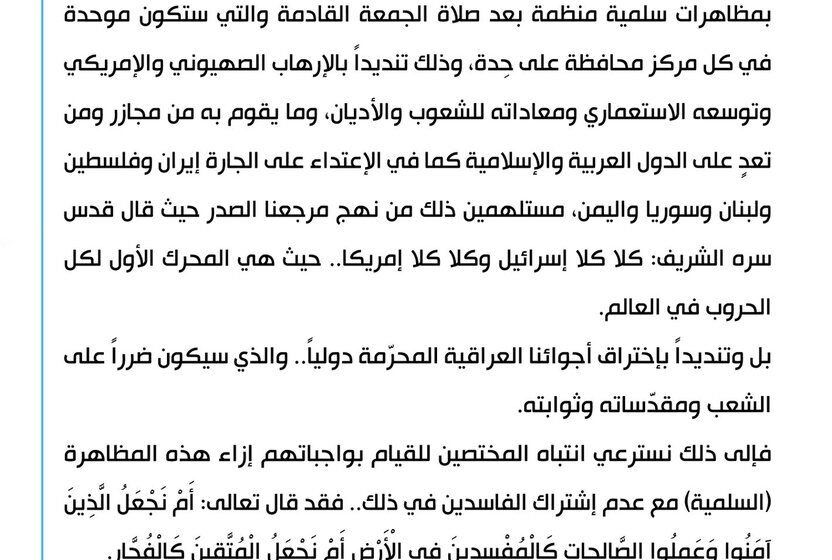
Shia cleric Muqtada al-Sadr (Post Impact: 100%) shared an image containing a formal statement addressing the current regional crisis. The post, which contained no text other than the link to the statement, garnered the highest engagement of the day. The statement calls for Iraq to be kept out of the ongoing conflict between foreign powers, emphasizing the importance of Iraqi sovereignty and warning against the nation being turned into an arena for proxy wars. It urges all parties to prioritize the interests of Iraq and its people above external allegiances and regional conflicts.
2. Trump’s Statements and Role in Iran-Israel War
A significant portion of the conversation revolved around former U.S. President Donald Trump’s involvement and commentary on the Iran-Israel conflict. ZaidBenjamin (Post Impact: 57%) shared a clip suggesting “Trump is still waiting for the green light from Cairo.” Another post from ZaidBenjamin (Post Impact: 10%) quotes Trump discussing his daily phone calls with Israeli Prime Minister Netanyahu, whom he calls a “good man who is not treated well.” Omar Abdulsattar (Post Impact: 4%) also highlights Trump’s confidence, quoting him: “I am sure that we have made progress in this military campaign and next week will be big. They were bullying everyone for forty years and now they have stopped.” These posts collectively portray Trump as a central, active figure in the conflict.
3. Deep Iraqi Polarization Over Iran-Israel Conflict
The escalating war has exposed deep divisions among Iraqi social media users. Pro-Iran accounts celebrated attacks on Israel, with Abu Azrael (Post Impact: 30%) posting a video with the caption “The soldiers of Hussein are in the field… and the Zionists are headed for demise.” In contrast, critics of Iran expressed satisfaction with the strikes against the regime. Faiq Al-Sheikh Ali (Post Impact: 22%) mocked pro-Iranian militias, stating he was indebted to them for sarcastically naming the war “celestial Vika forces,” which he says it truly is, fighting in Iran’s sky without ground troops. Similarly, Ghaith Al-Tamimi (Post Impact: 10%) declared he felt schadenfreude over the “resounding, humiliating fall” of the Khamenei regime.
4. US Political Infighting Over Iran Policy
Internal U.S. political debates regarding the Iran conflict were also a focus for Iraqi commentators. ZaidBenjamin (Post Impact: 38%) shared a clip of podcast host Tucker Carlson challenging Republican Senator Ted Cruz, a prominent advocate for regime change in Iran, on his lack of basic knowledge about the country. The post notes that Cruz later attacked Carlson for using the clip for publicity and claimed the full interview revealed Carlson’s “hatred for Trump and his support for Iran.” The exchange highlights deep rifts within the American right wing on how to handle the conflict, a debate closely watched in Iraq.
5. Iranian Propaganda and Official Statements
Accounts shared and analyzed official statements and media from Iran amidst the conflict. Hassan Al-Kaabi (Post Impact: 15%) reported on Iranian websites claiming that “if America joins the battle, Mr. Khamenei will issue a fatwa for jihad for all free Muslims in the world.” In a televised address, Khamenei struck a defiant tone, as reported by Rusly Al-Maliki (Post Impact: 4%), stating, “We will not surrender.” Meanwhile, ZaidBenjamin (Post Impact: 12%) noted that official Iranian media published a video showing a miniature nuclear warhead with the caption, “Perhaps.” These posts depict Iran’s public messaging as a mix of religious calls to arms, defiance, and nuclear threats.
6. Sunni Political Leader Criticizes Government Partners
Domestic political tensions are rising, with Sunni leaders voicing frustrations with their Shia partners in government. Dhafer Alani (Post Impact: 7%) recounted a speech by Sheikh Khamis Al-Khanjar during a State Administration Coalition meeting where he reportedly told the Shia Coordination Framework, “We can no longer convince our public to partner with you.” Al-Khanjar cited failures to implement the amnesty law and continued opposition to the return of displaced persons. Imad Al-Musafir (Post Impact: 5%) also reported, citing Haider Al-Mulla, that Al-Khanjar said the “Sunni street is comfortable with the war waged by the Zionist entity on Iran.”
7. Allegations Against Militia Figure Abu Azrael
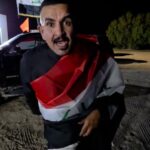
Prominent PMF figure Abu Azrael became the subject of controversy after being accused of acting as an informant for Iran. Shaho Al-Qaradaghi (Post Impact: 15%) shared a video clip where Abu Azrael appears to admit to warning Iranians about Iraqi students, asking, “Is the so-called Abu Azrael a leader in the Popular Mobilization Forces, or an informant for the Revolutionary Guard and Iran? You demonize the people of your country and incite against them for what?” In a seemingly related development, Wasan Al-Shaikhli (Post Impact: 4%) announced she was dropping a lawsuit she had previously filed against Abu Azrael, citing the need for unity in the current situation.
8. Najaf Hawza Declares Support for Khamenei
Amidst the conflict, key religious institutions in Iraq have declared their allegiance to Iran. Dr. Hussein Al-Safi (Post Impact: 12%) posted that “The Hawza Ilmiyya in Najaf announces its unconditional support for Sayyid Khamenei and the Islamic Republic.” This declaration signifies a formal alignment of the influential religious seminary with Iran’s leadership. Additionally, Omar Al-Janabi (Post Impact: 7%) shared a video of the Al-Salamiyin tribe in Karbala holding a mourning council for a deceased IRGC commander, whom they claim as one of their own. These posts highlight institutional and tribal support for Iran within Iraq.
9. Praise for Analyst Dr. Ahmed Al-Sharifi’s Patriotism
Several accounts praised the analysis of Dr. Ahmed Rashid Al-Sharifi, a security and strategic expert, holding him up as a model of Iraqi nationalism. Kifah Mahmood (Post Impact: 11%) celebrated him as “the voice of pure Iraqi patriotism,” quoting his statement, “I am a pilot, not a pigeon fancier,” which was interpreted as a jab at less professional commentators. Dr. Nayif Kurdistani (Post Impact: 7%) also shared a clip of Al-Sharifi, describing him as one of the “Iraqi national voices.” The posts suggest a demand for sober and patriotic analysis in a media environment saturated with propaganda.
10. Recalling Iranian Stance on 2003 Iraq War
Several users drew parallels between the current conflict and the 2003 US invasion of Iraq to criticize those now defending Iran. Mustafa Al-Dulaimi (Post Impact: 12%) shared a photo allegedly showing the “Iranian people when US military operations were bombing Iraq during the occupation,” urging people to remember this history. Similarly, Zina Al Saab (Post Impact: 5%) posted a meme stating, “When the strikes were on Iraq, it was permissible!! When the strikes are on Iran, it is forbidden!! We haven’t forgotten, you scoundrels!” These posts aim to highlight a perceived hypocrisy among supporters of Iran, arguing that they do not deserve Iraqi support.