2025-06-22: US/Israeli Airstrikes on Iran’s Nuclear Facilities

Analyzing 1622 X / Twitter posts trending on June 22, 2025, Miqrab AI identified that the primary focus of conversation in Iraq is the alleged US-Israeli airstrikes on Iran’s nuclear facilities. This event has sharply divided Iraqi social media users, with a significant number celebrating the destruction of Iran’s nuclear program and expressing anti-regime sentiments, while others defend Iran, condemn the attack as foreign aggression, and view it through a sectarian lens. Key narratives include detailed speculation about the military operation, debates over whether the attack was a pre-arranged “play” to save face for the Iranian regime, and discussion of the potential for wider regional escalation. Secondary topics include violence against Christians in Syria, domestic political tensions, and historical-religious framing of the current geopolitical conflicts.
Table Of Content
- 1. US/Israeli Airstrikes on Iran’s Nuclear Facilities
- 2. Speculation on a Pre-Arranged “Face-Saving” Deal
- 3. Doubts on Attack’s Effectiveness and Iranian Propaganda
- 4. Deepening Intra-Iraqi Political and Sectarian Divides
- 5. Iranian and Regional Responses to the Airstrikes
- 6. Violence and Threats Against Christians in Syria
- 7. Anti-Saudi Chants at Militia Commander’s Funeral
- 8. US Senator’s Alleged Anti-Arab Statement Circulates
- 9. Trump’s Central Role in the Airstrikes
- 10. The End of Iran’s Nuclear Program and Regime’s Future
Today’s Top 10 X (Twitter) Trends in Iraq:
1. US/Israeli Airstrikes on Iran’s Nuclear Facilities
The most dominant story on Iraqi social media is the large-scale airstrike targeting Iran’s nuclear facilities at Fordow, Natanz, and Isfahan. Accounts shared detailed but unconfirmed information about the operation, with Cliff Captain (Post Impact: 56%) reporting, based on CNN and ABC News, that six B-2A Spirit stealth bombers dropped GBU-57A/B MOP “bunker buster” bombs, supplemented by Tomahawk cruise missiles. The reactions were deeply polarized. Anti-Iranian government accounts like Faig Alsheakh/kalimati Liltarikh (Post Impact: 83%) celebrated the strikes as “overwhelming, crushing, devastating, destructive” and a form of revenge for the destruction of Iraq’s own Tammuz reactors. Similarly, Sufian Al-Samarrai (Post Impact: 67%) shared a video of a lion eating pistachios with the caption, “The lion of Zion eats Iranian pistachios,” framing the event as a psychological and military defeat for Iran. Conversely, pro-Iran accounts downplayed the impact, with Hassan Alkaaebi (Post Impact: 100%) claiming the Fordow facility is over 800 meters deep while Trump’s strike was limited to only 60 meters.
2. Speculation on a Pre-Arranged “Face-Saving” Deal
A significant narrative suggests the attack was not a surprise but rather a coordinated event between the US, Israel, and even elements within Iran. Ahmad Mulla Talal (Post Impact: 57%) argues that after this “great American-Israeli achievement,” Iran will be allowed some “simple, agreed-upon reactions” to save face, ensuring the regime survives without its nuclear or regional capabilities. This theory is supported by ZaidBenjamin (Post Impact: 11%), who cites CBS News reporting that the US informed Iran of the strikes in advance. Rusly Al-Maliki (Post Impact: 12%) provides a detailed scenario, suggesting Iran agreed to the destruction of its facilities in exchange for the regime’s survival, and that its enriched uranium was transferred to Russia beforehand, a claim he links to an earlier statement by Iranian official Mohsen Rezaei.
3. Doubts on Attack’s Effectiveness and Iranian Propaganda
Alongside celebrations, there is a strong counter-narrative questioning the extent of the damage and pointing to Iranian claims of having evacuated nuclear material. Omar Abdulsatar Mahmud (Post Impact: 73%) posted that the operation was more intelligence-based, with commandos first removing the uranium before the airstrike. However, this narrative was mocked by others. Sufian Al-Samarrai (Post Impact: 40%) ridiculed the idea of easily moving uranium, stating, “How do you move uranium from one place to another… is it food, or vegetables and fruits?” He described such claims as an attempt at mass delusion by the Iranian regime’s supporters. Liqaa Maki (Post Impact: 20%) analyzed that if Iran sticks to the story of having evacuated the facilities, it is a sign that Tehran does not intend to retaliate, using the strike’s “failure” as a pretext.
4. Deepening Intra-Iraqi Political and Sectarian Divides
The attacks on Iran have exposed and intensified the deep political and sectarian fault lines within Iraqi society. Faig Alsheakh/kalimati Liltarikh (Post Impact: 35%) highlighted the toxic discourse, noting that those who gloat over Iran’s misfortune are labeled traitors, while those who support Iran are called traitors to Iraq and killers of its people. Seeking to distance religious identity from geopolitics, Ahmad Mulla Talal (Post Impact: 48%) declared, “I was a Husseini, Alawi Shia before 1979 and I will remain and die on this belief after the fall of the Wilayat al-Faqih regime in Tehran.” On the other side, Hassan Alkaaebi (Post Impact: 42%) employed historical sectarian figures, stating that “the descendants of the whore Hind” are gloating over any believer who defends the Islamic nation, thereby framing critics of Iran as enemies of the faith.
5. Iranian and Regional Responses to the Airstrikes
Amid the crisis, accounts reported on Iran’s immediate reactions and the responses of neighboring countries. Wasan Al-Shayakhli (Post Impact: 52%) shared a video clip with the caption, “Iranian television broadcasts war anthems.” In a more official response, ZaidBenjamin (Post Impact: 32%) reported that the Iranian Parliament voted in favor of closing the Strait of Hormuz. The same account also noted reactions from Gulf states, reporting that Saudi Arabia condemned the US violation of Iranian sovereignty and that Bahrain activated 70% remote work for government employees due to the regional situation.
6. Violence and Threats Against Christians in Syria
A series of posts highlighted a deteriorating situation for Christians in Syria. The account Haidar (Post Impact: 53%) shared a video of a Syrian Arab Army commander identified as Abu Dajana al-Turkistani threatening Christians with the choice to either convert to Islam, pay the jizya (tax), or face war, stating, “I have come to you with men who love death as you love life.” The same account later reported that a suicide bombing by a “Syrian Muslim monotheist” inside a church in Damascus during prayers resulted in an initial toll of 15 martyrs, coinciding with the Israeli occupation of Quneitra.
7. Anti-Saudi Chants at Militia Commander’s Funeral
A video circulated showing mourners at a funeral chanting slogans against Saudi Arabia, sparking questions about misdirected anger. Shaho Al-Qaradaghi (Post Impact: 30%) posted a clip of the funeral for a senior Hezbollah and Kata’ib Sayyid al-Shuhada commander killed in the Israeli bombing in Iran, where chants of “Death to Al Saud” were prominent. He questioned the logic, asking, “What does Saudi Arabia have to do with it? What do we gain from antagonizing everyone?” Another account, Huroof Sumaria (Post Impact: 13%), also shared a video from the same funeral procession as it passed through Iraq, describing the deceased as a “mujahid in Lebanon, a martyr in Iran, mourned in Iraq.”
8. US Senator’s Alleged Anti-Arab Statement Circulates
A controversial and inflammatory quote attributed to a US Senator was shared by multiple accounts, drawing condemnation. Hassan Alkaaebi (Post Impact: 27%) and Haidar (Post Impact: 19%) both posted the alleged statement from US Senator “Jay Sullivan” (sic), which reads: “One million Arabs are not worth a Jew’s fingernail.” The posts shared an image of Senator Dan Sullivan of Alaska alongside the quote, presenting it as evidence of American anti-Arab sentiment and framing the US-Israel alliance in starkly racial terms.
9. Trump’s Central Role in the Airstrikes
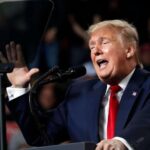
Many users focused on the personal role of US President Donald Trump, portraying him as the central figure who initiated the conflict. Tamara Alkhazraji (Post Impact: 12%) posted a picture of Trump with the caption “Slayer of the Persians and destroyer of Khamenei’s project in the region.” Omar Abdulsatar Mahmud (Post Impact: 13%) shared a video report with the title “And Trump entered the battle,” analyzing the political motivations behind the strike. Journalist Muna Sami (Post Impact: 18%) commented succinctly, “Trump ignites the Middle East!”, summarizing the view that the action was a direct result of his administration’s policies.
10. The End of Iran’s Nuclear Program and Regime’s Future
Many posts analyzed the long-term consequences of the strike, concluding that it marked the definitive end of Iran’s four-decade-long nuclear ambitions. ZaidBenjamin (Post Impact: 12%) estimated that Iran lost $500 billion on its nuclear program, which was then destroyed by bombs costing $2.4 billion. Liqaa Maki (Post Impact: 14%) compared the situation to Iran’s defeat in the Iran-Iraq war in 1988, which forced it to retreat from its regional ambitions for 15 years, and questioned how long it would take to recover this time. Several accounts, including Jews of Iraq (Post Impact: 11%), declared the end of both Iran’s nuclear dreams and the Supreme Leader’s rule, congratulating Iraq on the development.