2025-07-10: Sadrist Figure Leaks 2021 Political Agreement Document

Based on an analysis of 493 X / Twitter posts trending on July 10, 2025, Miqrab AI identified several key narratives circulating in Iraq. The most prominent story involved the leaking of a post-election political agreement by a key Sadrist figure, reigniting debates about political betrayal and the formation of the current government. Another major topic was the widespread condemnation following the vandalism of the grave of Tishreen protest icon Safaa Al-Saray, which many users framed as an act of political intimidation by militia-affiliated groups. Concurrently, Iraqis, including the Prime Minister, commemorated the anniversary of Mosul’s liberation from ISIS, celebrating the security forces while reflecting on the political failures that led to the city’s fall. Other significant trends included controversial statements by politician Faig Alsheakh, debates on Shia religious doctrine, unconfirmed rumors of an Iranian general’s assassination, and ongoing discussions about regional tensions between Iran and Israel.
Table Of Content
- 1. Sadrist Figure Leaks 2021 Political Agreement Document
- 2. Outrage After Grave of Activist Safaa Al-Saray is Vandalized
- 3. Iraq Commemorates Anniversary of Mosul’s Liberation from ISIS
- 4. Politician Faig Alsheakh Stirs Controversy with Online Posts
- 5. Online Debates Challenge Core Shia Religious Beliefs
- 6. Unconfirmed Reports of Iranian General’s Assassination Circulate
- 7. Sectarian Narratives Blame Sunni States and Salafis for Issues
- 8. Korean Rapper’s Riyadh Visit Sparks Online Ridicule
- 9. Concerns Raised Over Bleak Future for University Graduates
- 10. Israel-Iran Tensions and Iran’s Nuclear Program Discussed
Today’s Top 10 X (Twitter) Trends in Iraq:
1. Sadrist Figure Leaks 2021 Political Agreement Document
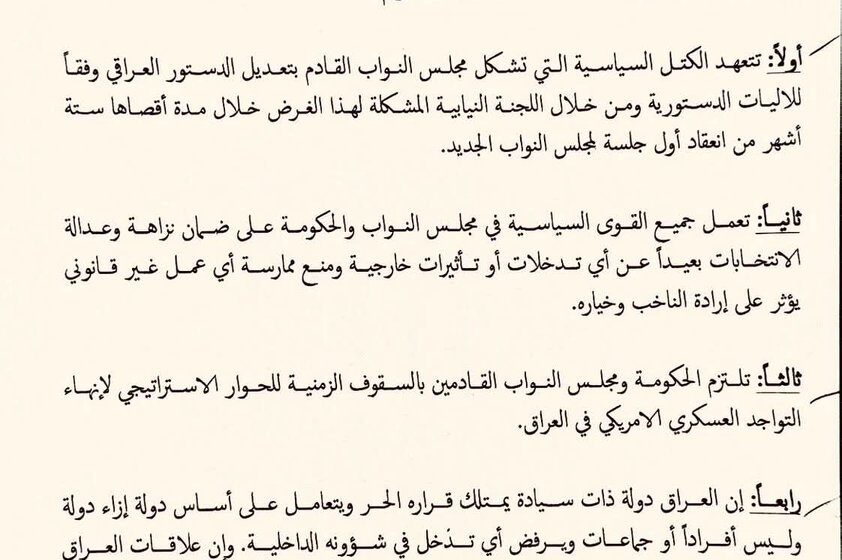
A political document from the Sadrist Movement’s archives, shared by Wazir Al-Qaid – Salih Muhammad Al-Iraqi (Post Impact: 94%), sparked intense discussion online. Salam Al-Husseini (Post Impact: 17%) explained that the document was a 16-point agreement for a national majority government signed by Muqtada al-Sadr with leaders of the Coordination Framework, including Hadi al-Amiri and Ammar al-Hakim, after the 2021 elections. Al-Husseini alleges that these leaders “reneged on their signatures,” leading to a “political coup” to avoid accountability for corruption and the killing of Tishreen protesters. Other users like Hussam Alhaj (Post Impact: 11%) questioned why political forces continue to fear the contents of the document, particularly the formation of a committee mentioned in one of its clauses.
2. Outrage After Grave of Activist Safaa Al-Saray is Vandalized
Numerous accounts expressed outrage over the vandalism of the grave of Safaa Al-Saray, an iconic activist from the Tishreen protests, in Najaf’s Wadi al-Salam cemetery. Images of the destroyed grave were shared by Hydar (Post Impact: 16%) and Zainab Rabee (Post Impact: 11%). Steven Nabil (Post Impact: 16%) lamented the act, describing Al-Saray as someone who “wanted a better life, dignity, and a strong country not subservient to anyone” and questioned how a state could be built with such destructive elements present. Yasser Eljuboori (Post Impact: 16%) sarcastically attributed the act to “valiant resistance factions” retaliating against the activist’s grave. Ghaith Al-Tamimi (Post Impact: 11%) blamed the “corruption of the religious establishment” for such incidents.
3. Iraq Commemorates Anniversary of Mosul’s Liberation from ISIS
Iraqi officials and social media users commemorated the anniversary of the liberation of Mosul from ISIS control. Prime Minister Mohammed Shia’ Al Sudani (Post Impact: 23%) praised the sacrifices of the security forces and stressed that the anniversary calls for learning from “past wrong policies,” while pledging to continue reconstruction projects in the city. Hydar (Post Impact: 24%) described the nine-month battle as the “immortal epic of Mosul” and one of the “fiercest street wars of the modern era.” Hassan Alkaaebi (Post Impact: 38%) posted a picture showing the aftermath of the battle as “the end of ISIS in Iraq.” The Iraqi Counter-Terrorism Service (Post Impact: 6%) also released a statement congratulating the Iraqi people.
4. Politician Faig Alsheakh Stirs Controversy with Online Posts
Politician Faig Alsheakh generated significant engagement with a series of provocative posts. He mocked what he described as “100,000 bot accounts” tasked with slandering him and his family, claiming their efforts backfired by increasing the visibility of his older tweets (Faig Alsheakh Ali/Kalimati Lil Tarikh, Post Impact: 42%). In a highly controversial post, Alsheakh made vulgar and profane accusations against a cleric who had criticized the Tishreen protesters (Faig Alsheakh Ali/Kalimati Lil Tarikh, Post Impact: 32%). He also commented on the recent vandalism of activist graves, suggesting that families of Tishreen martyrs should relocate their remains from the large cemetery in Najaf to their home provinces for better security (Faig Alsheakh Ali/Kalimati Lil Tarikh, Post Impact: 22%).
5. Online Debates Challenge Core Shia Religious Beliefs
A heated theological debate emerged after posts by user Mahdi Majeed (Post Impact: 43%) challenged the Shia doctrine of the infallibility of the Twelve Imams. He asked for proof from the Quran or authentic prophetic traditions, arguing that this belief has been used by clerics to issue “destructive fatwas.” In another popular post, he questioned the historical basis for Imam Mahdi and his mother Nargis, claiming that authentic Shia books state Imam Hasan al-Askari was sterile and that the public is being exploited by “two imaginary characters” (Mahdi Majeed, Post Impact: 21%). These posts sparked widespread discussion, including a public debate between Majeed and cleric Ghaith Al-Tamimi (Post Impact: 4%).
6. Unconfirmed Reports of Iranian General’s Assassination Circulate
Unsubstantiated rumors about the assassination of General Abdolrahim Mousavi, the Commander-in-Chief of the Iranian Armed Forces, circulated widely on Iraqi social media. The news was primarily spread by Hiba Al-Nnayib (Post Impact: 18%), who described the alleged event as the “most important assassination in the heart of Tehran so far.” In a subsequent post, she questioned Iran’s claims of victory in its conflict with Israel in light of the news (Hiba Al-Nnayib, Post Impact: 12%). The claim remained unverified by any other major sources or official statements within the analyzed posts.
7. Sectarian Narratives Blame Sunni States and Salafis for Issues
Some high-engagement posts promoted sectarian narratives, placing blame on Sunni groups for regional instability and conflicts. Abu Drandash Alaskree (Post Impact: 41%) shared a video with the comment that “all Sunni Arab countries conspired against Iraq and all Sunni Arab countries allowed the occupation to bomb Baghdad.” In a similar vein, Issam Hussein (Post Impact: 25%) wrote a rhetorical post urging someone to control the Salafis, claiming they are poised to “hand over all Islamic countries to Netanyahu.” These posts reflect a viewpoint that frames regional political issues through a sectarian lens.
8. Korean Rapper’s Riyadh Visit Sparks Online Ridicule
A post by Hydar (Post Impact: 100%) achieved the highest engagement by highlighting satirical international reactions to an Instagram post by South Korean rapper Dino, who shared photos of his visit to Riyadh. The post focused on a widely circulated comment by a Korean citizen, who wrote in Korean, “The Wadi al-Salam cemetery is more beautiful than Riyadh.” Hydar’s post presented this comment and others as evidence of Western and Korean mockery of the Saudi capital, fueling a narrative critical of Saudi Arabia.
9. Concerns Raised Over Bleak Future for University Graduates
The issue of graduate unemployment was a key topic of discussion, led by posts from Rusly Al-Maliki (Post Impact: 15%). He warned that between 2025 and 2030, an estimated 2.5 million students will graduate from Iraqi universities and institutes, adding to the existing number of unemployed graduates, and asked authorities, “Where will you put them?!” In a related post, he argued for the necessity of reforming higher education by closing departments with no job prospects, such as philosophy, and creating new ones focused on high-demand fields like artificial intelligence and programming (Rusly Al-Maliki, Post Impact: 14%).
10. Israel-Iran Tensions and Iran’s Nuclear Program Discussed
The ongoing conflict between Israel and Iran remained a prominent topic, with a focus on the status of Iran’s nuclear program after recent strikes. Rafid Jaboori (Post Impact: 14%) shared what he called an “Israeli intelligence assessment” concluding that “part of Iran’s highly enriched uranium was not destroyed in the US strike.” Similarly, Salem Aljomaili (Post Impact: 9%) reported that Israel is preparing for another “major attack” after detecting Iranian efforts to restore its nuclear facilities. Steven Nabil (Post Impact: 7%), citing the New York Times, also reported that some of Iran’s near-weapons-grade uranium likely survived the bombing.