2025-07-13: Sadrist Movement Sets Conditions for Election Participation

Based on an analysis of 510 X / Twitter posts trending in Iraq on July 13, 2025, Miqrab AI identified several key narratives. The most dominant conversation centers on the Sadrist movement’s potential return to the political scene, with leader Muqtada al-Sadr setting stringent conditions for electoral support, notably the disarmament of militias and the integration of the Popular Mobilization Forces (PMF) into the state’s official security apparatus. This announcement has triggered widespread debate and reactions from rival political factions and commentators. Other significant topics include a high-profile public dispute between writers Ahmad Abdulsada and Ali Wajeeh, growing concerns over escalating regional tensions between Iran and Israel, and discussions about political instability in neighboring Syria, including speculative talk of annexing Lebanon.
Table Of Content
- 1. Sadrist Movement Sets Conditions for Election Participation
- 2. Writer Ahmad Abdulsada in Public Feud with Ali Wajeeh
- 3. Growing Fears of Iran-Israel Military Escalation
- 4. Writer Ahmad Abdulsada Apologizes for Misunderstood Article
- 5. Divisions Over Integrating PMF into State Security Forces
- 6. Discussions on Syrian Politics and Annexing Lebanon
- 7. Calls for Civil Discourse and National Identity
- 8. Iraqi Parliament Speaker Warns of Coming Crises
- 9. Online Feuds Involve Accusations of Ba’athist Sympathies
- 10. Iran’s Internal Pressures and Nuclear Standoff
Today’s Top 10 X (Twitter) Trends in Iraq:
1. Sadrist Movement Sets Conditions for Election Participation
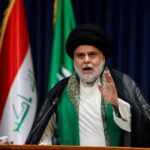
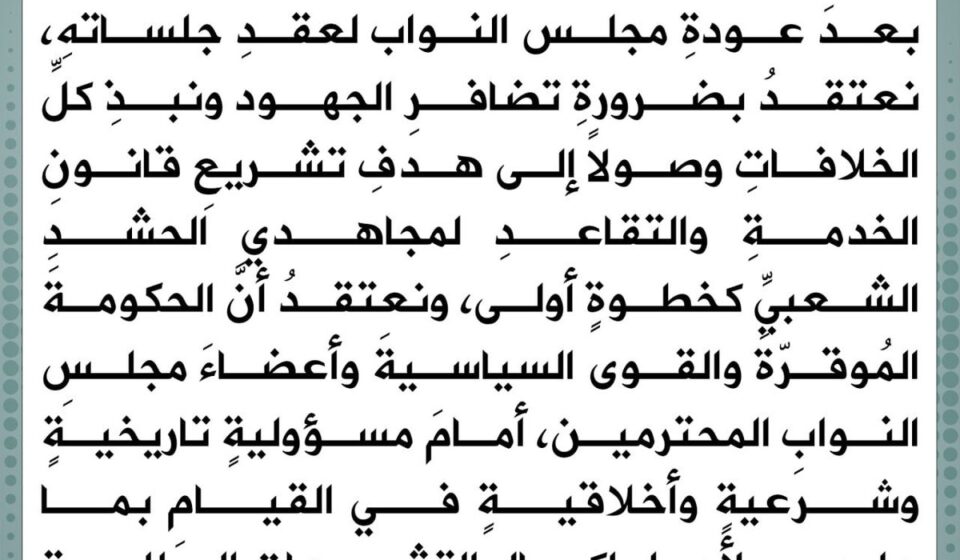
The most significant political development of the day emerged from a statement posted by Saleh Mohammed al-Iraqi (Post Impact: 68%), a close associate of Muqtada al-Sadr. The post detailed questions Sadr posed during a meeting in Al-Hanana, asking which political bloc could guarantee a program of “independence without subordination… confining weapons to the state… dissolving militias, and integrating the Popular Mobilization Forces into the security forces or organizing it.” This was widely seen as a list of non-negotiable conditions for the Sadrist movement to lend its electoral support to a future coalition. The announcement prompted swift reactions, including a widely circulated post from Qais al-Khazali (Post Impact: 100%), which contained only an image of himself with Badr Organization leader Hadi al-Amiri, interpreted as a message of unity from the rival Shiite Coordination Framework. Commentators such as Omar al-Janabi (Post Impact: 10%) highlighted that Sadr is the “first Shiite leader to call for an end to the existence of the Hashd,” while Steven Nabil (Post Impact: 3%) described it as a “major political development.”
2. Writer Ahmad Abdulsada in Public Feud with Ali Wajeeh
A heated public dispute unfolded between writers Ahmad Abdulsada and Ali Wajeeh, capturing significant attention. Ahmad Abdulsada (Post Impact: 18%) accused Wajeeh of making “despicable and vile” personal attacks regarding his family and past marriages. In a retaliatory move, Abdulsada published a poem he attributed to Wajeeh’s father praising Saddam Hussein, aiming to expose what he called Wajeeh’s “Ba’athist upbringing.” Abdulsada threatened to release more damaging information, stating, “the upcoming documents and photos will certainly be more shocking.” The feud drew commentary from others, including Najah Mohammed Ali (Post Impact: 4%), who defended Abdulsada as a “free voice” being targeted, and Asaad Al-Basri (Post Impact: 3%), who criticized Wajeeh’s personal attacks as an attempt to “assassinate a rival.”
3. Growing Fears of Iran-Israel Military Escalation
Multiple accounts reported on escalating tensions between Iran and Israel, fueling concerns of an imminent military conflict. Omar Abdulsatar Mahmud (Post Impact: 12%) shared news of a “widespread closure of Iranian airspace, especially over the western parts of the country.” Aayad Al Twfan (Post Impact: 10%) described the tensions as being at their “highest levels” and warned that a military confrontation this time “will leave nothing behind.” Adding to the alarm, Shaho al-Qaradaghi (Post Impact: 16%) reported a statement from Iran’s National Security Committee claiming they “discovered spy chips in the shoes of atomic energy inspectors during their inspection of Iranian nuclear sites.” Further reports, like one from Tamara Alkhazraji (Post Impact: 4%), mentioned that Istanbul airport had suddenly cancelled all flights to Iran, Iraq, and Jordan.
4. Writer Ahmad Abdulsada Apologizes for Misunderstood Article
Writer Ahmad Abdulsada (Post Impact: 25%) issued a public apology and clarification for a recent article that he stated was “misunderstood as targeting a specific political and religious leader.” Abdulsada explained that the article discussed a general public issue without naming anyone but had caused an “unintentional misunderstanding.” He announced he deleted the post “out of consideration for the feelings of those who felt the article offended their leader” and apologized to them. However, the apology was met with widespread skepticism. Safaa al-Asadi (Post Impact: 6%) dismissed it harshly, while Alaa Alabadi (Post Impact: 5%) suggested it was forced, posting, “You apologize against your will and the will of those who paid you.” Hussam Alhaj (Post Impact: 10%) shared a cryptic story about someone who “retreated and apologized, not out of shame, but terrified of being exposed.”
5. Divisions Over Integrating PMF into State Security Forces
Muqtada al-Sadr’s call to dissolve militias and integrate the Popular Mobilization Forces (PMF) into the state security apparatus sparked immediate and polarized reactions. Shaho al-Qaradaghi (Post Impact: 10%) quoted the PMF as stating that “talk of our merger with the Interior and Defense [ministries] is baseless,” and questioned their apparent fear of official state institutions. In direct opposition, pro-PMF voices like Ahmad al-Thawaq (Post Impact: 10%) argued that the Shiite public mood has changed and now strongly supports retaining armed factions for protection. Bahaa Khaleel (Post Impact: 6%) expressed skepticism about the feasibility of the merger from a logistical standpoint, asking, “How do you merge an ideological militia into an army with a different ideology?” This debate highlights the deep divide over the future of armed groups in Iraq.
6. Discussions on Syrian Politics and Annexing Lebanon
The political situation in Syria and its regional implications were a key topic of discussion. The account Hydikm (Post Impact: 20%) provided a detailed breakdown of territorial control in Syria, noting that over 30% of the country and nearly all its oil fields are outside state control. The same account also reported that there is “serious” talk on Syrian social media about “occupying Lebanon and making it the 15th province.” This idea was also discussed by Najeh Abbas al-Mizan (Post Impact: 14%), who sarcastically commented that if it happens, Hezbollah’s deputy, Naim Qassem, would “hand over his weapon to Damascus willingly.” The posts reflect Iraqi concern and commentary on the instability in Syria and its potential spillover into Lebanon.
7. Calls for Civil Discourse and National Identity
Amidst heated political rhetoric, several prominent figures called for civility and emphasized Iraqi national identity. Former MP Faiq Al-Sheikh Ali (Post Impact: 20%) urged his followers to engage in respectful debate: “Disagree in opinion. Oppose… Criticize… But do not offend, curse, insult, ridicule, mock, or slander.” He also declared his devotion to the Tishreen protest movement and its martyrs. In a similar vein, Mohammad Jabbar (Post Impact: 13%) posted a video with a caption directed at “Iraqis, not the Iranian community that God has afflicted us with,” pointing to internal divisions over foreign influence. Firas W. Alsarray (Post Impact: 5%) echoed this sentiment with a simple, nationalistic message: “Iraq is for the purebred Iraqis.”
8. Iraqi Parliament Speaker Warns of Coming Crises
A summary of alarming statements attributed to the Speaker of the Iraqi Parliament circulated widely, primarily through a post by Hydikm (Post Impact: 8%). The Speaker reportedly warned that Iraq might face popular protests next month, an impending security crisis, and the potential need for an emergency government if instability escalates. He also commented on foreign policy pressures, claiming the U.S. wants to merge the PMF into the security forces and blocked related legislation. The Speaker further warned of external threats, including Israel’s “David’s Corridor” project and potential actions by Kuwait regarding the Khor Abdullah waterway, a topic also mentioned by Abbas Al-Ardawi (Post Impact: 4%).
9. Online Feuds Involve Accusations of Ba’athist Sympathies
Accusations of ties to the former Ba’athist regime were used as a tool in online political disputes. As part of his ongoing feud, Ahmad Abdulsada (Post Impact: 18%) published a poem allegedly written by Ali Wajeeh’s father praising Saddam Hussein, aiming to discredit his rival by associating him with a “Ba’athist upbringing.” In a separate, lengthy post, Hamid al-Shaker (Post Impact: 4%) launched a fierce attack on Muqtada al-Sadr, claiming both he and his father were creations of Saddam Hussein’s “faith campaign” and alleging Sadr has been an “ally of the Ba’ath and Ba’athist terrorism since 2003.” These posts illustrate how the legacy of the former regime continues to be a potent weapon in contemporary Iraqi discourse.
10. Iran’s Internal Pressures and Nuclear Standoff
Accounts on X analyzed the internal and external pressures facing Iran, particularly concerning its nuclear program. Shaho al-Qaradaghi (Post Impact: 16%) shared a claim from Iran’s National Security Committee about discovering “spy chips” in the shoes of international nuclear inspectors. Analyst Salem al-Jomaili (Post Impact: 6%) provided a detailed assessment, suggesting Iran’s regime is in “a state of exhaustion” comparable to Saddam Hussein’s regime before 2003. He argued that Supreme Leader Ali Khamenei is the main obstacle to a nuclear deal, while the presidency and even the IRGC are more inclined towards a resolution to save the system from internal collapse. ZaidBenjamin (Post Impact: 3%) also relayed a report from Iran’s Fars News Agency claiming the Iranian president was slightly injured in an Israeli attack in June.