2025-08-09: Arbaeen Pilgrimage and Visitor Controversies

Based on Miqrab AI’s analysis of 490 X / Twitter posts trending in Iraq on August 9, 2025, the primary narratives revolve around the ongoing Arbaeen pilgrimage, domestic political tensions, and regional dynamics. The pilgrimage is a dominant theme, with posts highlighting the presence of international visitors, particularly from Iran, and sparking debates about national pride and service. A major domestic story involves the Iraqi government’s decisive action against Kata’ib Hezbollah following an investigation into a violent incident, leading to discussions about state sovereignty and the role of armed factions. Concurrently, regional events, especially the push for Hezbollah’s disarmament in Lebanon, are closely watched and linked to the situation in Iraq. Other key topics include US military support for specific Iraqi security forces, corruption allegations against government ministers, the exclusion of prominent politicians from upcoming elections, and commentary on the British ambassador’s statements regarding the Popular Mobilization Forces (PMF).
Table Of Content
- 1. Arbaeen Pilgrimage and Visitor Controversies
- 2. Government Takes Action Against Kata’ib Hezbollah
- 3. Hezbollah Disarmament in Lebanon Echoes in Iraq
- 4. Increased US Support for Counter-Terrorism Service
- 5. Four Ministers Reportedly Referred for Corruption Probe
- 6. Prominent Politicians Excluded From Elections
- 7. UK Ambassador’s Remarks on PMF Spark Debate
- 8. Death of Renowned Iranian Artist Mahmoud Farshchian
- 9. Sectarian Narratives and Political Commentary
- 10. Approval of Pro-Normalization Candidate’s Candidacy
Today’s Top 10 X (Twitter) Trends in Iraq:
1. Arbaeen Pilgrimage and Visitor Controversies
Discussions surrounding the Arbaeen pilgrimage feature heavily, with mixed sentiments regarding the presence and actions of foreign visitors. One widely circulated video, shared by Tamara Alkhazraji (Post Impact: 59%), shows an Iranian visitor instructing an Iraqi child on how to wash his feet, which she described as a moment of “humiliation and disgrace.” Similarly, Aayad Al Twfan (Post Impact: 9%) criticized a video of an Iraqi policeman massaging an Iranian visitor’s feet, calling it an “insult to the military uniform” and an act that undermines the dignity of the security forces. In contrast, other posts focus on the communal and spiritual aspects of the event. Wasan al-Shaikhli (Post Impact: 20%) shared a video of a procession established in the name of the late Kuwaiti artist Abdulhussain Abdulredha. Other accounts, like Wesam Aziz (Post Impact: 41%) and Wasan al-Shaikhli (Post Impact: 13%), posted images of pilgrims who bear a striking resemblance to Hezbollah leader Hassan Nasrallah.
2. Government Takes Action Against Kata’ib Hezbollah
A major development is the government’s response to the July 27 attack on the Karakh Agriculture Department. The Prime Minister’s Media Office (Post Impact: 13%) released an official statement announcing the findings of an investigation, which concluded that armed elements from Kata’ib Hezbollah, affiliated with PMF Brigades 45 and 46, were responsible for the attack. The statement confirmed that the force moved without orders and used weapons against security personnel. Consequently, Prime Minister Mohammed Shia’ Al Sudani approved recommendations to dismiss the commanders of both brigades and refer all involved individuals to the judiciary. Several accounts, including Haidar (Post Impact: 12%), reported on these decisions. Yasser Eljuboori (Post Impact: 13%) questioned whether this marks “the beginning of the confrontation between the Sudani government and the armed factions.” Meanwhile, Othman al-Mukhtar (Post Impact: 11%) interpreted the statement as the “first official recognition of the crimes of demographic change by Iranian militias in Iraq.”
3. Hezbollah Disarmament in Lebanon Echoes in Iraq
The political situation in Lebanon, particularly the issue of disarming Hezbollah, is a significant topic of discussion with clear parallels drawn to Iraq. Mustafa al-Dulaimi (Post Impact: 31%) quoted the Lebanese President stating, “Disarmament will be complete and anyone who confronts the Lebanese army will write their own end.” This sentiment was reinforced by a post from Haidar (Post Impact: 8%), which cited a Lebanese Foreign Ministry statement rejecting Iranian interference and any country’s “right of guardianship over Lebanon’s decisions.” In direct opposition, Omar Abdul Sattar Mahmoud (Post Impact: 6%) reported that an advisor to Iran’s Supreme Leader declared, “We will not allow the disarmament of Hezbollah in Lebanon or the Popular Mobilization Forces in Iraq.” This regional tension is also commented on by David Yassin (Post Impact: 8%), who suggested that the “delivery of weapons will happen without significant objection.”
4. Increased US Support for Counter-Terrorism Service
Attention was drawn to shifts in US military support for Iraqi security forces. Rusly Al-Maliki (Post Impact: 22%) reported that the United States has increased its support for the Iraqi Counter-Terrorism Service (CTS) by 700% while reducing aid to the Iraqi Army and the Kurdish Peshmerga. Al-Maliki suggested this indicates that the CTS is the only force trusted by Washington, which may be preparing it to “deal with the factions under the Popular Mobilization Forces in the future.” Echoing this perspective, Najeh Abbas Al-Mizan (Post Impact: 10%) commented that the Counter-Terrorism Service is gearing up to arrest members of the PMF based on “international orders.”
5. Four Ministers Reportedly Referred for Corruption Probe
News circulated that the Prime Minister has referred four sitting cabinet ministers to the judiciary on charges of administrative corruption. While the Prime Minister did not officially name the individuals, social media accounts quickly identified the alleged ministers. Both Yasser Eljuboori (Post Impact: 14%) and Mustafa al-Dulaimi (Post Impact: 14%) posted identical lists, naming the Minister of Defense Thabet al-Abbasi, Minister of Culture Ahmed al-Fakkak, Minister of Electricity Ziad Ali Fadel, and Minister of Industry Khaled Battal. Rafid Jaboori (Post Impact: 4%) also covered the story, noting the official announcement was made without names, which he described as an example of how “access to information is very difficult due to factors of negligence, complicity, and fear.”
6. Prominent Politicians Excluded From Elections
Several accounts reported on a list of politicians barred from participating in the upcoming elections by the Accountability and Justice Commission. Yasser Eljuboori (Post Impact: 13%) and Mustafa al-Dulaimi (Post Impact: 16%) both shared lists that included prominent names such as Alia Nasif, Ayad Allawi, Khaled al-Obeidi, Talal al-Zobaie, and Jawad al-Bolani. One of the named politicians, MP Alia Nasif (Post Impact: 5%), responded directly to the news on her account. She claimed that her opponents submitted an old, forged file against her and that she has presented original documents to the commission to refute the claims, stating, “In the end, the truth emerged, and I was victorious over them, thanks to God.”
7. UK Ambassador’s Remarks on PMF Spark Debate
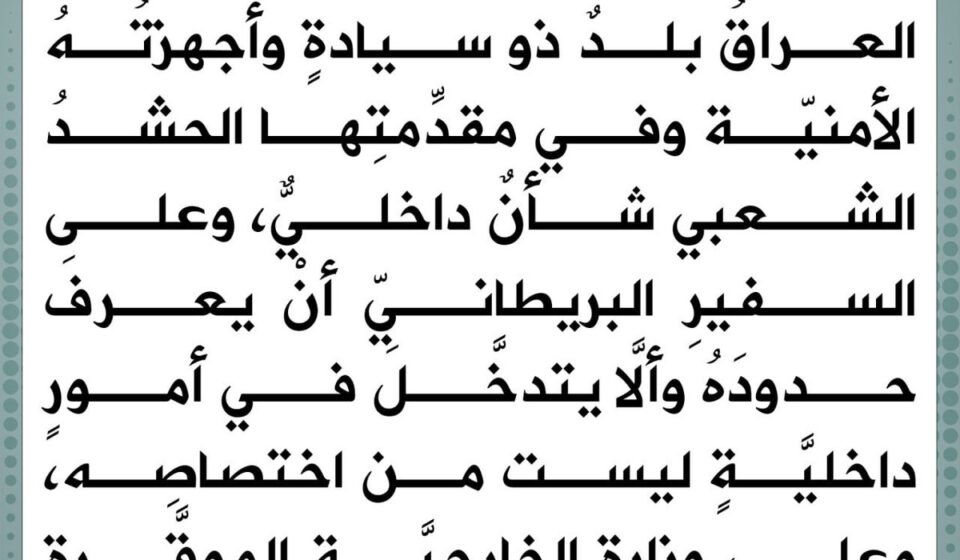
Comments made by the British Ambassador to Iraq regarding the Popular Mobilization Forces (PMF) generated significant debate. Mustafa al-Dulaimi (Post Impact: 9%) reported the ambassador’s view that “the need for the Popular Mobilization Forces has been satisfied and it must be dissolved.” This prompted a strong reaction from PMF-aligned figures. Haidar (Post Impact: 7%) reported that Qais al-Khazali responded by telling the ambassador to “know his limits” and insisting the PMF is an internal Iraqi affair. Pro-PMF outlet Sabereen News (Post Impact: 4%) also condemned the ambassador’s “interference.” Conversely, Mohammed Jabbar (Post Impact: 8%) criticized what he saw as a selective outrage, questioning why those upset with the British ambassador were silent when the US Secretary of State and embassy made similar demands to prevent the passage of the PMF law.
8. Death of Renowned Iranian Artist Mahmoud Farshchian
The death of prominent Iranian artist Mahmoud Farshchian was announced and discussed on several Iraqi pages. Dr. Hussein al-Safi (Post Impact: 12%) reported the news, highlighting Farshchian’s most famous works, including his painting “The Afternoon of Ashura” and his designs for the shrine enclosures of Imam Hussein and Imam Reza in Karbala and Mashhad, respectively. In a different take, Shaho Al-Qaradaghi (Post Impact: 9%) posted a picture of the artist and commented on the reaction to his death, stating, “They did not rejoice in Qasem Soleimani as much as they rejoiced in this person,” and adding that his influence was primarily limited to the “resistance audience.”
9. Sectarian Narratives and Political Commentary
Sectarian discourse remains a noticeable feature of online conversations. Issam Hussein (Post Impact: 20%) posted a lengthy, provocative question asking why some Sunnis seem to celebrate Israeli military operations while Shias have made sacrifices for “Sunni Gaza.” He questioned whether the “flaw” lies in their interpretation of religion, their clerics, or their political leaders. On the other side of the political and sectarian spectrum, Asaad Al-Basri (Post Impact: 4%) published a long defense of the PMF and Shia political identity, framing true Iraqi nationalism as rooted in the 2014 fatwa that created the PMF, not the Iran-Iraq War. He criticized what he sees as a resurgence of Ba’athist thought aimed at undermining the PMF and praised Qais al-Khazali for defending Iraq’s sovereignty.
10. Approval of Pro-Normalization Candidate’s Candidacy
The Iraqi High Electoral Commission’s decision to approve the candidacy of Talal al-Hariri for the upcoming elections drew criticism from some accounts. Haidar (Post Impact: 8%) reported the approval, describing al-Hariri as “one of the biggest advocates for joining the ‘Abraham Accords’ with Israel” and someone who had previously called for Israel to overthrow the Iraqi regime. Similarly, Ali Abdul Sahib al-Jubouri (Post Impact: 5%) referred to him as “the Zionist ‘Talal al-Hariri'” and sarcastically commented on the commission’s approval of his candidacy. The posts highlight opposition to any political figures perceived as being aligned with normalization efforts with Israel.