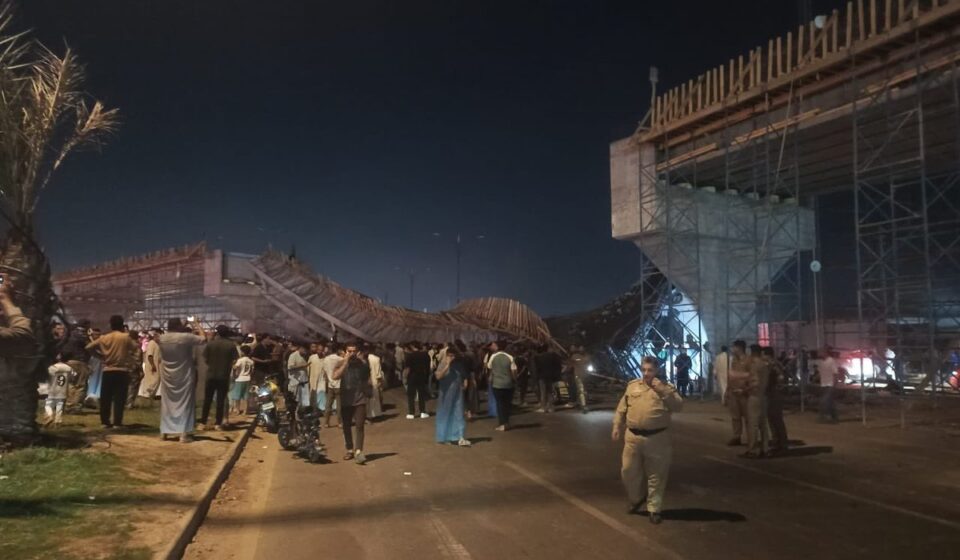
2025-09-06: Bridge Collapse in Karbala Sparks Outrage

Based on an analysis of 278 posts by Miqrab AI, the key themes and narratives trending on X / Twitter in Iraq on September 6, 2025, revolve around domestic crises and geopolitical anxieties. The most prominent story was the collapse of a bridge under construction in Karbala, which sparked widespread outrage over government corruption and negligence. This incident amplified a broader narrative of public discontent with the state’s failure to provide basic safety and services. Simultaneously, high-level political discourse included stark warnings of a future “storm” targeting Iraq, while discussions on escalating US-Iran tensions fueled concerns about regional instability. Narratives also explored Iran’s influence within Iraq, social decay illustrated by a viral video of family violence, and persistent calls for genuine political and social reform.
Table Of Content
- 1. Bridge Collapse in Karbala Sparks Outrage
- 2. Ezzat Alshabandar Warns of a “Coming Storm”
- 3. Viral Video of Sons Assaulting Father Causes Shock
- 4. Contrasting Views on Iran’s Regional Role and Challenges
- 5. Calls for Genuine Social and Political Reform
- 6. Concerns over Iranian-backed Group’s Influence in Mosul
- 7. Tensions over US “War Department” and Potential Iran Conflict
- 8. Discussion and Satire Surrounding Nouri al-Maliki
- 9. PM Orders Probe into Oil Smuggling Amid Skepticism
- 10. Debate on National Identity vs. Foreign Influence
Today’s Top 10 X (Twitter) Trends in Iraq:
1. Bridge Collapse in Karbala Sparks Outrage
A bridge under construction in Karbala, identified as the Atishi bridge, collapsed, leading to multiple casualties and sparking a wave of anger online. Accounts like Steven Nabil (Post Impact: 7%) and Hisham Ali (Post Impact: 3%) were among the first to report the breaking news. Commentators blamed the incident on systemic corruption and a lack of oversight. Haidar (Post Impact: 4%) stated that “people’s lives are hostage to poor contracting and corrupt deals that only produce disasters.” Jafar Alaboudi (Post Impact: 5%) questioned which corrupt companies were awarded the contracts and why safety measures were absent. The head of the National Wisdom Movement, Ammar Al-Hakim (Post Impact: 9%), weighed in, declaring that “Iraqi lives are too precious to be neglected” and demanding immediate accountability for those responsible.
2. Ezzat Alshabandar Warns of a “Coming Storm”
Politician and commentator Ezzat Alshabandar (Post Impact: 17%) issued a stark warning of a forthcoming crisis, which was widely shared by accounts such as Raad Hashim (Post Impact: 5%). Alshabandar told his followers to “Take it from a dervish,” describing the event as a “raging, surging, and roaring storm… unlike any other” with Iraq as its ultimate target, affecting all its communities. He asserted that the only protection against this threat would be “faith in God and His messengers, and steadfast national immunity,” which he believes can turn Iraq into the storm’s “graveyard.”
3. Viral Video of Sons Assaulting Father Causes Shock
A disturbing video showing several young men physically assaulting their father and demanding he leave his home circulated widely, causing shock and condemnation. Abu Drandesh Alaskari (Post Impact: 12%) shared the clip with the caption, “What a great upbringing… sons hitting their father and demanding he leave the house.” The video prompted a broader discussion on social and moral decay. Dr. Zaid Abdulwahab Al-Adhami (Post Impact: 5%) expressed his disgust, stating he was “at a loss for words to describe the filth of this video.”
4. Contrasting Views on Iran’s Regional Role and Challenges
Discussions on Iran’s position in the Middle East featured contrasting viewpoints. One perspective, shared by Hussein Abu Alima (Post Impact: 10%), highlighted Iran’s steadfastness as an ally. Citing Dr. Abdul Qadir Fayez, a specialist in Iranian affairs, the post claimed that despite being preoccupied with internal matters, Supreme Leader Khamenei surprised everyone by endorsing the October 7th operation just two days after it occurred, proving that “there is no ally in the world like the Iranian ally.” In contrast, a detailed analysis shared by Rusly Al-Maliki (Post Impact: 7%), attributed to Ali Aghwan, outlined the immense international pressure on Iran. The post detailed European and American demands at the UN Security Council to reactivate “snapback” sanctions, which could cripple Iran’s economy and military programs, suggesting the region could be “very close to a new military confrontation.”
5. Calls for Genuine Social and Political Reform
A strong narrative of public frustration with the political status quo emerged, with users calling for meaningful change over symbolic gestures. Rusly Al-Maliki (Post Impact: 9%) proposed a shift in how the nation honors its fallen, suggesting, “Instead of hanging pictures of martyrs in the streets, plant a tree for each martyr in his name.” This sentiment of unfulfilled expectations was echoed by Ali al-Khalidi (Post Impact: 3%), who lamented that in Iraq, “Entitlements have become an achievement, and rights have become a wish!”
6. Concerns over Iranian-backed Group’s Influence in Mosul
Concerns were raised over the growing influence of an Iran-affiliated group known as “Al-Rabat Al-Muhammadi” in Mosul. Othman Al-Mukhtar (Post Impact: 7%) described the group’s takeover of one of Mosul’s most important mosques as a serious threat to Sunnis in Iraq, calling for a popular reaction from the city’s residents. Similarly, Dr. Zaid Abdulwahab Al-Adhami (Post Impact: 3%) called it a “major crime” for a preacher from this “misguided” group to occupy the pulpit of the Al-Nuri Mosque, arguing that it is illogical to replace one extremist ideology that destroyed the city with another that carries “extraneous agendas.”
7. Tensions over US “War Department” and Potential Iran Conflict
The changing of the name of the US Department of Defense to the “Department of War” under a potential Trump administration sparked discussion about escalating regional tensions. Rusly Al-Maliki (Post Impact: 6%) noted a White House statement that followed, saying, “We will use the highest degrees of lethality against the enemy in case of war.” In a detailed analysis, Essam Hussein (Post Impact: 4%) argued that this move is a reaction to the China-Russia-North Korea alliance, not just aimed at Iran and its allies. He contended that Trump views certain groups in the region as “trained guard dogs” to protect US interests in its conflict with the rising Eastern axis.
8. Discussion and Satire Surrounding Nouri al-Maliki
Former Prime Minister Nouri al-Maliki was a subject of both praise and satire. Raad Hashim (Post Impact: 3%) shared a video of a man identified as Haidar Asal praising the former leader, wishing him a life as long as the Prophet Shuaib. In contrast, Rusly Al-Maliki (Post Impact: 6%) posted a satirical piece describing a “Nouri al-Maliki package” that comes with a “64-bit conspiracy,” a two-meter tail, and a warning label saying “we won’t give it up,” mocking his political style and longevity.
9. PM Orders Probe into Oil Smuggling Amid Skepticism
Prime Minister Mohammed Shia’ Al Sudani ordered the formation of a high-level committee to investigate allegations of corruption related to the mixing and smuggling of crude oil and petroleum products. The announcement was shared by the Prime Minister’s Media Office (Post Impact: 1%) and accounts like Shaho Al-Qaradaghi (Post Impact: 2%). However, the move was met with skepticism. Ziad Al-Hashemi (Post Impact: 2%) noted the government’s action came “late” after months of international reports and US sanctions, suggesting the committee will likely be “ceremonial.” Dr. Ihssan Shmary (Post Impact: 5%) questioned, “Is it conceivable that Washington discovers oil and dollar smuggling before Baghdad does…!!”
10. Debate on National Identity vs. Foreign Influence
A broader discussion took place regarding national identity and the impact of foreign influence and sectarian narratives. Ahmad Abdul Sada (Post Impact: 5%) analyzed a social media campaign in Lebanon promoting the phrase “I am Shia, and my only authority is the Lebanese state,” arguing it was a disingenuous campaign run by anti-Hezbollah groups to create a false impression of division. He compared it to past campaigns in Iraq like “I am Shia and I love my Sunni brother,” which he claims were used to undermine Shia cohesion and achievements, such as the victory over ISIS. This reflects a wider narrative about the battle over identity and loyalty, particularly in relation to Iran’s influence, a theme also seen in posts from users like Othman Al-Mukhtar (Post Impact: 7%).

