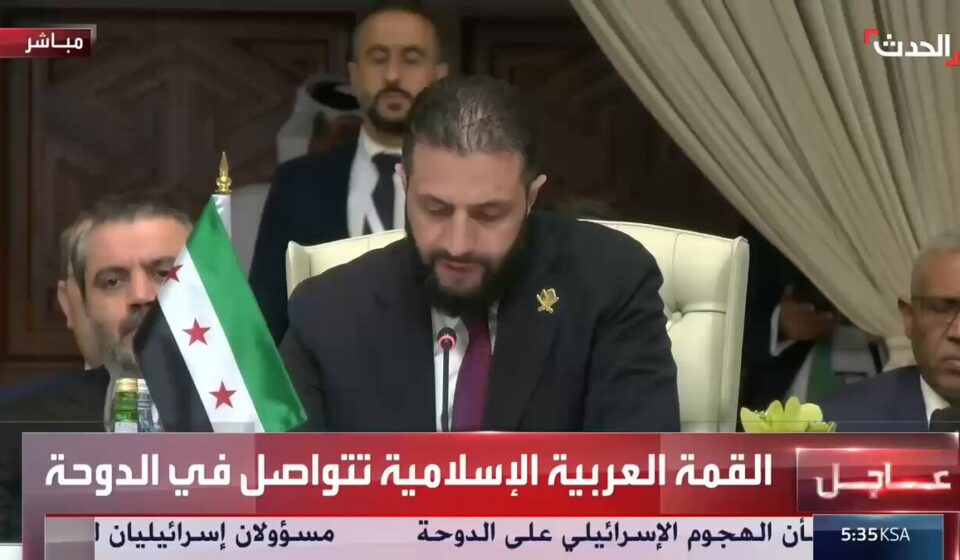
2025-09-15: Syrian President’s Speech at Doha Summit Praised for Brevity

Based on an analysis of 548 posts by Miqrab AI, X / Twitter conversations in Iraq on September 15, 2025, were dominated by the emergency Arab-Islamic summit in Doha. The primary narratives focused on widespread criticism of the summit’s perceived inaction and weakness in response to Israeli aggression, with many users mocking the leaders’ statements as empty rhetoric. This was contrasted with significant praise for a very brief but forceful speech by new Syrian President Ahmed al-Shara, which was lauded for its clarity and conciseness. Other major topics included reports of an Iraqi militia incursion into Syria, the geopolitical fallout from the recent Israeli strike on Doha involving the US, and domestic Iraqi issues such as Iranian influence in state institutions, government corruption, and the controversial release of an Israeli researcher.
Table Of Content
- 1. Syrian President’s Speech at Doha Summit Praised for Brevity
- 2. Widespread Criticism and Mockery of the Doha Arab Summit
- 3. US-Israel-Qatar Dynamics After Doha Strike
- 4. Iraqi Force Crosses Syrian Border, Threatens Locals
- 5. Iraqi Resistance Factions Mocked for Ineffectiveness
- 6. Iranian Influence in Iraqi Security Forces Questioned
- 7. Corruption and Sectarianism in Iraqi Governance Criticized
- 8. Arrest of Suspects in Sheikh al-Qarghouli’s Murder
- 9. Controversy Over Release of Israeli Researcher Elizabeth Tsurkov
- 10. PM’s Office Criticized for Diplomatic and Media Gaffes
Today’s Top 10 X (Twitter) Trends in Iraq:
1. Syrian President’s Speech at Doha Summit Praised for Brevity
A 47-second speech by Syrian President Ahmed al-Shara at the Doha Summit became a major topic of discussion, with many users praising its concise and powerful message. Mashan al-Jabouri (Post Impact: 100%) highlighted the speech’s brevity, noting it was shorter than the historically briefest US presidential address and declared that “the era of verbosity is over and that meaning can be summarized in less than a minute.” Al-Jabouri summarized that al-Shara condemned Israeli aggression, affirmed Syria’s solidarity with Qatar, and ended with a line of poetry. Similarly, Eyad al-Dulaimi (Post Impact: 2%) shared the clip, stating that the president “said, summarized, and pained” with his words. The speech was framed as a model of effective communication in contrast to the longer, less decisive statements from other leaders.
2. Widespread Criticism and Mockery of the Doha Arab Summit
The Arab-Islamic Summit in Doha faced intense criticism and ridicule from Iraqi X users, who largely viewed it as ineffective and performative. Faig al-Sheikh Ali (Post Impact: 18%) described the leaders’ words as “surrendering, defeatist, fearful, apprehensive, and confused,” concluding that the summit was a “failure.” In a highly engaged satirical post, Haydar (Post Impact: 20%) listed fictional “official results” from the summit, mocking each country’s response as weak or absurd. Many users, including Mahdi Majeed (Post Impact: 5%) and Zaynab al-Ghanim (Post Impact: 5%), questioned why Arab leaders do not take concrete actions like severing diplomatic and economic ties with Israel, instead of just issuing condemnations. The general sentiment was that such summits have historically failed to produce meaningful results.
3. US-Israel-Qatar Dynamics After Doha Strike
The geopolitical fallout from the Israeli strike on Doha was a significant topic, focusing on communication between Israel and the United States. Zaid Benjamin (Post Impact: 3%), citing a detailed report from Axios, shared that Israeli Prime Minister Netanyahu informed US President Trump of the strike only 51 minutes before the missiles hit, effectively preventing the US from stopping it. Benjamin’s posts noted that Israeli officials claim this was enough time for Trump to object if he had wanted to. In a different vein, Sufian al-Samarrai (Post Impact: 17%) interpreted the event as a joint US-Israeli strategy to “crush everything Qatar and Turkey have built,” and claimed the US is preparing to designate the Muslim Brotherhood as a terrorist organization.
4. Iraqi Force Crosses Syrian Border, Threatens Locals
Several accounts reported on an alleged border incursion by an Iraqi force into Syrian territory. Both Haydar (Post Impact: 12%) and Raad Hashim (Post Impact: 8%) cited sources from the Syrian Television Network, stating that an Iraqi force entered the “Al-Zuwairiya” area in eastern Syria. The reports claim the force remained for several hours, threatened local shepherds and residents against approaching the Iraqi border, and directed insults at the Syrian government before withdrawing back into Iraq. The posts highlight ongoing security issues and the actions of armed groups along the porous border.
5. Iraqi Resistance Factions Mocked for Ineffectiveness
A number of posts ridiculed the self-proclaimed “resistance” factions in Iraq and the region, portraying them as weak and their threats as empty. Mustafa al-Dulaimi (Post Impact: 11%) and Bahaa khaleel (Post Impact: 9%) shared a video of an Iraqi journalist in Lebanon who they say “wiped the floor with the resistance and exposed all their scams in a few minutes.” Separately, Dr. A. D. Ghalib al-Da’mi (Post Impact: 7%) posted a clip of Safaa al-A’sam, a figure associated with the factions, stating that if they are attacked by Israel and cannot strike back, they will “curse at them,” a statement that was widely interpreted as a sign of impotence.
6. Iranian Influence in Iraqi Security Forces Questioned
A video circulating on X sparked discussion about Iranian influence within Iraq’s security apparatus. Raad Hashim (Post Impact: 12%) shared a clip showing Iran’s Commander-in-Chief of Police testing Iraq’s 911 emergency hotline in the presence of Iraqi Interior Minister Abdul Amir al-Shammari. The video shows the operator on the other end responding in Persian, which users interpreted as a clear and embarrassing sign of pervasive Iranian influence within sensitive Iraqi state institutions.
7. Corruption and Sectarianism in Iraqi Governance Criticized
Commentary on domestic governance focused on deep-rooted corruption and sectarianism. Dr. Hussein al-Safi (Post Impact: 16%) posted photos of several political figures, accusing them of being “those who founded sectarianism in Iraq.” In another post, al-Safi (Post Impact: 9%) criticized the Ministry of Education, which he notes has been led by Sunni parties for 14 years, for failing to distribute textbooks at the start of the school year. He alleged widespread corruption, claiming that “80% of the money for printing books is stolen” and that ministerial positions are bought and sold, leading to the “destruction of generations.”
8. Arrest of Suspects in Sheikh al-Qarghouli’s Murder
News of an arrest in a high-profile murder case was shared by several accounts. Both Haydar (Post Impact: 5%) and Dr. Hussein al-Safi (Post Impact: 4%) posted photos of the men arrested for the murder of Sheikh Abdul Sattar al-Qarghouli. The accounts state that the suspects, who belong to the Salafi-Madkhali group, were apprehended by security forces for the killing, which took place at the Karim al-Nasser mosque in Baghdad.
9. Controversy Over Release of Israeli Researcher Elizabeth Tsurkov
The release of Israeli-Russian researcher Elizabeth Tsurkov generated controversy and accusations of deflection among political commentators. Aws al-Khafaji (Post Impact: 5%) argued that to escape the “predicament” of releasing an Israeli spy, pro-militia leaders are now deflecting by accusing the Tishreen protest movement of being backed by Israel. On the same topic, Shaho al-Qaradaghi (Post Impact: 4%) noted that pro-militia media claimed that “resistance fighters” were freed in exchange for Tsurkov’s release, but have failed to provide any names or pictures of those released, suggesting that “the rope of lies is short.”
10. PM’s Office Criticized for Diplomatic and Media Gaffes
The Iraqi Prime Minister’s office came under fire for perceived incompetence during the Doha summit. Ali Al-Mikdam (Post Impact: 4%) described a meeting between the Iraqi and Turkish delegations as a “shameful protocol failure,” noting that President Erdoğan was accompanied by his foreign minister and intelligence chief, while the Iraqi president was met by only an ambassador and a media office director. Separately, Mustafa al-Dulaimi (Post Impact: 4%) and Nazar Haidar (Post Impact: 2%) pointed out that the PM’s media office posted a photo of the meeting with President Erdoğan but mistakenly captioned it as a meeting with the Saudi Crown Prince, Mohammed bin Salman.

