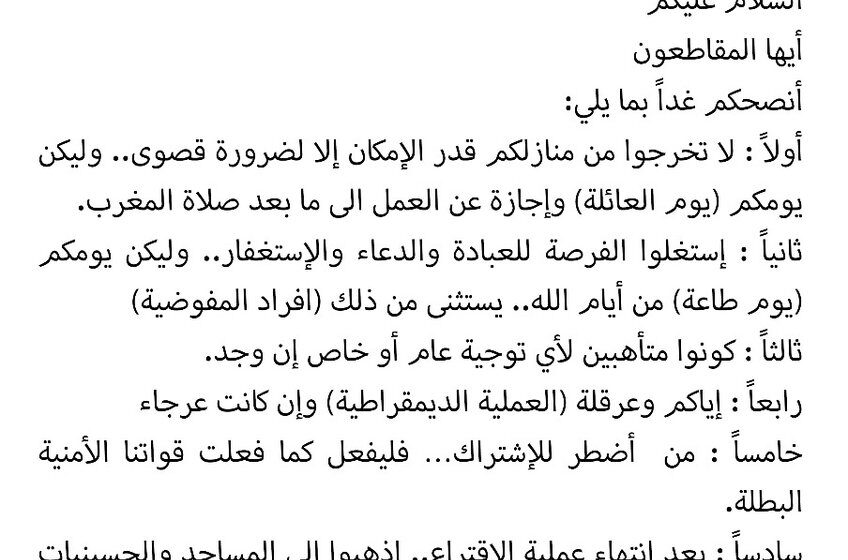
2025-11-10: Sadrists Lead Intensified Calls to Boycott Parliamentary Elections

Based on a Miqrab AI analysis of 646 trending X / Twitter posts in Iraq on November 10, 2025, the social media landscape was dominated by intense political discourse surrounding the upcoming parliamentary elections. The most prominent narrative, driven by accounts affiliated with the Sadrist movement, was a widespread and forceful call to boycott the vote, framing it as a religious and national duty against a corrupt political class. This was countered by calls for participation from other political blocs and the Kurdistan Regional Government, who urged citizens to exercise their democratic rights. Another significant theme was the emergence of rare diplomatic tension between Iraq and Iran, after the Iraqi Foreign Ministry issued a sharp rebuke against perceived Iranian interference in its electoral affairs. Discussions also revolved around allegations of potential electoral fraud, legal actions against social media influencers for hate speech, and renewed debates over Iraq’s sectarian demographics and historical narratives.
Table Of Content
- 1. Sadrists Lead Intensified Calls to Boycott Parliamentary Elections
- 2. Iraq’s Foreign Ministry Issues Rare Rebuke to Iran Over Election Interference
- 3. Counter-Campaigns and Religious Edicts Encourage Election Participation
- 4. Arrest Warrant for Influencer Omar Al-Jamal Sparks Freedom of Speech Debate
- 5. Allegations and Questions Surface Regarding Electoral Integrity
- 6. Post Challenges Narrative of Shiite Majority in Iraq, Citing Voter Data
- 7. Progress in Post-Assad Syria Sparks Critical Comparisons to Iraq
- 8. Support Emerges for Adnan al-Taie for Head of Media Commission
- 9. Historical Interview of Saudi King on Palestine Resurfaces
- 10. Video Shows Destruction in Al-Awja, Highlighting Militia Control and Displacement
Today’s Top 10 X (Twitter) Trends in Iraq:
1. Sadrists Lead Intensified Calls to Boycott Parliamentary Elections
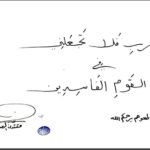
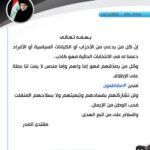
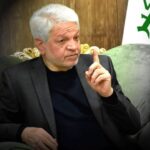
Accounts affiliated with Muqtada al-Sadr, most notably Minister of the Leader – Salih Muhammad al-Iraqi (Post Impact: 100%), are spearheading a vigorous campaign urging Iraqis to boycott the upcoming parliamentary elections. In a series of highly engaged posts, al-Iraqi shared messages from al-Sadr advising boycotters to stay home, pray, and be ready for further instructions, while warning them not to obstruct the “lame democratic process.” The campaign uses hashtags like #قاطعوهم_يرحمكم_الله (Boycott them, may God have mercy on you), which were widely shared by accounts like Safaa Al-Asadi (Post Impact: 9%) and Engineer Mona Ahmed Al-Faisal (Post Impact: 7%). Adding to the boycott call, politician Faiq Al-Sheikh Ali (Post Impact: 54%) posted a video from Mecca, stating he prayed for the martyrs of the Tishreen protests and called on his followers to boycott the elections. The sentiment conveyed is that participation is futile and legitimizes a corrupt system.
2. Iraq’s Foreign Ministry Issues Rare Rebuke to Iran Over Election Interference
A significant diplomatic development trended across several pages, focusing on the Iraqi Ministry of Foreign Affairs’ response to comments made by its Iranian counterpart. Accounts including Steven Nabil (Post Impact: 7%) and Rusly Al-Maliki (Post Impact: 5%) shared the official statement, which described the Iranian spokesperson’s remarks on the Iraqi elections as “a clear and rejected interference in Iraq’s internal affairs.” The Iraqi statement emphasized that the electoral process is a “purely national matter” and that maintaining good neighborly relations requires respecting sovereignty. Hussam Alhaj (Post Impact: 7%) noted this was the first time in at least 15 years that Iraq had officially rejected Iranian interference, while Ali Farhan (Post Impact: 6%) praised the move as a “strong, brave, and responsible position.”
3. Counter-Campaigns and Religious Edicts Encourage Election Participation
In direct opposition to the boycott movement, another set of narratives encouraged Iraqis to vote. Hayder (Post Impact: 4%) reported that the Hawza (religious seminary) in Najaf announced the suspension of its lessons to allow for participation in the elections. Dr. Hayder Al-Barzinji (Post Impact: 6%) framed this decision as significant, noting the Hawza only suspends lessons for “important and fateful matters” and that change comes exclusively through elections. In the Kurdistan Region, President Nechirvan Barzani (Post Impact: 5%) issued a call for active participation, stating that the nation’s destiny and the implementation of the constitution are determined by votes. These posts frame voting as a national responsibility essential for stability and reform.
4. Arrest Warrant for Influencer Omar Al-Jamal Sparks Freedom of Speech Debate
The issuance of an arrest warrant for social media figure Omar Al-Jamal for allegedly broadcasting hate speech became a contentious topic. Hayder (Post Impact: 8%) reported on the judicial order. However, journalist Salim Al-Jumaili (Post Impact: 7%) defended Al-Jamal, arguing that his message was simply urging Sunnis to vote for Sunni candidates and was not hate speech, contrasting it with what he described as overt sectarian rhetoric from others who face no legal consequences. Ali Farhan (Post Impact: 4%) also criticized the “selectivity” of such legal actions, calling for a single standard to be applied to all forms of sectarian discourse. The discussion highlights tensions around sectarianism, freedom of speech, and perceived double standards in the justice system.
5. Allegations and Questions Surface Regarding Electoral Integrity
Concerns about the integrity of the electoral process were raised by prominent commentators. Satirist Ahmed Albasheer (Post Impact: 16%) cast doubt by asking a pointed question: “How many cards were printed by the commission for political entity observers?” This implies the potential for an excessive number of observers, which could facilitate fraud. In a more direct accusation, user Tamara Alkhazraji (Post Impact: 8%) shared a video with the sarcastic caption, “Manual counting and sorting is now done in homes.. God bless the Independent High Electoral Commission for Fools,” suggesting that the vote-counting process is compromised and being manipulated outside of official channels.
6. Post Challenges Narrative of Shiite Majority in Iraq, Citing Voter Data
A widely discussed post by Sheikh Thaer Al-Bayati (Post Impact: 15%) challenges the long-held political narrative of a Shiite majority in Iraq. Al-Bayati presented an analysis of voter registration numbers by governorate, arguing that when Sunni Arabs are combined with the “absolute Sunni majority” in the Kurdistan Region, the actual majority in Iraq is Sunni, not Shiite. He claims the “Shiite majority” was a “political trick” devised by Paul Bremer and used by “tools of Tehran” to justify their hegemony, failure, and corruption. The post labels the concept a lie used to divide society and calls for an end to what it describes as “selling lies.”
7. Progress in Post-Assad Syria Sparks Critical Comparisons to Iraq
Iraqi commentators are closely watching developments in neighboring Syria following the fall of the Assad regime, often drawing unfavorable comparisons with their own country’s situation. Rusly Al-Maliki (Post Impact: 17%) sarcastically noted that one year after the regime’s collapse, Aleppo is celebrating 24-hour electricity, questioning why this progress hasn’t been blocked by America, which he implies is only an obstacle to “Ja’afari rule.” Meanwhile, Maan Habib (Post Impact: 9%) celebrated the news that Syria is now “outside of Caesar sanctions,” congratulating the Syrian people. These posts use Syria’s perceived rapid progress to criticize the persistent failures of governance and public services in Iraq.
8. Support Emerges for Adnan al-Taie for Head of Media Commission
A campaign appears to be underway in support of media personality Adnan al-Taie to lead the Iraqi Communications and Media Commission. Former parliamentarian Mithal Al-Alusi (Post Impact: 16%) formally nominated al-Taie, describing him as a “professional and committed national media figure.” Al-Alusi’s post stated this move was to teach the corrupt that “freedom of opinion and media cannot be subject to their suspicious whims.” This was echoed by Zayed Al-Assad (Post Impact: 6%), who praised al-Taie for his support during the Tishreen protests when his program provided a platform for activists’ voices, offering his unwavering support.
9. Historical Interview of Saudi King on Palestine Resurfaces
A lengthy historical text shared by journalist ZaidBenjamin (Post Impact: 22%) gained significant attention. The post contains a transcript of a 1943 interview between King Abdul Aziz of Saudi Arabia and a representative from LIFE magazine. In the interview, the King articulates his views on the issue of Palestine, asserting that Jewish claims to the land are unjustified as Arabs have controlled it for over 1,300 years. He also expresses his belief that a Jewish state would not have power and that their demands cause strife between Muslims and their allies. The recirculation of this historical document provides context and reflects ongoing interest in regional history and the Palestinian cause among Iraqi social media users.
10. Video Shows Destruction in Al-Awja, Highlighting Militia Control and Displacement
A post by Othman Al-Mukhtar (Post Impact: 12%) shed light on the ongoing plight of the town of Al-Awja. The post features a video showing scenes of destruction and looting, including stolen windows and roofs, and claims that even graves have been desecrated. Al-Mukhtar states that the town has been “occupied by militias” for 11 years, preventing its original inhabitants from returning. The post labels those responsible as “criminals,” drawing attention to the unresolved issues of internally displaced persons (IDPs) and the power wielded by armed groups in certain parts of the country.