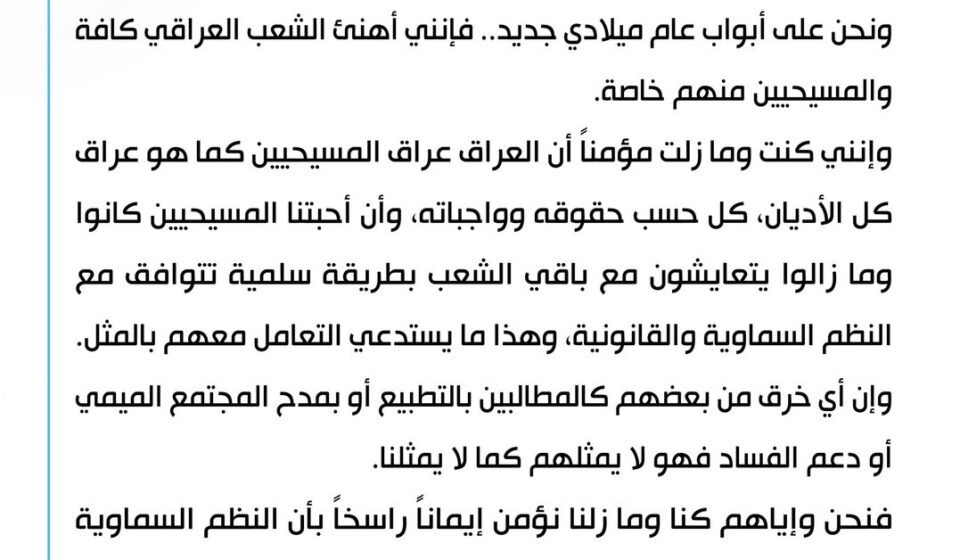
2025-12-28: Al-Sadr Criticizes Cardinal Sako Over “Normalization”

Based on an analysis of 465 X / Twitter posts trending on December 28, 2025, Miqrab AI identified several key narratives circulating in Iraq. The most dominant conversation centered on a political and religious clash between Shiite cleric Muqtada al-Sadr and Chaldean Patriarch Cardinal Louis Sako over the latter’s Christmas sermon, which was interpreted by Sadr as promoting normalization with Israel. Another highly discussed topic was the legacy of Nawaf al-Zaydan, the man who informed on Saddam Hussein’s sons, Uday and Qusay, leading to their deaths, with users fiercely debating whether he was a hero or a traitor. Other significant themes included criticism of the Iraqi government for suppressing media freedom, specifically the suspension of journalist Ahmad Mulla Talal’s program; reports on US sanctions against militia leader Rayan al-Kildani; and discussions of regional instability, including clashes in Syria and Iran’s severe economic crisis.
Table Of Content
- 1. Al-Sadr Criticizes Cardinal Sako Over “Normalization”
- 2. Legacy of Nawaf al-Zaydan Divides Iraqi Social Media
- 3. Nationalist Rhetoric Highlights Historical Battles
- 4. Media Freedom Under Fire as Journalist Suspended
- 5. Reports of Violent Clashes on the Syrian Coast
- 6. US Renews Sanctions on Militia Leader Rayan al-Kildani
- 7. Reports Highlight Protests and Economic Crisis in Iran
- 8. Battle of “Karbala 4” Recalled as Iraqi Victory
- 9. Accusations of Recruiting Iraqis to Fight in Ukraine
- 10. Tishreen Supporters Pin Hopes on Faeq Al-Sheikh Ali
Today’s Top 10 X (Twitter) Trends in Iraq:
1. Al-Sadr Criticizes Cardinal Sako Over “Normalization”
A major controversy erupted after Shiite cleric Muqtada al-Sadr issued a statement strongly condemning Chaldean Patriarch Cardinal Louis Sako. Muqtada al-Sadr (Post Impact: 100%) published a post criticizing Sako’s Christmas sermon for allegedly including remarks that promoted normalization with Israel. Following this, other accounts amplified the story. Shaho Al-Qaradaghi (Post Impact: 8%) shared a video of Cardinal Sako’s response, in which he stated, “If my execution will save Iraq, I am ready and will not be afraid.” Conversely, accounts like Haydar (Post Impact: 5%) and Hiba Alnnayib (Post Impact: 3%) reported that politician Khamis al-Khanjar defended Sako and attacked his critics, referring to them as “the small ones who should respect the elders, their thought, and their depth.”
2. Legacy of Nawaf al-Zaydan Divides Iraqi Social Media
A fierce debate has resurfaced around Nawaf al-Zaydan, the individual who informed US forces about the whereabouts of Saddam Hussein’s sons, Uday and Qusay, leading to their deaths. The page Haydar (Post Impact: 6%) argued that without al-Zaydan’s “brave and exceptional step,” the brothers could have led a long-term armed insurgency, destabilizing Iraq for years. This account also shared clips of al-Zaydan recounting details of their hiding, such as Uday craving baklava, to discredit Ba’athist narratives of their “heroic resistance.” Other accounts, such as Zainab Al-Ghanim (Post Impact: 5%) and Issam Hussein (Post Impact: 3%), praised al-Zaydan’s action as a service to Iraq. However, Haydar (Post Impact: 11%) also posted a critique highlighting the hypocrisy of Arab nations whose governments facilitated the US invasion of Iraq now labeling al-Zaydan a “traitor.”
3. Nationalist Rhetoric Highlights Historical Battles
A strong current of Iraqi nationalism was visible, primarily driven by the account Rusly Al-Maliki (Post Impact: 13%). This account shared posts that invoked historical battles to assert an Arab-Iraqi identity distinct from its neighbors, particularly Iran. In one post, the page referenced the battles of “Qadisiyyah against the Persians” and “Yarmouk against the Romans,” stating, “Here is Baghdad.” In another post, the same account mocked those who are pained by the memory of Qadisiyyah, sarcastically suggesting they use a “Qadisiyyah-meter” to measure their pain. This rhetoric frames historical conflicts as central to modern Iraqi identity and resilience.
4. Media Freedom Under Fire as Journalist Suspended
The suspension of journalist Ahmad Mulla Talal’s television program sparked a conversation about press freedom in Iraq. Ahmad Mulla Talal (Post Impact: 9%) himself posted a thinly veiled critique, stating that corrupt officials who “disbelieve in God every hour” only remember the divine when they want to “muzzle mouths.” Other journalists and commentators condemned the decision by the Communications and Media Commission. Adnan Al-Taei (Post Impact: 6%) called the move a “strange act” with no justification, arguing the commission has become both “adversary and judge.” Similarly, Ayad Al-Anbar (Post Impact: 6%) described the two-month ban as an agenda to “suppress media freedoms” driven by politicians’ fears of the program’s influence on public opinion.
5. Reports of Violent Clashes on the Syrian Coast
Several accounts reported on escalating violence in the Syrian coastal region between Alawite protesters and forces loyal to Abu Mohammad al-Jolani. Sufian Al-Samarrai (Post Impact: 9%) praised the protesters, calling Druze, Alawites, and Kurds “braver than Sunnis and Shias combined” for challenging “armed political Islam.” The same account later shared a post stating that Al-Jolani sent tanks to “exterminate them” after just two hours of protests. Meanwhile, Haydar (Post Impact: 3%) reported on “fierce battles” and casualties among protesters, who are described by the ruling authority as “Nusayri infidels.” Ahmad Abdulsada (Post Impact: 2%) accused the “terrorist ruling authority in Damascus” of orchestrating these attacks, including a recent mosque bombing, to suppress the Alawite community.
6. US Renews Sanctions on Militia Leader Rayan al-Kildani
News circulated that the U.S. Treasury Department renewed its sanctions on Rayan al-Kildani, the leader of the Babylon Brigades militia. Rusly Al-Maliki (Post Impact: 8%) and Dr. Zaid Abdul-Wahab Al-Adhami (Post Impact: 3%) reported that al-Kildani was listed for terrorism and colluding with Iran. Othman Al-Mukhtar (Post Impact: 2%) provided details from the Office of Foreign Assets Control (OFAC), noting the sanctions are for “human rights violations, corruption, terrorism, and collusion with Iran,” and entail asset freezes and a ban on financial dealings. Mohammed Jabbar (Post Impact: 2%) interpreted the move as a message that “politics no longer coexists with undisciplined force.”
7. Reports Highlight Protests and Economic Crisis in Iran
Multiple Iraqi accounts focused on the severe economic crisis and growing unrest in neighboring Iran. Mujtahid Iraq (Post Impact: 7%) and Raad Hashim (Post Impact: 4%) shared videos of protests breaking out in different parts of Iran, including Tehran. The dire economic situation was a key theme, with Rusly Al-Maliki (Post Impact: 6%) highlighting the historic collapse of the Iranian currency, where $100 now equals 14,400,000 Toman. Further illustrating the hardship, Hiba Alnnayib (Post Impact: 4%) posted a video allegedly showing an Iranian officer offering to sell his kidney to provide for his family.
8. Battle of “Karbala 4” Recalled as Iraqi Victory
A detailed account of a specific battle from the Iran-Iraq War, Operation Karbala 4 in 1986, was shared by Aayad Al-Twfan (Post Impact: 10%). The post described the event as a “massacre” of Iranian diver units who were attempting to encircle and occupy Basra. According to the narrative, Iraqi military intelligence obtained the zero-hour for the attack and successfully ambushed the Iranian forces in the Shatt al-Arab. The account credits a well-coordinated counterattack involving heavy machine guns, artillery, and army aviation with killing hundreds or thousands of Iranian soldiers, framing it as a heroic defense of Iraq and a testament to the prowess of the former Iraqi army.
9. Accusations of Recruiting Iraqis to Fight in Ukraine
A serious discussion emerged regarding the alleged recruitment of young Iraqis to fight for Russia in Ukraine. Shaho Al-Qaradaghi (Post Impact: 5%) shared a video of Iraqi MP Mustafa Sanad denying any connection to the recruitment and claiming he is the target of a smear campaign. However, Hiba Alnnayib (Post Impact: 3%), citing an article from “HuffPost Iraqi,” accused Sanad of using his trip to Moscow—ostensibly to pursue a fugitive from the “theft of the century” case—as a cover for arranging the recruitment of thousands of Iraqi mercenaries. Shaho Al-Qaradaghi (Post Impact: 3%) also highlighted the human cost by sharing an interview from Rudaw with the father of a young Iraqi man killed fighting for Russia, calling for the perpetrators and criminal networks to be held accountable.
10. Tishreen Supporters Pin Hopes on Faeq Al-Sheikh Ali
Supporters of the Tishreen protest movement expressed continued faith in politician Faeq Al-Sheikh Ali as a leader for their cause. The account Mulla Aboud Al-Karkhi (Post Impact: 8%) posted a prayer for Al-Sheikh Ali, asking God to grant victory to the “Tishreen revolution” through him. In other posts, the account praised Al-Sheikh Ali’s “great international relations” and claimed he has a plan for the “great mission” that will usher in a “new era for Iraq.” This narrative portrays him as a strategic leader capable of realizing the goals of the protest movement, which began in October 2019.