2026-04-27: Ali al-Zaydi Nominated as New Prime Minister

Based on a Miqrab AI analysis of (694) X / Twitter posts trending in Iraq on April 27, 2026, the online conversation was dominated by the surprise nomination of businessman Ali al-Zaydi for the position of Prime Minister by the Coordination Framework. This development generated a wide spectrum of reactions, from official congratulations by political leaders to public skepticism and critical commentary regarding his background and alleged connections. Another significant theme was the escalating tension between Iraqi political factions and the United States, highlighted by posts discussing a stern warning from Washington to the Coordination Framework and the announcement of multi-million dollar bounties on the heads of Iraqi militia leaders. Discussions also covered regional politics, particularly concerning Iran’s diplomatic maneuvering with the US, and domestic issues such as allegations of high-level corruption involving Korek Telecom and positive environmental news about increased rainfall and the recovery of the country’s southern marshes.
Table Of Content
- 1. Ali al-Zaydi Nominated as New Prime Minister
- 2. US Issues Warning to Iraq’s Coordination Framework
- 3. US Offers $10 Million Bounty on Iraqi Militia Leaders
- 4. Debates on Iranian Influence and Media Presence
- 5. Allegations of Corruption Over Korek Telecom’s Debt
- 6. Gulf States Revoke Citizenship of Nationals
- 7. Ilhan Omar’s “World War Eleven” Gaffe
- 8. Al-Maliki’s Views on Attacking Gulf Countries
- 9. Calls for Justice Against Syrian Official Atif Najib
- 10. Positive Environmental News on Rainfall and Marshes
Today’s Top 10 X (Twitter) Trends in Iraq:
1. Ali al-Zaydi Nominated as New Prime Minister
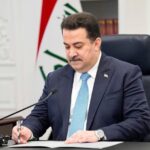
The most significant story was the official nomination of businessman Ali al-Zaydi as the next Prime Minister of Iraq by the Coordination Framework. The news prompted a flurry of reactions from across the political spectrum. High-profile figures such as Mohamed Shia Al-Sudani (Post Impact: 1%), Ammar Al-Hakim (Post Impact: 1%), Mohammed al-Halbousi (Post Impact: 1%), and Nechirvan Barzani (Post Impact: 0%) issued statements congratulating al-Zaydi and expressing hope for his success in forming a government. Other accounts, like Haider (Post Impact: 1%) and Abu Maryam (Post Impact: 1%), shared his biography, noting his youth, Dhi Qar origins, and extensive background in law, finance, and business. However, skepticism and criticism were also prevalent. Ali Fadhil (Post Impact: 3%) sarcastically referred to al-Zaydi’s “very honorable history,” while Omar al-Janabi (Post Impact: 1%) accused him of money laundering for Iran. Political analyst Faig Alsheakh Ali (Post Impact: 3%) described al-Zaydi as a personal friend who is diplomatic and has strong relations with all political blocs and militias but questioned whether he would succeed in his mission.
2. US Issues Warning to Iraq’s Coordination Framework
A strong narrative emerged regarding a “severe message” from Washington to Iraq’s Coordination Framework. According to Rusly Al-Maliki (Post Impact: 1%), citing “Al-Hadath” sources, Washington rejected any outcomes from armed groups, accused the Iraqi government of failing to address assassinations of journalists and currency smuggling, and considered the Framework a partner in “failure and theft.” Qusay Mahbouba (Post Impact: 1%) interpreted this as the US government making it clear that the Framework is considered an adversary, not an ally, stating, “The Shiite Framework has become a meal.” David Yassin (Post Impact: 1%) reinforced this by stating that international decision-making rooms view the rise of armed factions as a breach and that “removing militias from the circle of decision is not an option… but a path that will be implemented.”
3. US Offers $10 Million Bounty on Iraqi Militia Leaders
Commentary circulated around the United States’ announcement of a $10 million reward for information on Iraqi militia leaders. Faig Alsheakh Ali (Post Impact: 2%) offered his observations, calling the price “fantastic” but noting that information could be obtained for as little as $100. He also mocked the value of the individuals targeted, stating “the most expensive one among them wouldn’t sell for two dollars in the Ghazl market,” and predicted they would be betrayed by their own people. Similarly, Najeh Abbas Al-Mizan (Post Impact: 1%) addressed the targeted individuals directly, suggesting they turn themselves in to the embassy to both rid Iraq of their “shame” and bring money into the country.
4. Debates on Iranian Influence and Media Presence
The topic of Iranian influence in the region was a point of discussion, particularly regarding media representation. Faig Alsheakh Ali (Post Impact: 2%) highlighted what he sees as an imbalance, where Iranian officials and Revolutionary Guard members are frequently hosted on Arab TV stations to promote Iranian policy, while no Arab politicians or analysts are given a platform on Iranian television. He lamented this as an “(unjust division)!”. In a separate post, he also questioned the source of internal disagreement within Iran’s leadership, citing a statement by an Iranian official that there is “no agreement in Iran on the American conditions.” These posts reflect a critical perspective on Iran’s regional power dynamics and internal politics.
5. Allegations of Corruption Over Korek Telecom’s Debt
Serious allegations of corruption surfaced regarding the Communications and Media Commission (CMC). Accounts including Ahmad Abdulsada (Post Impact: 1%) and Hiba Alnnayib (Post Impact: 0%) claimed that the CMC, under the leadership of Baligh Abu Gulal of the Al-Hikma Movement, canceled a 2 trillion Iraqi dinar debt owed by the telecommunications company Korek. The posts state that this move, coupled with lifting the seizure of the company’s assets, allowed Korek to empty its bank accounts without paying its dues. Iyad al-Anbar (Post Impact: 1%) questioned where the Prime Minister and the Integrity Commission were in this matter, amplifying the call for accountability over the massive sum of public money.
6. Gulf States Revoke Citizenship of Nationals
The actions of neighboring Gulf states regarding citizenship were a topic of discussion, with a focus on perceived sectarian or political motivations. The account Haider (Post Impact: 1%) reported that Bahrain revoked the citizenship of 69 Shia citizens and their families for “sectarian reasons.” In another post, the same account highlighted Kuwait’s decision to strip the citizenship of Meshal al-Anzi, whose son was a fighter who resisted the 1990 Iraqi invasion and whose remains were found in a mass grave in Iraq. The posts contrast these actions with the status of the ruling families, creating a narrative critical of citizenship policies in these countries.
7. Ilhan Omar’s “World War Eleven” Gaffe
A post with exceptionally high engagement mocked a verbal slip by U.S. Representative Ilhan Omar. The account I Meme Therefore I Am 🇺🇸 (Post Impact: 100%) shared a video clip where Omar mistakenly refers to “World War Eleven” while discussing the Alien Enemies Act. The post sarcastically commented on her education, suggesting she attended the “Quality Learing Center,” a misspelling intended to further ridicule her intelligence. The post’s massive impact indicates it was widely viewed and shared among Iraqi social media users, injecting a moment of American political satire into the local online discourse.
8. Al-Maliki’s Views on Attacking Gulf Countries
A statement attributed to former Prime Minister Nouri al-Maliki regarding relations with Gulf countries drew sarcastic commentary. Ali Farhan ali farhan (Post Impact: 1%) commented on al-Maliki’s purported logic, sarcastically explaining that Iraq’s issue with the Gulf is “religious and ideological,” not political. The post mockingly paraphrased the sentiment: “our doctrine obliges us to stand with Iran and hit you with a few drones to pressure America!” It further ridiculed the idea that Iraq should abandon its “religious and legal duty” for the sake of good neighborly relations, framing the position as selfish and illogical.
9. Calls for Justice Against Syrian Official Atif Najib
A post detailing the alleged atrocities committed by Syrian official Atif Najib in Daraa gained traction, evoking anger and calls for divine retribution. Aayad Al Twfan – Aayad Al Twfan (Post Impact: 1%) recounted an incident where Najib allegedly responded to pleas to release detained children by telling tribal elders to “forget them and make new ones, and if you can’t, bring your women to us and we will do the duty.” The post also quotes Najib as saying, “In Daraa, I am God.” The author ends by praying to God to show His power against the criminal tyrants.
10. Positive Environmental News on Rainfall and Marshes
Amidst the political turmoil, some accounts shared positive news about Iraq’s environmental situation. Dr.hussein Alsafi (Post Impact: 1%) celebrated the recent increase in rainfall, noting that it now rains twice a week compared to every two months previously, calling it “good tidings.” The account Haider (Post Impact: 0%) reported that the Hawizeh Marshes in Maysan province are recovering from a long drought thanks to the heavy rains, allowing fishing boats to return. This account also shared a detailed statement from the Minister of Water Resources confirming that dams on the Tigris River are nearly full and that water is being diverted to revive the southern marshes, promising a secure water supply for the summer.