2026-05-08: Muqtada al-Sadr’s Recommendations for New Government

Based on an analysis of 334 X / Twitter posts trending in Iraq on May 8, 2026, Miqrab AI found that the political discourse was dominated by calls for significant governmental reform and the disarmament of armed factions. The most prominent narrative centered on a statement by Muqtada al-Sadr, who outlined several demands for the new government, including the restructuring of armed groups and a swift campaign against corruption. This theme was echoed in broader discussions predicting an imminent, US-backed operation to disarm rogue militias. Concurrently, regional tensions were a major focus, with many accounts commenting on the conflict between Iran and the UAE, expressing solidarity with Gulf nations. Domestic politics were also heavily debated, with significant attention on the formation of Prime Minister-designate Ali al-Zaidi’s cabinet and renewed scrutiny over the controversial pasts of political figures like Laith al-Khazali.
Table Of Content
- 1. Muqtada al-Sadr’s Recommendations for New Government
- 2. Calls to Disarm Iraqi Militias
- 3. Regional Tensions Involving Iran, UAE, and the US
- 4. Historical Allegations Against Laith al-Khazali
- 5. National Security Service Operation Against Ba’ath Party
- 6. Hawizeh Marshes Environmental Concerns
- 7. Faiq al-Sheikh Ali’s Political Criticism
- 8. Formation of Ali al-Zaidi’s Government
- 9. Iraqi Relations with Gulf Neighbors
- 10. Commentary on Foreign Goods and Iraqi Economy
Today’s Top 10 X (Twitter) Trends in Iraq:
1. Muqtada al-Sadr’s Recommendations for New Government
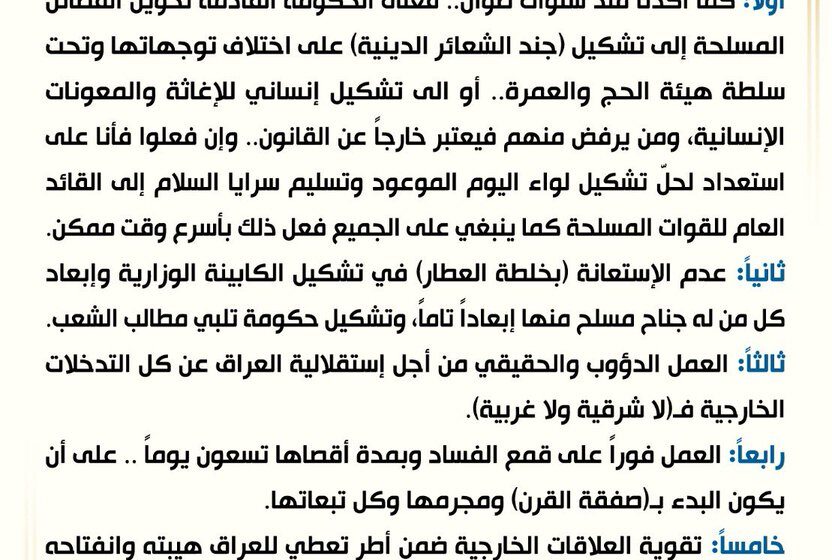
The most impactful story was a statement from influential cleric Muqtada al-Sayyid Muhammad al-Sadr (Post Impact: 100%), who broke his political silence to issue a series of recommendations to Prime Minister-designate Ali al-Zaidi. As detailed by accounts like Haydar (Post Impact: 6%) and Ali Farhan (Post Impact: 4%), al-Sadr called for the transformation of armed factions into a “Religious Rites Force” under the Hajj and Umrah Commission or a humanitarian relief organization, declaring any who refuse as outlaws. He also demanded a government free from those with armed wings, a crackdown on corruption within 90 days, and stressed that no one from his Sadrist Movement would be part of the new cabinet. Commentator Falah al-Mashal (Post Impact: 3%) praised al-Sadr as the “bravest Shiite leader in Iraq” for his clear and courageous stances.
2. Calls to Disarm Iraqi Militias
The topic of disarming militias was a major point of discussion, fueled by both al-Sadr’s statement and other political commentary. Political analyst Faiq al-Sheikh Ali (Post Impact: 24%) made the strong claim that the Counter-Terrorism Service will be tasked with disarming “unruly Iraqi militias” under the direct command, armament, and supervision of the United States, adding that force would be used against those who resist. In contrast, politician Ezzat Alshabandar (Post Impact: 4%) defended the factions, stating they were established for “national reasons” to confront terrorism and that their fate must also be a national one. Columnist Omar al-Janabi (Post Impact: 2%) opined that Iran’s axis in Iraq faces a choice: either dismantle its armed factions or face a confrontation that will lead to their inevitable end.
3. Regional Tensions Involving Iran, UAE, and the US
Regional conflict, particularly between Iran and its neighbors, was a prominent theme. Raghad Saddam Hussein (Post Impact: 31%) expressed strong support for the United Arab Emirates, attributing Iran’s actions to longstanding hatred and envy over the UAE’s prosperity. She told her Emirati “brothers” that “relief is near, God willing.” Similarly, Mustafa al-Dulaimi (Post Impact: 10%) celebrated what he described as UAE drone strikes from Iranian airspace, stating that the “screams of the group [pro-Iran factions] are heard from Iraq.” Meanwhile, Salim al-Jumaili (Post Impact: 6%) reported on a warning from former US President Trump to Iran, who allegedly threatened unprecedented bombing—a “white flash”—if Tehran rejects US terms to end the war.
4. Historical Allegations Against Laith al-Khazali
Serious historical allegations resurfaced against Laith al-Khazali, brother of Asa’ib Ahl al-Haq leader Qais al-Khazali. Journalist Othman al-Mukhtar (Post Impact: 22%) posted a detailed accusation, claiming that Laith al-Khazali was responsible for the 2006 kidnapping and murder of seven university students and a professor, whose bodies were found in east Baghdad. Al-Mukhtar noted the irony that Khazali has now become a university professor and concluded, “In Iraq, memory is a weapon.” In response, accounts like Emad Al Musafir (Post Impact: 5%) defended Khazali, dismissing the criticism as coming from a figure who “failed socially and electorally” and is now trying to attack successful people to cover his own failures.
5. National Security Service Operation Against Ba’ath Party
The Iraqi National Security Service announced a major intelligence operation against a banned Ba’ath Party cell. According to a statement shared by Haydar (Post Impact: 8%), the operation targeted a clandestine group active online, culminating in the arrest of several leaders and the seizure of documents and equipment. In a dramatic move, the service’s spokesperson, Arshad al-Hakem, appeared unexpectedly during one of the group’s live broadcasts, shocking participants by announcing that the broadcast was under the service’s control. The official account of the Iraqi National Security Service (Post Impact: 3%) had teased the operation earlier with a video message stating, “The broadcast is under control… Details later.”
6. Hawizeh Marshes Environmental Concerns
Attention was drawn to the environmental future of the Hawizeh Marshes in southern Iraq. In a widely shared post, user Haydar (Post Impact: 14%) shared a video showing the marshes’ beauty after recent rainfall. However, the account claimed that the Iraqi government intends to dry up this “beauty” in order to extract oil, in collaboration with the Chinese company Geo-Jade. The post highlights a potential conflict between preserving Iraq’s natural heritage and pursuing economic development through fossil fuels.
7. Faiq al-Sheikh Ali’s Political Criticism
Politician Faiq al-Sheikh Ali (Post Impact: 13%) was active with critical commentary on the political scene. In a prominent post, he targeted three unnamed political entities, accusing their leaders and members of continuously claiming they are “coming to Iraq to take power.” He asserted that these claims are nothing more than “noise and distraction for Iraqis,” as these groups lack history and influence. He concluded with a sharp rebuke, stating, “They should have respected themselves and kept quiet. Shut up.”
8. Formation of Ali al-Zaidi’s Government
The formation of a new government under Prime Minister-designate Ali al-Zaidi was a key topic, with discussions focusing on cabinet appointments and policy direction. Ammar Al-Hakim (Post Impact: 6%) detailed his meeting with al-Zaidi, emphasizing the need for a competent government to tackle economic challenges and build balanced foreign relations. Reports from accounts like Abu Maryam (Post Impact: 5%), citing a high-level political source, claimed that al-Zaidi refuses to renew confidence in any current ministers and wants “new faces.” In a specific personnel change, Dr. Qusay Shafiq (Post Impact: 6%) reported that Finance Ministry official Taif Sami would be moved out of the ministry for the first time since 2003 and appointed as a prime ministerial advisor.
9. Iraqi Relations with Gulf Neighbors
Tensions in Iraq’s relationships with its Gulf neighbors were highlighted in several posts. Raad Hashim (Post Impact: 10%) questioned how Iraqi authorities could permit “public celebrations in the heart of Baghdad to transgress against the Kingdom of Saudi Arabia,” especially given Saudi Arabia’s good treatment of Iraqi pilgrims. He called on the government to stop these insults. Separately, journalist Anwar al-Hamdani (Post Impact: 5%) condemned recent remarks by MP Alia Nassif against the Kuwaiti army as “rejected and irresponsible,” arguing that such statements embarrass Iraq.
10. Commentary on Foreign Goods and Iraqi Economy
The state of the Iraqi economy was discussed, particularly in relation to foreign goods flooding the market. Rusly Al-Maliki (Post Impact: 14%) pointed out the paradox that Turkish, Gulf, and Iranian products are sold more cheaply in Iraq than in their countries of origin, implying a distorted market that harms local production. Meanwhile, Haydar (Post Impact: 4%) shared data from the Iraqi Ministry of Finance showing the country’s external debt at $10 million and internal debt at a staggering 96 trillion Iraqi dinars, underscoring the severe financial pressures facing the nation.