2026-05-27: Al-Sadr Dissolves Saraya al-Salam Militia

Based on Miqrab AI’s analysis of 403 X / Twitter posts trending in Iraq on May 27, 2026, the dominant narrative revolves around Shiite cleric Muqtada al-Sadr’s major announcements. The most impactful story was his decision to dissolve his Saraya al-Salam (Peace Brigades) militia and integrate it into the state’s command, a move that sparked widespread debate about the broader issue of armed factions and state sovereignty. Concurrently, al-Sadr’s sharp rebuke of the British Ambassador for comments about the 2003 handover of power also garnered significant attention, highlighting ongoing sensitivities about foreign influence. Other prominent themes included Eid al-Adha greetings and documentation of political leaders’ holiday activities, a flare-up of anti-Kurdish sentiment following a sporting event, and discussions on regional tensions, particularly concerning US-Iran relations.
Table Of Content
- 1. Al-Sadr Dissolves Saraya al-Salam Militia
- 2. Al-Sadr Demands Apology from British Ambassador
- 3. Debate and Skepticism Over Disarming Factions
- 4. Eid Al-Adha Greetings and Observations
- 5. Anti-Kurdish Sentiment After Loss to Egypt
- 6. Prime Minister’s Eid Activities
- 7. Qais Khazali’s Statements and Public Criticism
- 8. Ammar Al-Hakim’s Messages of Unity and Sovereignty
- 9. US-Iran Tensions and Trump’s Statements Circulate
- 10. Muthanna al-Samarrai Holds Eid Receptions
Today’s Top 10 X (Twitter) Trends in Iraq:
1. Al-Sadr Dissolves Saraya al-Salam Militia
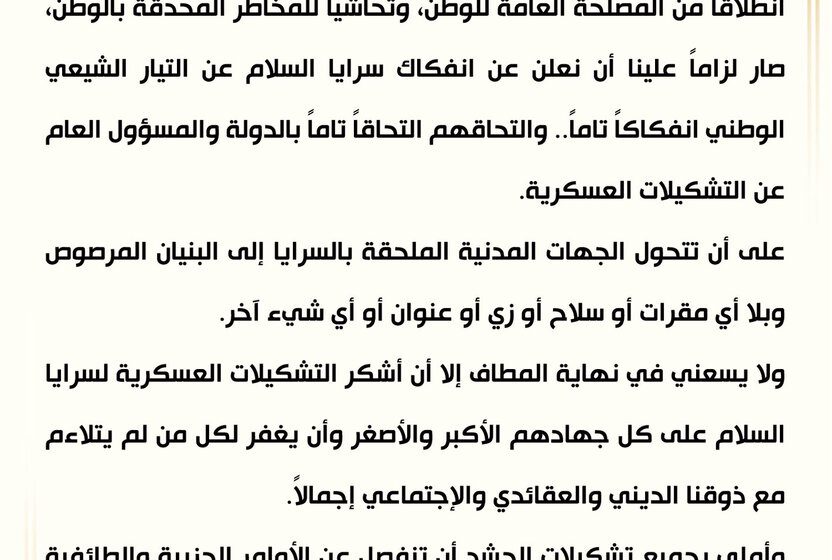
The most significant story was Shiite cleric Muqtada al-Sadr’s announcement to dissolve his Saraya al-Salam (Peace Brigades) militia and place it entirely under the command of the state. In a widely shared statement from his official account, Muqtada Al-Sadr (Post Impact: 100%) declared the “disengagement” of the brigades from the Sadrist Movement and their complete integration into the state. This move was framed by supporters as a historic step towards strengthening the state and restricting arms to official institutions. Accounts like Rusly Al-Maliki (Post Impact: 7%) and Ali Farhan (Post Impact: 4%) quickly reported the news. Commentators such as Yasser Eljuboori (Post Impact: 4%) praised al-Sadr for offering the “biggest gift to Iraq, which is stability,” without preconditions. Salam Al-Husseini (Post Impact: 4%) viewed the decision as a patriotic move that removes excuses for other armed groups to retain their weapons and puts pressure on them to follow suit.
2. Al-Sadr Demands Apology from British Ambassador
Another high-engagement topic was Muqtada al-Sadr’s strong reaction to comments made by the British Ambassador. In a post from his account Muqtada Al-Sadr (Post Impact: 76%), the cleric stated he was “angry and sad” about the ambassador’s claim that the UK and the US had handed over governance to the Shiites in Iraq. Al-Sadr demanded an official apology through diplomatic channels. He drew a clear distinction, stating, “If a handful of Shiites have appeared before you, we are not among them and will never be.” News and analysis accounts like Shaho Al-Qaradaghi (Post Impact: 4%) also covered the statement, highlighting al-Sadr’s call for a formal apology and his firm rejection of the ambassador’s narrative.
3. Debate and Skepticism Over Disarming Factions
Following Muqtada al-Sadr’s announcement, a broader debate emerged about the feasibility and sincerity of disarming Iraq’s numerous armed factions. Analyst Othman Al-Mukhtar (Post Impact: 6%) warned against being deceived by what he called a “new play” by militias to escape US pressure, posing a long list of critical questions. He asked what “handing over weapons to the state” truly means when state institutions are influenced by faction leaders, and whether “integration” would simply legitimize armed groups within the state rather than dismantling them. Similarly, Sajjad Salem (Post Impact: 5%) noted that al-Sadr had made similar announcements in 2017 and 2019 which were not implemented, suggesting that other factions are more concerned with al-Sadr himself than with the issue of weapons. David Yassin (Post Impact: 6%) alluded to an international protocol with “executive guarantees to dismantle the financial and functional influence of the factions” that is now in effect.
4. Eid Al-Adha Greetings and Observations
Numerous accounts shared greetings and images celebrating Eid al-Adha. Political and social media figures wished their followers a blessed holiday. Aayad Al Twfan (Post Impact: 8%) posted a congratulatory message, praying for God to accept everyone’s good deeds. Haidar (Post Impact: 7%) and Adnan Al-Taie (Post Impact: 7%) shared similar well-wishes for health and safety. The holiday was also marked by images of public prayers, such as a post from Haidar (Post Impact: 9%) showing the Eid prayer in Karbala.
5. Anti-Kurdish Sentiment After Loss to Egypt
A strong anti-Kurdish narrative emerged from the account Haidar (Post Impact: 8%), which called for a ban on any Kurd representing Iraq in international sporting, cultural, or diplomatic events. The post argues that a “large part of the Kurdish component” responds to respect from the state with “rebellion and attacks on the state and its symbols.” It congratulates the “Egyptian brother” on a “sweeping victory” and wishes defeat upon every “separatist Iraqi.” In a follow-up post, Haidar (Post Impact: 3%) further analyzed the issue, suggesting that Kurds in neighboring countries are more compliant because they are ruled with an “iron fist,” whereas in Iraq, they have misinterpreted respect as weakness.
6. Prime Minister’s Eid Activities
Prime Minister Ali Faleh Al-Zaidi’s activities on Eid al-Adha were documented by his official media office and other accounts. The Prime Minister’s Media Office (Post Impact: 6%) reported that after performing Eid prayers at the Kadhimiya shrine, the Prime Minister visited the shrine of Imam Abu Hanifa al-Numan in the Adhamiyah district of Baghdad. This visit, which bridges two major Sunni and Shiite religious sites, was also reported by accounts like Abu Maryam (Post Impact: 2%) and commented on by Rafid Jaboori (Post Impact: 2%), who noted the symbolism of the visit.
7. Qais Khazali’s Statements and Public Criticism
Statements by Qais Khazali, leader of the Asa’ib Ahl al-Haq militia, and the backlash against them were a point of discussion. Emad Al Musafir (Post Impact: 2%) shared a clip of Khazali stating, “Our march was not easy and our path was not paved with roses.” This statement was met with harsh criticism from others. Najih Abbas Al-Mizan (Post Impact: 4%) responded sarcastically, recounting a list of accusations against Khazali, including “the killing of 1500 innocent Iraqis” and the “theft of the Baiji refinery.”
8. Ammar Al-Hakim’s Messages of Unity and Sovereignty
Ammar Al-Hakim, leader of the National Wisdom Movement, used the occasion of Eid al-Adha to deliver political messages focused on national unity and sovereignty. In one post, Ammar Al-Hakim (Post Impact: 3%) stated that Iraq cannot be built through dominance or division but through “national partnership… and consolidating the concept of a modern, just state.” In another message, Ammar Al-Hakim (Post Impact: 4%) reaffirmed Iraq’s position of respecting the sovereignty of other nations and refusing to allow its territory to be used for attacks on its neighbors, emphasizing that Iraq aims to be a factor of stability, not a conflict zone.
9. US-Iran Tensions and Trump’s Statements Circulate
Statements by former US President Donald Trump regarding Iran were circulated by several Iraqi accounts, reflecting local interest in regional tensions. Omar Abdul Sattar Mahmoud (Post Impact: 3%) and Raad Hashim (Post Impact: 2%) both shared a quote attributed to Trump: “Either we make a deal with Iran or we go back again to finish the job.” Rafid Jaboori (Post Impact: 2%) reported that the Trump administration accused Iran of fabricating a draft agreement, insisting that negotiations were ongoing and that Trump would only accept a “good deal.”
10. Muthanna al-Samarrai Holds Eid Receptions
Muthanna al-Samarrai, leader of the Azm Alliance, was active during Eid, holding receptions for political and social leaders. His official account, Muthanna Al-Samarrai (Post Impact: 3%), posted a video of him receiving MPs, tribal elders, and academics in Baghdad. In a related post, Muthanna Al-Samarrai (Post Impact: 2%) stressed the importance of supporting the path to government formation and completing the cabinet based on political and constitutional entitlements. His meetings aimed to “enhance national understanding and maintain stability.”