2026-06-16: Iraqi National Team Fans Celebrated at World Cup

Based on an analysis of 354 X / Twitter posts on June 16, 2026, Miqrab AI identified that the primary narratives in Iraq revolve around the high-stakes diplomatic visit of U.S. Special Presidential Envoy Tom Barrack. Discussions focused heavily on the resulting joint U.S.-Iraqi statement, which outlined commitments to disarm militias, grant operating licenses to American companies like Starlink and Chevron, and strengthen bilateral partnerships, sparking a polarized debate about Iraqi sovereignty and political allegiances. Alongside this dominant political theme, significant engagement was seen around national pride for the Iraqi football team’s participation in the World Cup, controversy over a university student’s expulsion for her graduation attire, and ongoing reactions to the recent U.S.-Iran agreement, with commentators fiercely divided on whether Iran emerged victorious or was forced into concessions.
Table Of Content
- 1. Iraqi National Team Fans Celebrated at World Cup
- 2. US Envoy Tom Barrack’s High-Stakes Visit to Baghdad
- 3. Polarized Reactions to the US-Iran Agreement
- 4. Starlink’s Approval Signals New Iraq-US Economic Ties
- 5. Commentary on Political Elites’ Shift Towards the US
- 6. Tensions Rise in Samarra Over Saraya al-Salam Command
- 7. Student Expelled Over Graduation Ceremony Attire
- 8. Trump’s Comments on Hezbollah, Israel, and Syria
- 9. Kurdish Leaders Meet with US Envoy Tom Barrack
- 10. Satirical Posts Target Political Commentator Rusly Al-Maliki
Today’s Top 10 X (Twitter) Trends in Iraq:
1. Iraqi National Team Fans Celebrated at World Cup
The highest engagement centered on the Iraqi national football team’s participation in the World Cup, particularly the enthusiastic support from its fans. Steven Nabil (Post Impact: 100%) shared a viral post thanking Southwest Airlines for ensuring a plane full of Iraqi fans arrived in Boston safely and on time, highlighting a flight attendant who researched the team’s jerseys and gave a “heartfelt welcome announcement.” This sense of national pride and anticipation was echoed by others, such as Adnan Al-Taie (Post Impact: 24%), who expressed optimism and support for the team. Meanwhile, conversations also turned to the difficulty of the upcoming match against Norway, with Haidar (Post Impact: 28%) sharing a video of the Norwegian Prime Minister telling his team to “go and crush Iraq.” Basil Hussein (Post Impact: 14%) offered a more sobering analysis, predicting a difficult match and a potential heavy loss for Iraq given the technical differences between the two teams.
2. US Envoy Tom Barrack’s High-Stakes Visit to Baghdad
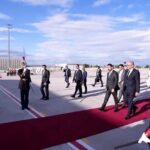
The visit of U.S. Special Presidential Envoy Tom Barrack and his meetings with Iraqi and Kurdish leadership dominated political discussions. The U.S. Embassy Baghdad (Post Impact: 53%) and the Prime Minister’s Media Office (Post Impact: 31%) released a joint statement outlining a commitment to a strong U.S.-Iraqi partnership. Key points included plans to disarm all armed groups operating outside state control, deepen trade and investment, and an invitation from President Trump for Prime Minister Ali Al-Zaidi to visit the White House. Commentators like Rafid Jaboori (Post Impact: 23%) interpreted Al-Zaidi’s pledge to disarm militias as dependent on the “degree and reality of American pressure.” Ali Farhan (Post Impact: 16%) listed the U.S. “conditions” carried by Barrack, including disarming factions, combating corruption, and a new security agreement, warning of sanctions if they are not met.
3. Polarized Reactions to the US-Iran Agreement
The recent agreement between the U.S. and Iran triggered a sharp and divided reaction online. Some accounts portrayed the outcome as a major victory for Iran. Dr. Hussein Al-Safi (Post Impact: 37%) claimed that under the agreement, America would release $24 billion of Iran’s frozen assets and establish a $300 billion compensation fund paid for by Gulf countries, asking, “How is this not a victory?” Similarly, Amir al-Mousawi (Post Impact: 29%) celebrated the raising of the Iranian flag in Los Angeles as a symbol of defiance against “arrogance, tyranny, and terrorism.” In stark contrast, Sufian Al-Samarrai (Post Impact: 32%) ridiculed these claims, posting a video of Iranian official Ghalibaf burning an American flag and stating that the “humiliated Safavid now kisses the shoe of the American administration” for a fraction of its frozen money after suffering huge losses. Sheikh Thaer Al-Bayati (Post Impact: 13%) urged followers not to believe “loyalist propaganda,” stating that negotiations and conditions will reveal whether the Iranian regime has truly become compliant.
4. Starlink’s Approval Signals New Iraq-US Economic Ties
A specific outcome of U.S. envoy Tom Barrack’s visit that garnered significant attention was Iraq’s decision to grant an operating license to Starlink. In a post highlighting the reversal of fortunes, Abu Maryam (Post Impact: 34%) noted that Barrack praised the Ministry of Communications for approving the American company. Haidar (Post Impact: 22%) detailed Iraq’s previous long-standing opposition to the service, quoting a prior government statement that all communication services must “be subject to sovereign and regulatory standards.” Asaad Al-Basri (Post Impact: 10%) provided a more in-depth analysis, describing the move as “scary” due to the state’s potential inability to cut internet access during protests, and suggesting the new Minister of Communications had been seeking to implement Iranian expertise in jamming Starlink services.
5. Commentary on Political Elites’ Shift Towards the US
Many commentators reacted with sarcasm and criticism to what they perceived as a sudden pivot by Iraqi political figures toward cooperation with the United States, especially from factions previously known for their anti-American rhetoric. Rusly Al-Maliki (Post Impact: 37%) posted an image of an embrace with the caption, “In an embrace, my brother… What about the blood of the factions’ members who fell in the war?” Shaho Al-Qaradaghi (Post Impact: 30%) observed that after meeting with Barrack, “All the slogans, accusations of treason, and noise evaporated, and now they have become loyal to America and its interests.” Mustafa Al-DULAIMI (Post Impact: 22%) highlighted the perceived hypocrisy, stating that when any Iraqi, including the Prime Minister, meets with the American side, he is accused of treason, “but when Iran sits and negotiates, we don’t even see a comment.”
6. Tensions Rise in Samarra Over Saraya al-Salam Command
Reports of growing tensions in Samarra involving Saraya al-Salam (the Peace Companies), the militia associated with Muqtada al-Sadr, circulated widely. Abu Maryam (Post Impact: 20%) reported that Saraya al-Salam announced its refusal to operate under the command of the Popular Mobilization Forces (PMF) and rejected the replacement of its commander of operations in Samarra. Mujahid Al-Taee (Post Impact: 5%), citing Shafaq News, explained that the tension arose after PMF Chairman Faleh al-Fayyad replaced the Saraya-affiliated commander with another from Asa’ib Ahl al-Haq. Mohamed Almaroof (Post Impact: 12%) described the move as a “rebellion,” quoting the militia as saying, “We will not withdraw from the city of Samarra… and we will remain in it by force if necessary!”
7. Student Expelled Over Graduation Ceremony Attire
A decision by the Ministry of Higher Education to expel a female dental student in Kirkuk over her graduation ceremony attire sparked a debate about personal freedoms and social norms. Abu Maryam (Post Impact: 23%) posted a video of the student, noting she was dismissed for wearing clothes “considered contrary to university regulations and instructions.” While Dr. Zainab Al-Dulaimi (Post Impact: 10%) called the decision “correct” and compatible with Iraqi ethics, Tamara Alkhazraji (Post Impact: 13%) criticized what she saw as a double standard. She argued that the issue lies with a societal “gaze of shame,” pointing out that a female parliamentarian and a media personality recently wore similar outfits without facing consequences, but the student was targeted because “she doesn’t have a backer in the country.”
8. Trump’s Comments on Hezbollah, Israel, and Syria
A statement from U.S. President Donald Trump regarding the conflict between Israel and Hezbollah drew attention from Iraqi accounts. Haidar (Post Impact: 24%) reported Trump’s comment: “Israel has been fighting Hezbollah for a very long time… If Israel cannot get the job done in Lebanon without killing everyone, then Syria should do it.” Ali Farhan (Post Impact: 12%) also shared the quote, which was interpreted as a significant geopolitical signal for the region. The sharing of these comments indicates a close following of regional power dynamics and the U.S. President’s stance on them.
9. Kurdish Leaders Meet with US Envoy Tom Barrack
The meetings between U.S. Envoy Tom Barrack and leaders in the Kurdistan Region were a key sub-topic of his visit. Kurdistan Region President Nechirvan Barzani (Post Impact: 43%) detailed his meeting with Barrack and Syrian Democratic Forces General Mazloum Abdi, where they emphasized “dialogue, coordination, and joint efforts to preserve stability.” Kurdistan Prime Minister Masrour Barzani (Post Impact: 21%) also reported on his meeting, stating they agreed to advance trade and energy investment and stressed the urgency of reactivating the Kurdistan Parliament. Adding a significant claim to the conversation, Abu Maryam (Post Impact: 14%) and Mohamed Almaroof (Post Impact: 10%) both reported that Barrack informed the Kurdish leadership that U.S. forces would be withdrawn from Erbil and the region in September of the current year.
10. Satirical Posts Target Political Commentator Rusly Al-Maliki
The political commentator Rusly Al-Maliki became the subject of satirical posts, reflecting his prominent and often controversial role in online political discourse. In a post titled “Most Trending,” Haidar (Post Impact: 32%) jokingly reported that “Rusly Oglu calls on the government of Ali Al-Zaidi to adopt his ideas and plans to build Iraq.” This type of content, while humorous, underscores the influence of social media personalities in shaping public debate and how they themselves become subjects of discussion and parody within the Iraqi digital sphere. In a separate post, Rusly Al-Maliki (Post Impact: 16%) himself engaged in satire, quoting Napoleon as saying, “God is with the one with the best AI clips.“