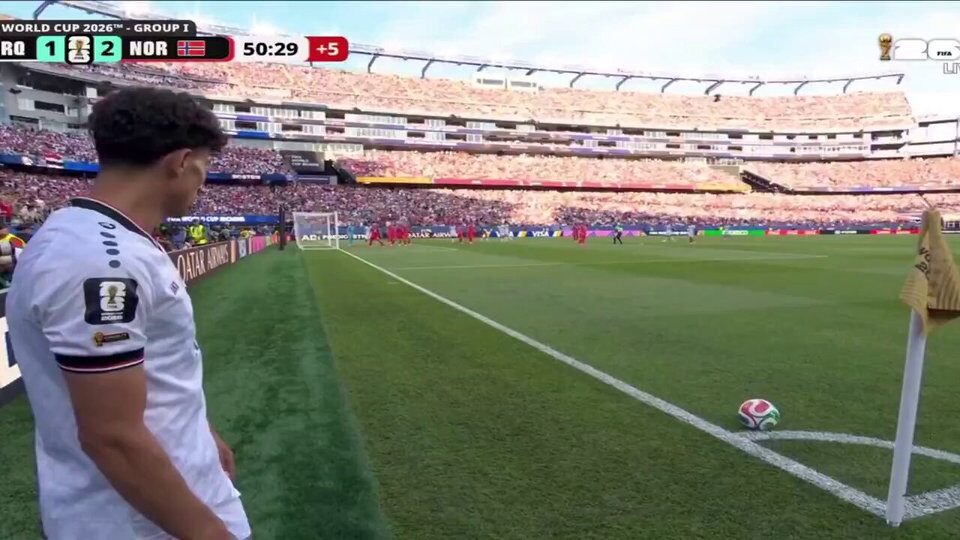
2026-06-17: Backlash Against Iraqi Football Team and Goalkeeper Jalal Hassan

Based on an analysis of 465 X / Twitter posts by Miqrab AI, the most prominent narratives trending in Iraq on June 17, 2026, revolved around the national football team’s performance, remarks by U.S. President Donald Trump concerning Iran, and the launch of Starlink internet service. Conversations were dominated by strong reactions to the football team’s recent match, with widespread criticism directed at goalkeeper Jalal Hassan. Simultaneously, there was significant discussion surrounding Trump’s statements about a potential agreement with Iran and its regional implications. Another major topic was the official approval for Starlink to operate in Iraq, which users viewed as a significant technological development. Other key themes included reports that the funeral of Iran’s Supreme Leader Ali Khamenei would be held in Iraq, ongoing criticism of domestic political corruption, and the influence of militias in state institutions.
Table Of Content
- 1. Backlash Against Iraqi Football Team and Goalkeeper Jalal Hassan
- 2. Trump’s Conflicting Statements on Iran and a Potential Deal
- 3. Starlink Satellite Internet Service Approved in Iraq
- 4. Reports of Khamenei’s Funeral to Be Held in Iraq
- 5. Analysis of a Leaked US-Iran Memorandum of Understanding
- 6. Accusations of Corruption Against Iraqi Politicians
- 7. US Diplomatic Engagement and Influence in Iraq
- 8. Criticism of Militia Influence in Government
- 9. Calls to Remove “Fake” Religious Shrines
- 10. Discussions on Iraq’s Defense Budget and Military Promotions
Today’s Top 10 X (Twitter) Trends in Iraq:
1. Backlash Against Iraqi Football Team and Goalkeeper Jalal Hassan
Following a match, Iraqi social media users expressed a mix of frustration and support for the national football team, with a significant amount of criticism directed at goalkeeper Jalal Hassan. Bahaa khaleel Bahaa khaleel (Post Impact: 100%) focused on a positive moment, highlighting that a goal by Akam Hashim was a “hypersonic missile” reaching 113 km/h, faster than Roberto Carlos’s famous 1997 free-kick. However, many others focused on the negatives. Dr. Qusay Shafiq (Post Impact: 2%) called Hassan’s performance a “scandal,” suggesting his selection was based on connections rather than merit. Similarly, Tamara Alkhazraji (Post Impact: 2%) posted a video mocking the goalkeeper for “distributing points” to opposing teams. In contrast, Ahmad Mulla Talal (Post Impact: 3%) urged Iraqis to stop the “self-flagellation,” defending the team’s performance against Norway as “honorable” and arguing that the goals conceded were due to “trivial mistakes.” Meanwhile, Haidar (Post Impact: 4%) criticized the Kurdish channel AVA, affiliated with the Barzani family, for allegedly celebrating the Iraqi team’s loss.
2. Trump’s Conflicting Statements on Iran and a Potential Deal
U.S. President Donald Trump’s recent comments regarding Iran, Saudi Arabia, and a potential nuclear agreement generated significant discussion. Haidar (Post Impact: 13%) shared a clip of Trump stating, “we use Saudi Arabia’s airports and they can’t stop us if we don’t want them to.” Accounts also focused on a potential U.S.-Iran deal. Rafid Jaboori (Post Impact: 1%) noted that Trump denied the existence of a $300 billion investment fund for Iran, which was reportedly part of a leaked agreement, while Abu Mariam (Post Impact: 1%) posted that Trump threatened to “go right back to dropping bombs in the middle of their heads” if Iran does not behave. In another contradictory statement shared by Najh Mohammed Ali (Post Impact: 1%) and Raad Hashim (Post Impact: 1%), Trump defended Iran’s right to possess ballistic missiles for parity with other regional powers. Analyst Dr. Hussein Al-Safi (Post Impact: 2%) interpreted these moves as a strategic win for Iran, claiming Trump divided the war’s losses among his allies while Iran successfully imposed its “new equation.”
3. Starlink Satellite Internet Service Approved in Iraq
Multiple accounts celebrated the news that Iraq has officially approved an operating license for Elon Musk’s Starlink satellite internet service. Rusly Al-Maliki (Post Impact: 6%) reported that both Iraqi Prime Minister Ali Al-Zaydi and U.S. Special Presidential Envoy Tom Barrack welcomed the approval, but noted that this means “the authority of the internet in Iraq is now in the hands of Elon Musk, not the Ministry of Communications.” Haidar (Post Impact: 3%) shared a post attributed to Elon Musk announcing the news. Yasser Eljuboori (Post Impact: 2%) described the approval as a “big step” toward enhancing digital connectivity and supporting economic growth. Raad Hashim (Post Impact: 1%) linked the decision to the recent visit of Trump’s envoy to Baghdad.
4. Reports of Khamenei’s Funeral to Be Held in Iraq
A recurring story across several accounts claimed that Iran has agreed to hold funeral ceremonies for its late Supreme Leader, Ali Khamenei, in Iraq’s holy cities. Haidar (Post Impact: 4%) stated that Iran had “officially announced” its approval for the funeral to take place in Iraq on July 17. However, another post from Haidar (Post Impact: 3%) mentioned the date as July 8 and specified the cities of Karbala and Najaf. The July 8 date was also cited by Yasser Eljuboori (Post Impact: 1%), who attributed the announcement to Tehran’s mayor, Ali Zakani. Shahou Al-Qaradaghi (Post Impact: 1%), citing a source close to the Iranian embassy, detailed plans to transport the body to Najaf airport on July 8 for rites in Najaf and Karbala before returning to Mashhad. Abu Mariam (Post Impact: 1%) noted that politician Zainab Al-Moussawi had formally requested that Iran allow the funeral to be held in Iraq.
5. Analysis of a Leaked US-Iran Memorandum of Understanding
Commentators analyzed a reportedly leaked memorandum of understanding between the U.S. and Iran, with most concluding that the terms heavily favor Tehran. Liqaa Maki (Post Impact: 6%), referencing reporting from Bloomberg and CNN, wrote that if the text is accurate, it would be a “significant gain” for Iran’s strategic presence in the region. He argued that while Iran may reduce its nuclear ambitions, it would gain immense economic power in return, which it could use to “support its expansion,” inevitably clashing with other regional states. He concluded that “the result of this war was in Iran’s favor,” as it received a better deal than what was offered in Geneva before the conflict. Dr. Hussein Al-Safi (Post Impact: 2%) similarly asserted that Iran successfully imposed its “new equation” on the region, while Trump “abandoned everyone” else.
6. Accusations of Corruption Against Iraqi Politicians
Allegations of corruption and unethical behavior targeting high-level Iraqi politicians were a significant topic of conversation. Haidar (Post Impact: 3%) shared an anecdote from an Iraqi journalist who claimed that Prime Minister Ali Al-Zaydi gave him and other media figures iPhones and perfume on two separate occasions, once before becoming PM and once after. The journalist noted that the gift bag was later branded with the Prime Minister’s Office logo. Ahmed Al-Alwani (Post Impact: 3%) launched a harsh critique of former PM Nouri al-Maliki, accusing him of committing “the most heinous crimes” and predicting he will face trial once the U.S. abandons the current political system. Furthermore, Journalist Samer Al-Saadi (Post Impact: 2%) quoted analyst Nizar Haidar, who alleged that former Speaker Mohammed al-Halbousi attempted to smuggle $2 billion through Turkey and may soon face U.S. Treasury sanctions.
7. US Diplomatic Engagement and Influence in Iraq
The visit of U.S. Special Presidential Envoy Tom Barrack and broader American influence in Iraq’s political landscape were subjects of speculation and analysis. Abu Mariam (Post Impact: 3%) predicted that a “very high-level” Iraqi political figure would soon face U.S. sanctions, pointing out that Tom Barrack did not meet with this individual during his recent visit to Baghdad. In another post, Abu Mariam (Post Impact: 2%) outlined what he described as a major U.S. plan, managed by Barrack, that started with the killing of Qasem Soleimani and aims to culminate in joint Iraqi-Saudi normalization with Israel. Similarly, Raad Hashim (Post Impact: 1%) cited an article from Asharq Al-Awsat suggesting U.S. intelligence is skeptical of Prime Minister Ali Al-Zaydi’s moves to disarm factions ahead of his planned visit to Washington.
8. Criticism of Militia Influence in Government
The continued influence of armed militias in state affairs, particularly at the provincial level, drew criticism from several commentators. Othman Al-Mukhtar (Post Impact: 2%) condemned the appointment of Ali Turki, a leader in the U.S.-designated terrorist group Asa’ib Ahl al-Haq, as the governor of Babil. He argued that Turki is legally unqualified for the position but holds it because of his militia affiliation, which he now uses for “sectarian persecution.” He asserted that the displaced people of Jurf al-Sakhr will return “in spite of you.” Echoing this, Ali Farhan ali farhan (Post Impact: 1%) questioned the governor’s actual authority over Jurf al-Sakhr, recalling an incident where an armed group allegedly brandished weapons at him and denied him entry. In a different context, Ahmed Abdulsada (Post Impact: 1%) posted a lengthy statement attributed to Abu Hussein al-Hamidawi, Secretary-General of Kata’ib Hezbollah, declaring victory in a recent conflict but warning that the battle is not over and vowing to keep “our hands on the trigger.”
9. Calls to Remove “Fake” Religious Shrines
A notable conversation called on the Iraqi government to address the proliferation of what were described as “fake” or unofficial religious shrines. Rusly Al-Maliki (Post Impact: 4%) argued that the government must remove thousands of these sites because they “drain the pockets of the poor and simple people for nothing in return.” He proposed a two-step solution: first, asking the Shia Endowment to provide a list of officially recognized shrines, and second, directing security forces and municipalities to remove any site not on that list. This sentiment was complemented by Emad Al Musafir (Post Impact: 1%), who contrasted the actions of Imam Hussein, who purchased his own burial land, with some of his modern followers who “exploit influence and legal loopholes to acquire state or public lands.”
10. Discussions on Iraq’s Defense Budget and Military Promotions
Iraqi defense policy and military administration were the focus of several posts. Haidar (Post Impact: 2%) reported that the Parliamentary Security and Defense Committee has proposed separating the budgets for the Air Defense and Air Force from the general Ministry of Defense budget. The stated goal of this move is to “ensure a sustainable financial flow to build an integrated deterrence system.” On a different note concerning military personnel, Abu Mariam (Post Impact: 1%) shared a directive from the Chief of Staff of the Army to find positions for and promote all officers from the rank of Lieutenant to Lieutenant Colonel, even if it leads to “duplication” of roles.