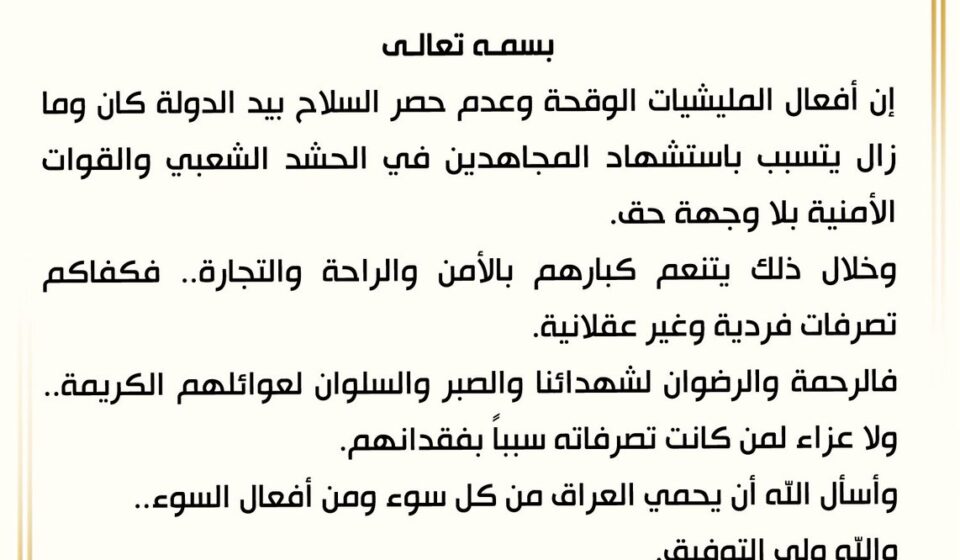
2026-07-30: Muqtada al-Sadr Blames Militias for Attacks

An analysis of 478 X / Twitter posts trending in Iraq on July 30, 2026, conducted by Miqrab AI, reveals a landscape dominated by escalating regional tensions and sharp domestic political criticism. The foremost narrative revolves around a statement from influential cleric Muqtada al-Sadr, who blamed “disgraceful” militias for recent attacks, drawing both praise and condemnation. Tensions with Saudi Arabia are a central theme, fueled by reports of Houthi-led attacks launched from Iraqi soil and a viral video of militants threatening to destroy the Kaaba, which sparked widespread outrage. Concurrently, discussions reflect a deep divide, with some users calling for de-escalation and positive relations with Arab neighbors, while others express staunch opposition to Saudi Arabia and defend Iran-aligned factions. These geopolitical conflicts are compounded by pressing domestic concerns, including a severe government financial crisis and public frustration over decades of political failure and corruption.
Table Of Content
- 1. Muqtada al-Sadr Blames Militias for Attacks
- 2. Video of Militants Threatening to Destroy the Kaaba
- 3. Tensions Rise Over Attacks from Iraq on Saudi Arabia
- 4. Calls for Reconciliation and Better Iraq-Saudi Relations
- 5. Polarized Debate on Role of Pro-Iran Militias
- 6. Saudi Arabia Forms New Regional Naval Coalition
- 7. Houthi Leader Offers Condolences to Iraq
- 8. Iraqi Government Faces Severe Financial Crisis
- 9. Criticism Mounts Over Government and Shia Parties’ Failures
- 10. PM’s Saudi Visit Postponed Amid Calls for Reform
Today’s Top 10 X (Twitter) Trends in Iraq:
1. Muqtada al-Sadr Blames Militias for Attacks
The most prominent story on Iraqi social media was a statement from cleric Muqtada al-Sadr, which was shared by his official account, Muqtada Sayyid Muhammad al-Sadr (Post Impact: 100%). While the post itself was just a link, other accounts quickly summarized its content, reporting that al-Sadr held “disgraceful militias” and their failure to restrict weapons to state control responsible for the recent deaths of members of the Popular Mobilization Forces (PMF) and security forces. Accounts like Ali Farhan (Post Impact: 3%) and Shaho Al-Qaradaghi (Post Impact: 2%) highlighted al-Sadr’s accusation that while fighters are being killed, militia leaders “enjoy security, comfort, and trade.” The statement was described by commentators such as Zaidon Samir (Post Impact: 2%) as a “patriotic statement par excellence” that “put the dots on the letters.” The comments reflect a clear division, with many praising al-Sadr for his direct criticism of the armed factions operating outside of state control.
2. Video of Militants Threatening to Destroy the Kaaba
A video allegedly showing Shia militants from Iraq threatening to demolish the Kaaba in Mecca, Saudi Arabia, circulated widely, sparking outrage and concern. Sufian al-Samarrai (Post Impact: 24%) shared the clip, claiming, “Shia factions from Iraq threaten to destroy the Kaaba in Mecca in revenge for Hussein.” He framed the incident as a sectarian trap set by the “defeated Iranian regime” to reignite conflict. Similarly, Tamara Alkhazraji (Post Impact: 10%) posted the video showing six masked men and asked, “What is this?” These posts generated significant alarm, with users interpreting the threat as a dangerous escalation of sectarian rhetoric aimed at destabilizing the region further.
3. Tensions Rise Over Attacks from Iraq on Saudi Arabia
Allegations that armed groups are using Iraqi territory to launch attacks against neighboring countries, particularly Saudi Arabia, were a major topic of discussion. Ali Farhan (Post Impact: 9%) cited a Reuters report claiming that Houthis, in cooperation with Iraqi factions and under the supervision of Iran’s Quds Force, launched an attack on Saudi oil facilities from inside Iraq. This narrative was supported by Rusly Al-Maliki (Post Impact: 7%), who blamed “Iran’s tails” for endangering Iraq’s security. In contrast, the Iraqi government officially denied these claims, as reported by Shaho Al-Qaradaghi (Post Impact: 3%), who quoted the military spokesperson stating there is “no evidence of attacks launched from our territory.” However, commentators like Dr. Hussein Al-Moayed (Post Impact: 3%) argued that the government’s repeated denials make it complicit.
4. Calls for Reconciliation and Better Iraq-Saudi Relations
Amid the escalating tensions, some voices on X called for de-escalation and building positive relationships between Iraq and its Arab neighbors. Mahdi Majeed (Post Impact: 23%) observed that Saudi accounts he follows have not attacked Iraq or its people, only Iran-aligned militias, and instead “declare their love and respect for Iraq and Iraqis.” He concluded that it is the duty of Iraqi accounts to reciprocate this respect. This sentiment was echoed by Basil Hussein (Post Impact: 10%), who warned that Iraq’s poor relations with all its neighbors except Iran are leading to isolation. He questioned the national interest in targeting other Arab countries, stating that when they react, “Iraq is the one that pays the price and the prestige of the state is eroded.”
5. Polarized Debate on Role of Pro-Iran Militias
The role and actions of Iran-aligned militias in Iraq continue to be a source of intense and polarized debate. Critics like Hiba Alnnayib (Post Impact: 12%) mocked militia leaders like Abu Fadak for their rhetoric on revenge, suggesting their allegiances are misplaced. On the other side of the debate, Ahmad Abdul Sada (Post Impact: 9%) expressed a hardline pro-militia stance, asserting that “any Iraqi Shiite who does not consider Saudi Arabia an enemy… is an opportunist and a coward.” Adding another layer, Issam Hussein (Post Impact: 6%) argued that discussions about “Iran’s arms” are one-sided, ignoring what he calls “America’s arms in the region,” referring to the Gulf states. This reflects a deep societal division over Iraq’s regional alignment and the legitimacy of armed factions.
6. Saudi Arabia Forms New Regional Naval Coalition
News of Saudi Arabia forming a new multinational naval defense coalition garnered significant attention, with interpretations split along political lines. Rusly Al-Maliki (Post Impact: 5%) reported that Saudi Arabia hosted a meeting of representatives from 43 countries to launch the alliance, aimed at protecting international waterways like the Bab al-Mandab strait and the Red Sea, with its headquarters to be in the Kingdom. In contrast, Haydar (Post Impact: 4%) sarcastically referred to it as “coalition number one hundred to fight the Houthis,” mocking the inclusion of countries like Sudan, Somalia, and Bangladesh. Meanwhile, Dr. Hussein Al-Moayed (Post Impact: 1%) praised the move as a “shrewd political and military decision” that would put Iran and its proxies in a difficult position.
7. Houthi Leader Offers Condolences to Iraq
Accounts aligned with the “Axis of Resistance” shared a statement from Houthi leader Abdul-Malik al-Houthi, who offered condolences to Iraq following the recent “American-Saudi aggression.” The statement, shared by Haydar (Post Impact: 5%), emphasized solidarity with the Iraqi people and accused the Saudi regime of serving Zionist and American interests. The message was welcomed by supporters like Ahmad Abdul Sada (Post Impact: 3%), who thanked “the great Yemen and its brave, proud leader.” This highlights the ongoing coordination and shared narrative among Iran-aligned groups in the region, portraying their conflict as a unified front against a common US-Saudi-Israeli enemy.
8. Iraqi Government Faces Severe Financial Crisis
A statement by Iraq’s Minister of Health revealing the government’s dire financial situation was widely discussed, fueling concerns about the country’s economic stability. Rafid Jaboori (Post Impact: 3%) highlighted the minister’s admission that the government struggles all month to secure funds for public sector salaries, arguing that these salaries, without corresponding productivity, are merely a “means for the authorities to buy people’s silence.” Omar al-Janabi (Post Impact: 2%) linked the crisis to regional politics, questioning whether those who support Iran’s actions in the Strait of Hormuz realize it could prevent the government from paying their salaries. The conversation underscores deep-seated anxiety over the state’s solvency amidst ongoing regional conflict.
9. Criticism Mounts Over Government and Shia Parties’ Failures
Public frustration with the performance of Iraq’s ruling political class, particularly Shia parties that have dominated government for over two decades, was a recurring theme. Sheikh Thaer al-Bayati (Post Impact: 5%) posted a sharp critique, asking what these parties have achieved after 23 years, listing a complete failure in providing security, services, or a functional economy. Following news of the financial crisis, he added in another post that with over $2 trillion in oil revenue, the state is now declared bankrupt, concluding, “You have proven that you are not fit to run a state, not even a kindergarten.” In a different vein, Abu Maryam (Post Impact: 4%) defended the current government of Ali Al-Zaydi, suggesting that the recent turmoil is a deliberate attempt to sabotage his anti-corruption and state-building initiatives.
10. PM’s Saudi Visit Postponed Amid Calls for Reform
The postponement of Prime Minister Ali Al-Zaydi’s planned visit to Saudi Arabia was reported in the context of both regional tensions and domestic policy. Haydar (Post Impact: 2%) announced the suspension of the visit following the recent attacks on Iraqi territory. This development prompted calls for the government to refocus on internal issues, particularly the fight against corruption. Amer Abduljabbar Ismael (Post Impact: 7%) suggested the postponement created a suitable moment for a “new charge in arresting a handful of corrupt people” to prove the government’s commitment to reform. Similarly, Dr. Ghalib Al-Da’mi (Post Impact: 2%) lamented a slowdown in the anti-corruption campaign, warning it allows the corrupt to regroup.