2026-09-24: Muqtada al-Sadr Responds to His Critics

Based on an analysis of 422 X / Twitter posts trending on September 24, 2026, Miqrab AI identified several key narratives dominating online conversations in Iraq. The most prominent theme revolved around the international flight ban on Iran, with numerous accounts discussing its widespread impact, Iraq’s compliance with the sanctions, and historical parallels to the 1990s sanctions on Iraq. Other significant topics included a statement from Muqtada al-Sadr addressing his critics, praise for Jordanian King Abdullah II’s speech at the United Nations, and controversy over a video showing a Houthi leader in southern Iraq. Discussions also covered Prime Minister Al-Zaidi’s diplomatic meetings in the United States, the withdrawal of foreign troops from Iraqi bases, and reactions from Iran-aligned factions to the sanctions.
Table Of Content
- 1. Muqtada al-Sadr Responds to His Critics
- 2. Impact of Sanctions on Iranian Aviation
- 3. Praise for King Abdullah’s UN Speech
- 4. Video of Houthi Leader in Iraq Sparks Controversy
- 5. PM Al-Zaidi’s Meetings in the United States
- 6. Kata’ib Hezbollah’s Stance on Iran Sanctions
- 7. US Advisor’s Comments on Kurdistan and Federalism
- 8. Withdrawal of Foreign Forces from Iraq
- 9. Ammar al-Hakim’s Visit to Egypt
- 10. Image of Qasem Soleimani Displayed at the UN
Today’s Top 10 X (Twitter) Trends in Iraq:
1. Muqtada al-Sadr Responds to His Critics
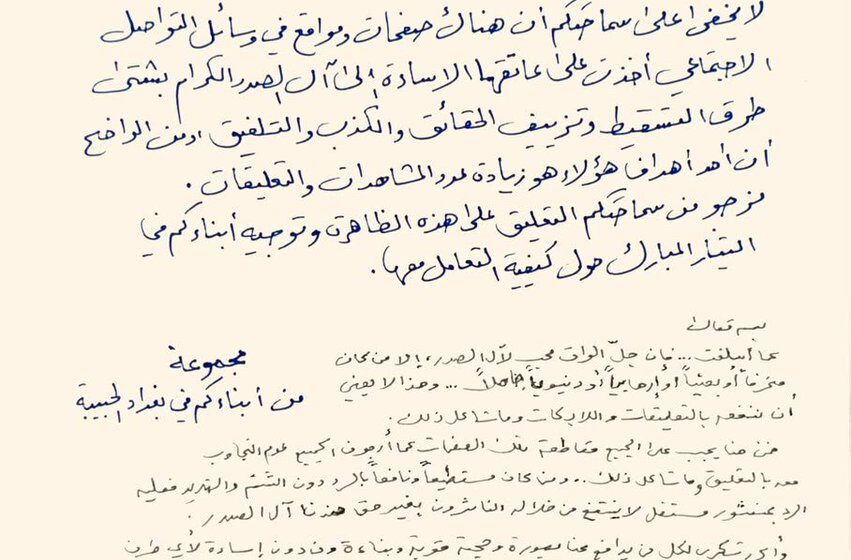
The most impactful post of the day came from Saleh Muhammad al-Iraqi (Post Impact: 100%), a page associated with Muqtada al-Sadr, which shared an image of a new statement. While the text of the statement itself is in the image, commentary from other users provides context. Shaho Al-Qaradaghi (Post Impact: 4%) quotes al-Sadr as saying, “All of Iraq loves us except for those who are deviant, Ba’athist, or a worldly ignorant person,” interpreting it as a response to those who have been attacking the al-Sadr family. The statement appears to categorize his opponents into specific groups, reinforcing a narrative of broad support among the Iraqi populace while dismissing criticism as coming from illegitimate sources.
2. Impact of Sanctions on Iranian Aviation
A major topic of discussion was the international flight ban against Iran and its repercussions for Iraq and the region. Rusly Al-Maliki (Post Impact: 24%) noted that the travel time from Baghdad to Tehran has increased from just over an hour by air to 12 hours by land, calling it a “major blow to the Iranian tourism sector which relies mainly on Iraqi tourists.” This account and others, including Ali Farhan (Post Impact: 7%) and Dr. Zaid Abdulwahab Al-Adhami (Post Impact: 6%), shared videos of Iranian flights being turned back from countries like Azerbaijan and the UAE canceling all flights from Iranian airlines. The conversation extended to Najaf airport, with Yasser Eljuboori (Post Impact: 10%) and Shaho Al-Qaradaghi (Post Impact: 8%) reporting a halt in air traffic between Najaf and Iran, a move questioned by those who cited earlier claims that flights would continue.
3. Praise for King Abdullah’s UN Speech
The speech by King Abdullah II bin Al-Hussein of Jordan at the United Nations garnered significant positive attention. Faig Al-Sheikh Ali (Post Impact: 63%) praised the King’s “lofty language, composed body language, and high self-confidence,” adding that he viewed the speech as a lesson in “politically refuting Israel’s theses and an alternative presence for Palestine.” Similarly, Dr. Zaid Abdulwahab Al-Adhami (Post Impact: 9%) described the address as “distinctive in content, language, and performance,” and classified it as a lecture in political science and conflict management theory. Both accounts lauded the King’s strong oratory skills and his effective advocacy on the international stage.
4. Video of Houthi Leader in Iraq Sparks Controversy
A video showing Houthi leader Mohammed Ayash Qahim in Iraq’s Muthanna province circulated widely, drawing criticism for his sectarian and aggressive remarks against Saudi Arabia. Othman Al-Mukhtar (Post Impact: 41%) shared the video, commenting that “After Iran’s decay… Iraq has turned into an incubator for the terrorists of the ‘Wilayat al-Faqih’ project, from which it finances them and supports their activities.” Ali Farhan (Post Impact: 36%) used the video to draw a hypothetical comparison, questioning the reaction if a Kurdish or Sunni minister were seen embracing a commander from a Turkish or Saudi-backed militia. While Shaho Al-Qaradaghi (Post Impact: 5%) pointed out the video is not new, the posts reflect a narrative of concern over foreign militia influence and sectarian rhetoric on Iraqi soil.
5. PM Al-Zaidi’s Meetings in the United States
The Iraqi Prime Minister’s visit to the United States and his meetings with American officials were a topic of discussion. Aayad Al Twfan (Post Impact: 30%) analyzed a photo from a meeting with former President Trump’s team, noting the presence of key officials from the State Department, intelligence, and the Federal Reserve, but suggesting that Trump’s envoy to Iraq, Tom Barrack, was excluded. The account speculates that Prime Minister Ali Al-Zaidi attended the meeting alone because the Americans had analyzed the backgrounds of the entire Iraqi delegation to prevent leaks. In a related post, Abu Maryam (Post Impact: 4%) shared a statement from Trump’s senior advisor, Massad Boulos, who confirmed “important discussions with Prime Minister Ali Al-Zaidi” and reiterated America’s commitment to working with its partners for regional stability.
6. Kata’ib Hezbollah’s Stance on Iran Sanctions
Iran-aligned factions publicly reacted to the sanctions imposed on Iran. Sabereen News (Post Impact: 15%) posted a statement from Kata’ib Hezbollah that posed a direct question to religious authorities: “What is the Sharia ruling on helping the enemies—in any way—to besiege and starve the faithful Iranian people?” Ahmad Abdulsada (Post Impact: 4%) shared the full text of the same statement, which frames the sanctions as an unjust siege reminiscent of the “plight of Muslims in the valley of Abi Talib.” The statement condemns the US and those who comply with its decisions, calling on Iraqis to break the siege by supporting Iranian products. The narrative positions compliance with sanctions as a betrayal and a violation of religious and brotherly duties.
7. US Advisor’s Comments on Kurdistan and Federalism
Comments made by US advisor Tom Barrack regarding the Kurdistan Region’s governance model and security forces were a point of discussion. Ahmed Al-Thawaq (Post Impact: 14%) highlighted Barrack’s criticism of the federal system, quoting him as telling Kurdish press, “Your federalism will not succeed and you are failures.” The post calls on Shia factions to capitalize on this shift in US policy to weaken the authority of Erbil and dismantle the “failed system.” Another account, Hayder (Post Impact: 9%), transcribed a Q&A where Barrack emphasized that a “single, unified military force for a sovereign state is essential,” suggesting that militias should be dissolved and their members integrated into state institutions, including the Peshmerga.
8. Withdrawal of Foreign Forces from Iraq
The planned withdrawal of US and Turkish forces from Iraq was a celebrated topic among some accounts. Dr. Hussein Al-Safi (Post Impact: 13%) hailed September 30 as a “day of national sovereignty” and credited the religious authority (Marja’iya) for the departure of US and Turkish forces, thanking both past and present Iraqi governments. The narrative of Iraqi sovereignty was further supported by news of a handover. Hayder (Post Impact: 8%) and Abu Maryam (Post Impact: 4%) both reported on the signing of an agreement between Iraq and the United States for the handover of the Victoria Base (Diplomatic Support Site) at Baghdad Airport to Iraqi forces.
9. Ammar al-Hakim’s Visit to Egypt
The meeting between Ammar al-Hakim, leader of the National Wisdom Movement, and Egyptian President Abdel Fattah El-Sisi was covered from opposing viewpoints. Ammar Al-Hakim (Post Impact: 17%) described the meeting as affirming the deep relations between the two countries, stating that he discussed Iraq’s post-coalition future, efforts to control unauthorized weapons, and regional de-escalation. However, the meeting was sharply criticized by Mustafa Salim (Post Impact: 6%), who called it an example of “peak absurdity,” describing al-Hakim as a “blatant model of corruption and betrayal.” This account argued the meeting serves personal deals rather than national interests and ultimately harms both Iraq and Egypt.
10. Image of Qasem Soleimani Displayed at the UN
The memory of the late Iranian General Qasem Soleimani was invoked during the UN General Assembly. Hayder (Post Impact: 14%) shared a video clip showing a photo of Soleimani being displayed on the Iranian delegation’s desk during Israeli Prime Minister Netanyahu’s speech. This act was presented as a defiant gesture against an adversary. Concurrently, another account, Abu Mzeal (Post Impact: 18%), posted an image of Soleimani with the caption, “The martyr Qasem Soleimani is more dangerous than General Qasem Soleimani,” suggesting that his legacy and martyrdom have a more potent and lasting impact than his physical presence did.