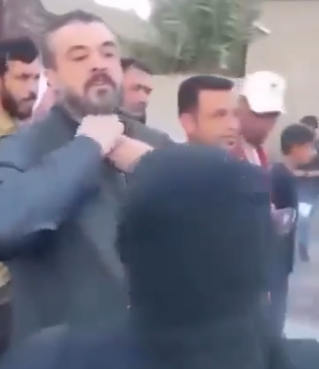
2025-10-28: Outrage Over Yazan Mashaan al-Jubouri’s Treatment of an Elderly Woman

Based on an analysis of 494 X / Twitter posts trending in Iraq on October 28, 2025, Miqrab AI identified several key narratives dominating online discourse. The most prominent story involves widespread social media outrage directed at politician Yazan Mashaan al-Jubouri for his treatment of an elderly woman seeking medical aid, sparking condemnation and offers of help from others. Another significant conversation revolves around the Iraqi judiciary, initially criticized for a death sentence issued to a Syrian national, which was later clarified as being for terrorism-related charges, not political expression. Additionally, controversial statements by political figure Iyad Jamal al-Din have ignited debates on sectarianism and regional politics, while discussions also covered the ongoing conflict in Sudan, condolences for former Prime Minister Haider al-Abadi, and domestic issues like government land allocations and upcoming elections.
Table Of Content
- 1. Outrage Over Yazan Mashaan al-Jubouri’s Treatment of an Elderly Woman
- 2. Debate Surrounding Death Sentence for a Syrian National
- 3. Controversy Over Iyad Jamal al-Din’s Political Statements
- 4. Former Prime Minister Haider al-Abadi Mourns His Mother
- 5. Commentary on Foreign Influence in Regional Conflicts in Sudan and Syria
- 6. Fight Breaks Out at Sunni Electoral Festival in Mosul
- 7. Sectarian Discourse on Political Demographics in Iraq
- 8. Government Announces Land Allocation for Higher Education Employees
- 9. Politician Aras Habib Criticized for Television Appearance
- 10. Faiq Al-Sheikh Ali Commemorates the Tishreen Revolution
Today’s Top 10 X (Twitter) Trends in Iraq:
1. Outrage Over Yazan Mashaan al-Jubouri’s Treatment of an Elderly Woman
Widespread condemnation has been directed at politician Yazan Mashaan al-Jubouri after a video circulated showing him mistreating and dismissing an elderly woman who was pleading for financial assistance for a brain tumor operation. Accounts like Yasser Eljuboori – ياسر الجبوري (Post Impact: 100%) strongly criticized al-Jubouri’s behavior as humiliating and lacking morals, stating, “Damn the poverty that makes an old woman beg from Yazan!!!!… It’s not your duty to give her money for the operation, but at the same time, it’s not your right to insult a woman in this way.” Other users, such as Hiba Alnnayib (Post Impact: 27%), shared the video calling him the “reckless son of Soleimani,” while Ali Farhan (Post Impact: 26%) suggested al-Jubouri’s refusal to help was because he was recently excluded from the elections. In response to the incident, Mahdi Majeed (Post Impact: 57%) shared contact information for a hospital in Belgium, offering to arrange free treatment for the woman through a humanitarian organization.
2. Debate Surrounding Death Sentence for a Syrian National
A significant debate erupted over news that a Syrian national was sentenced to death in Iraq, with initial reports claiming it was for possessing a picture of Syrian leader Ahmed al-Sharaa on his phone. Othman Al-Mokhtar (Post Impact: 68%) used the story to highlight what he calls a “terrifying prison file in Iraq,” citing past cases of wrongful executions due to torture and a sectarian judiciary. However, the narrative shifted after the Iraqi judiciary issued a clarification, which was shared by accounts like Haidar (Post Impact: 40%) and Yasser Eljuboori (Post Impact: 15%). The official statement clarified that the sentence was for glorifying the deceased ISIS leader Abu Bakr al-Baghdadi, encouraging the killing of Iraqi army and PMF personnel, and burning a picture of Imam Ali to incite sedition. Following the clarification, Issam Hussein (Post Impact: 15%) criticized those who defended the Syrian man, accusing them of hypocrisy for rejecting the state’s judiciary while claiming to want a state of law.
3. Controversy Over Iyad Jamal al-Din’s Political Statements
Cleric and politician Iyad Jamal al-Din has become a focal point of a heated online debate following his recent statements. Rusly Al-Maliki (Post Impact: 62%) labeled him a “terrorist” for suggesting that the Baghdad authorities should treat Iraqi Sunnis the way Syrian leader al-Jolani treats Alawites and Druze. Conversely, other users came to his defense. Ahmed Al-Thawaq (Post Impact: 56%) called for al-Din’s return to Iraq, describing him as a brave man who was not tempted by money or palaces. Ahmed Al-Thawaq (Post Impact: 33%) also supported the idea of applying “al-Jolani’s rule” in Iraq for Shiites. In another post shared by Shaho Al-Qaradaghi (Post Impact: 30%), al-Din is shown stating that Iran is a primary obstacle to reconstruction in Iraq and that it established militias and supported al-Qaeda to hinder the country’s development.
4. Former Prime Minister Haider al-Abadi Mourns His Mother
Former Iraqi Prime Minister Haider Al-Abadi (Post Impact: 70%) announced the passing and burial of his mother in a heartfelt post. He bid farewell to her, describing her as a “pure soul,” a “righteous mother,” and the “mother of martyrs,” stating that the time for her reunion with them has come. He shared a prayer for her, asking God to unite her with Prophet Muhammad and his family. The post, which concluded with “To God we belong and to Him we shall return,” garnered significant engagement as followers offered their condolences.
5. Commentary on Foreign Influence in Regional Conflicts in Sudan and Syria
Users are drawing parallels between the conflicts in Sudan and Syria, blaming external actors, particularly Gulf states and Israel, for fueling instability. Issam Hussein (Post Impact: 67%) argues that “Gulf money” was responsible for bringing both “women-thief al-Jolani” to power in Syria and “livestock-thief Hemedti” to power in Sudan, with Zionist support as another common factor. He points to the ongoing atrocities in El Fasher, Sudan, committed by Hemedti’s gangs, which he claims are backed by the UAE, and states the same destructive scenario funded by the same money is repeating itself from Syria to Iraq and now Sudan. Similarly, Liqaa Maki (Post Impact: 45%) views the events in Sudan as the beginning of another division of the country, blaming the former Bashir regime for creating and legitimizing the Rapid Support Forces (RSF), which now control the country’s west and its gold wealth.
6. Fight Breaks Out at Sunni Electoral Festival in Mosul
A video showing a violent brawl at an electoral festival for a Sunni political party in Mosul has been circulating on social media. According to Salam Al-Husseini (Post Impact: 57%), the fight was not from a prehistoric era but from a recent event, and it allegedly started due to a dispute over a piece of meat on a serving tray. The post uses the video to comment on the state of political events and criticizes the behavior shown, including the hashtag #لاتضيعوها (Don’t waste it), seemingly referring to the electoral opportunity.
7. Sectarian Discourse on Political Demographics in Iraq
A post by Issam Hussein (Post Impact: 52%) challenges the description of Sunnis as a “main component” of Iraq, arguing that the primary component is the Shiites due to their status as the absolute majority politically, socially, and ideologically. He positions Sunnis as the third component after the Kurds. Hussein expresses surprise at the negative reaction to his post, stating that followers of “Najdi religion” openly praise the “Syrian experience” under al-Jolani as a successful model of governance. He suggests that if this model, where the majority rules completely, were to be applied in Iraq, it would result in a “100% Shiite rule,” though he adds they would not treat minorities the same way al-Jolani’s supporters treat Alawites, Druze, and Shiites.
8. Government Announces Land Allocation for Higher Education Employees
The Minister of Higher Education and Scientific Research, Naeem Al-Aboudi (Post Impact: 47%), announced the allocation of residential land plots for the staff of his ministry, its universities, and the Iraqi Atomic Energy Commission in Baghdad. He described the decision as the fulfillment of a promise to provide “dignified housing” for those in the higher education sector, calling it a dream that has become a reality after a “journey of patience, persistence, and work.” Mahmoud Al-Rubaie (Post Impact: 23%) praised the minister for the move, celebrating that he had turned the “dream into a reality.”
9. Politician Aras Habib Criticized for Television Appearance
Politician Aras Habib is facing criticism following a television interview where his behavior was described as erratic and possibly intoxicated. Rusly Al-Maliki (Post Impact: 51%) posted a clip of the interview, mockingly telling Habib, “Aras you drink… and you drink a lot sometimes… your stomach is ruined from drinking.” Bahaa Khaleel (Post Impact: 21%) sarcastically advised program hosts to use a breathalyzer on guests before they go on air to avoid embarrassment. Similarly, Mulla Aboud Al-Karkhi (Post Impact: 26%) described the interview as filled with nonsensical talk from a drunken Habib and mocked his claim to represent Shiites.
10. Faiq Al-Sheikh Ali Commemorates the Tishreen Revolution
Politician Faiq Al-Sheikh Ali (Post Impact: 31%) posted a series of tweets commemorating the Tishreen (October) Revolution, describing himself as a “soldier” in its cause. He claims the revolution terrified the ruling regime, militias, and Iran, leading Khamenei to issue a secret fatwa to “slaughter Tishreen and its leaders.” In other posts, he lauds the uprising as the “greatest revolution in Iraq’s history,” arguing it was unique because it was a popular movement, primarily by Shiites, against Shiite rulers and a Shiite occupier (Faiq Al-Sheikh Ali, (Post Impact: 27%)). He also praises it as a pure, clean, and honest movement that was not tainted by “dirty politicians” and highlights the voluntary participation of people from all households from Baghdad to Basra (Faiq Al-Sheikh Ali, (Post Impact: 28%)).