2025-11-13: Shia Factions Celebrate Parliamentary Election Victories

Based on an analysis of 559 X / Twitter posts trending in Iraq on November 13, 2025, conducted by Miqrab AI, the primary online conversation revolves around the results and immediate aftermath of the country’s sixth parliamentary elections. The dominant narratives include celebrations of victory by prominent Shia political blocs, particularly the Sadiqun Movement and the State of Law Coalition, alongside widespread public criticism and disappointment directed at voters for returning controversial figures to power. Discussions are also heavily focused on the impending government formation process, with significant speculation about Nouri al-Maliki’s potential return to a powerful position. Other key themes include the sectarian breakdown of the new parliament, the perceived failure of candidates from the Tishreen protest movement, outrage over the desecration of the Iraqi flag in the Kurdistan region, and analyses of notable winners and losers in the electoral contest.
Table Of Content
- 1. Shia Factions Celebrate Parliamentary Election Victories
- 2. Public Backlash and Criticism of Voters for Election Results
- 3. Speculation on Government Formation and Nouri al-Maliki’s Key Role
- 4. Analysis of Election Results Along Sectarian Lines
- 5. Outrage Over Desecration of Iraqi Flag in Kurdistan Region
- 6. Failure of Tishreen and Independent Candidates Discussed
- 7. Amer Abdul Jabbar’s Victory Praised as a Positive Outcome
- 8. Reports on Notable Figures Who Lost Their Seats
- 9. Analysis of Sunni Political Landscape and Voter Behavior
- 10. Predictions for Iraq’s Political Future and Government
Today’s Top 10 X (Twitter) Trends in Iraq:
1. Shia Factions Celebrate Parliamentary Election Victories
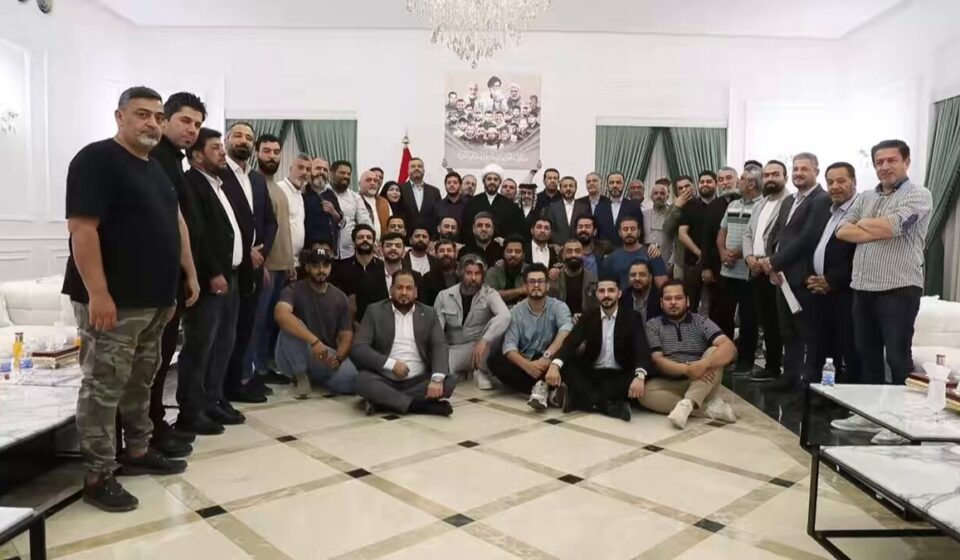
Leaders of prominent Shia political factions took to X to celebrate their success in the parliamentary elections. Qais al-Khazali (Post Impact: 100%), the leader of Asa’ib Ahl al-Haq, congratulated his Sadiqun Movement on what he called a “great achievement in the sixth parliamentary elections.” Similarly, Ammar Al-Hakim (Post Impact: 33%) announced that he had exchanged congratulations with Sheikh al-Khazali, and they both stressed the need to form a government quickly and translate electoral promises into service programs. Mohsen Al-Mandalawi (Post Impact: 7%) posted about his meeting with State of Law coalition leader Nouri al-Maliki, where they also exchanged congratulations and affirmed that the wide participation reflected the people’s belief in democracy. Naim Al-Aboudi (Post Impact: 20%) commented on the high voter awareness and participation, viewing it as a decision by the Iraqi people to monitor the performance of their elected representatives.
2. Public Backlash and Criticism of Voters for Election Results
A significant counter-narrative emerged, criticizing the electorate for the election’s outcome, particularly for voting for established figures like Nouri al-Maliki and Hadi al-Amiri. Rusly Al-Maliki (Post Impact: 57%) posted a photo of a dilapidated city with the caption, “This city… elected Hadi al-Amiri and Nouri al-Maliki… Yes, this one.” In a similar vein, Bahaa khaleel (Post Impact: 52%) shared an image of a child laborer, directly addressing voters with the question, “You who gave your vote to al-Maliki, did the image of this child not come before you?” Othman Al-Mokhtar (Post Impact: 18%) lamented that the problem lies not with politicians but with Iraqi society itself, stating that voters in various provinces re-elected militias and individuals responsible for their suffering, concluding that “a backward and ignorant people allows thieves, criminals, and scoundrels to grow, remain, and endure.”
3. Speculation on Government Formation and Nouri al-Maliki’s Key Role
Following the election results, many users focused on the future political landscape, especially the prominent role Nouri al-Maliki is expected to play. Accounts like Ashouri (Post Impact: 23%) pointed out the “strongest surprise” that al-Maliki will preside over the first session of parliament as the eldest member. Dr. Qusay Shafiq (Post Impact: 17%) elaborated on this, explaining that al-Maliki would manage the session until a speaker is elected and that he would use this position to ensure the Coordination Framework’s candidate for prime minister is approved. Abbas Al-Ardawi (Post Impact: 16%) described al-Maliki as the “hard number in the political process” and the strongest candidate for prime minister, citing a supposed high-level consensus on his return due to the challenges facing Iraq. Haidar (Post Impact: 11%) shared a quote from Iyad Jamal al-Din, who claimed that al-Maliki would sideline Mohammed Shaya al-Sudani just as he did to previous rivals.
4. Analysis of Election Results Along Sectarian Lines
Several accounts analyzed the election results through a sectarian lens, emphasizing the dominance of the Shia component in the new parliament. Emad Al Musafir (Post Impact: 33%) declared, “In the end, we are the largest component, whether some like it or not,” adding that other components should know their “true size.” Dr. Hussein Al-Safi (Post Impact: 29%) provided a numerical breakdown, stating that Shia representatives secured 197 seats, compared to 67 for Sunnis and 56 for Kurds. Similarly, Essam Hussein (Post Impact: 20%) argued that for Shia control over political decisions to be complete, the Ministry of Foreign Affairs must be held by a Shia figure in the next government, framing it as a necessity to ensure Iraq’s foreign policy aligns with the majority’s vision.
5. Outrage Over Desecration of Iraqi Flag in Kurdistan Region
A video circulating on X showing the Iraqi flag being placed under car tires and disrespected sparked outrage among users, who condemned the act and called for accountability. Tamara Alkhazraji (Post Impact: 21%) expressed her disgust, saying, “What a shame… a masked person who isn’t worth a shoe puts it under cars!” and called for the perpetrator to be imprisoned for life. Yasser Eljuboori (Post Impact: 17%) described the insult to the flag as “an unforgivable crime” and stated, “We await real accountability from the authorities in the region.” Haidar (Post Impact: 18%) compared the lack of respect for the Iraqi flag in the region to what he described as Kurdish deference to Turkey and Iran, arguing that some groups only respect those who treat them harshly.
6. Failure of Tishreen and Independent Candidates Discussed
The electoral losses of candidates associated with the Tishreen protest movement and other independents were a major topic of discussion. Salam Al-Husseini (Post Impact: 22%) wrote a detailed post recounting how Tishreen-affiliated MPs from the 2021 election sided with the Coordination Framework to change the election law to the “Saint-Laguë” system, which ultimately led to them being “slaughtered electorally.” Al-Shabandar (Post Impact: 20%) claimed that the loss of Tishreen parties proved that “Tishreen was not a people’s revolution as we believed,” but rather a temporary media-driven sentiment. Rusly Al-Maliki (Post Impact: 20%) offered a different perspective, arguing that Tishreen as a movement “rewards and punishes” based on loyalty, citing the losses of former MPs like Nour Nafi al-Jalihawi and Nisan Zayer after they aligned with the government and Nouri al-Maliki, respectively.
7. Amer Abdul Jabbar’s Victory Praised as a Positive Outcome
Amid general disappointment with the election results, the victory of candidate Amer Abdul Jabbar was highlighted as a rare positive development. Bahaa khaleel (Post Impact: 27%) called his win “the only good thing in these elections.” This sentiment was echoed by Ali Farhan (Post Impact: 21%), who shared a post stating that Abdul Jabbar won over 28,000 votes while his campaign cost only 1.15 million Iraqi dinars (approximately $800). Haidar (Post Impact: 14%) also shared Abdul Jabbar’s statement about his low-cost campaign, framing it as a notable success against politically funded competitors.
8. Reports on Notable Figures Who Lost Their Seats
Several prominent political figures failed to win seats in the new parliament, a fact widely reported and commented on by X users. Ali Al-Khalidi (Post Impact: 22%) announced that politician Aras Habib was “out of the electoral race.” In other posts, he reported on the losses of former Parliament Speaker Mahmoud al-Mashhadani and Minister of Migration Evan Faeq Jabro (Ali Al-Khalidi (Post Impact: 16%)), as well as Sara Ayad Allawi, daughter of the former Prime Minister (Ali Al-Khalidi (Post Impact: 17%)). Yasser Eljuboori (Post Impact: 8%) also commented on the results, expressing schadenfreude over the losses of al-Mashhadani and others, stating they were “expired.”
9. Analysis of Sunni Political Landscape and Voter Behavior
The electoral dynamics within the Sunni community were a subject of analysis, with some commentators interpreting the results as a strategic choice by Sunni voters. Ahmed Al-Thawaq (Post Impact: 21%) argued that the “honorable Sunni majority” punished Khamis al-Khanjar and supported Mohammed al-Halbousi and Muthanna al-Samarrai, viewing it as a move against Barzani’s influence in Sunni areas. He called on Shia to ease their rhetoric towards this Sunni majority to help them “return Nineveh from Barzani’s grip.” Meanwhile, Mustafa Al-Dulaimi (Post Impact: 9%) called on all Sunni political forces to unite and agree on a candidate for parliament speaker and a unified set of demands, including the return of displaced persons and the resolution of the missing persons file, before negotiating with other blocs.
10. Predictions for Iraq’s Political Future and Government
Analysts and commentators shared their predictions for the upcoming political phase in Iraq. Ahmad Abdulsada (Post Impact: 18%) offered a detailed forecast, predicting that the Coordination Framework would form the next government without Prime Minister al-Sudani, that Mohammed al-Halbousi would return as Parliament Speaker, and that al-Sudani could face legal challenges threatening his political future. Rafid Jaboori (Post Impact: 25%) made a cynical prediction that “militias will appoint a prime minister who will pledge to dissolve the militias.” Adding to the pessimistic outlook, Dr. Ihssan Al-Shammari (Post Impact: 25%) stated simply that “reconstruction and development will be the biggest losers.”