2025-12-26: Iraqi Leaders Condemn Homs Mosque Bombing

Miqrab AI’s analysis of 386 X / Twitter posts trending in Iraq on December 26, 2025, reveals a landscape dominated by reactions to regional violence, sharp domestic political criticism, and ongoing geopolitical maneuvering. The most significant event driving conversation was the deadly bombing of a mosque in Homs, Syria, which drew swift condemnation from top Iraqi Shiite political and religious leaders who warned of renewed sectarian conflict. Domestically, prominent commentators launched critiques against the government’s economic policies, its failure to reform the currency, and the persistent influence of Iran over Iraqi affairs. The opaque process of selecting a new prime minister fueled speculation and cynicism about backroom deals among the political elite. At the same time, discussions resurfaced around historical grievances, including the killing of a controversial militia member in Basra and a widely condemned television interview with the man who informed on Saddam Hussein’s sons.
Table Of Content
- 1. Iraqi Leaders Condemn Homs Mosque Bombing
- 2. Faig Al-Sheikh Ali Criticizes Government and Iran
- 3. Controversy Surrounds Qais al-Khazali’s Christmas Visit
- 4. Backlash Over Nawaf al-Zaydan’s TV Interview
- 5. Speculation on Iraq’s Next Prime Minister
- 6. Killing of Militiaman Ahmed Twaisa Sparks Debate
- 7. Concerns Over Iraq’s Economic Policies and Stability
- 8. Shifting Alliances and Tensions in the Middle East
- 9. Plight of Iraqi Christians and Property Seizures
- 10. Iranian Ambassador Praises Funds from Iraq
Today’s Top 10 X (Twitter) Trends in Iraq:
1. Iraqi Leaders Condemn Homs Mosque Bombing
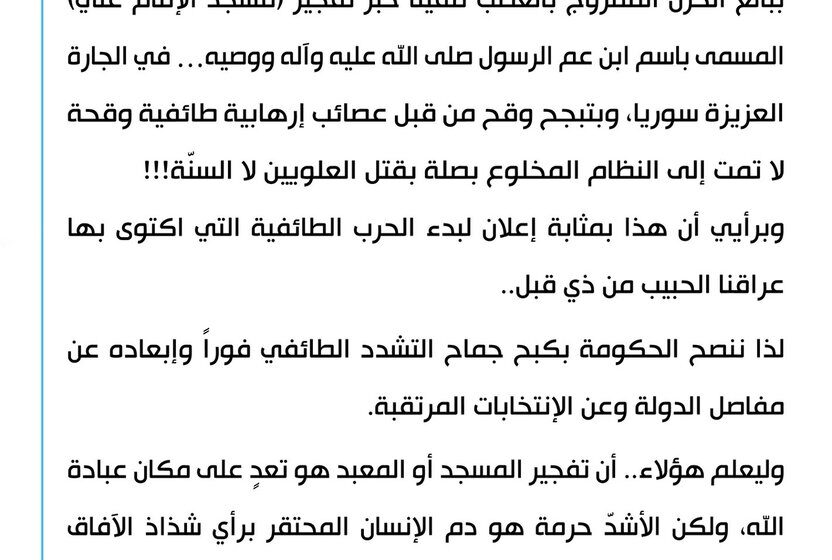
The suicide bombing at the Imam Ali mosque in Homs, Syria, during Friday prayers was the most dominant topic, with accounts like Hayder (Post Impact: 10%) reporting on the attack and rising casualty numbers. Prominent Shiite political leaders issued swift condemnations. Muqtada al-Sadr (Post Impact: 100%) released a statement expressing sorrow and anger, warning that the attack could be “an announcement of the beginning of the sectarian war that our beloved Iraq was afflicted with before,” and urging the government to curb sectarian extremism. Similarly, Qais al-Khazali (Post Impact: 39%) condemned the “treacherous suicide bombing” and blamed extremist groups. Ammar Al-Hakim (Post Impact: 8%) also condemned the attack and called on Syrian authorities to protect all components of its society.
2. Faig Al-Sheikh Ali Criticizes Government and Iran
Politician Faig Al-Sheikh Ali was a prominent voice of criticism across several highly engaged posts. In one, Faig Al-Sheikh Ali/My Word for History (Post Impact: 20%) contrasted Syrian President Ahmed al-Sharaa’s swift removal of two zeros from the Syrian Lira with Iraq’s 22-year failure to remove three zeros from its currency, attributing the inaction to officials claiming it is “extremely difficult in accounts and records.” In another post, Faig Al-Sheikh Ali/My Word for History (Post Impact: 16%) fiercely condemned Iraqis of foreign origin who defend Iran’s policies against Iraq, calling them “despicable, base, dirty, and cursed in this world and the next.” He also dismissed recent media talk of an imminent Iranian missile strike on Israel as “pure nonsense and rubbish,” predicting it would lead to the end of the Iranian regime if attempted.
3. Controversy Surrounds Qais al-Khazali’s Christmas Visit
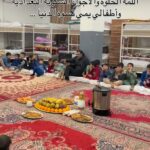
A visit by Qais al-Khazali, leader of the Asa’ib Ahl al-Haq militia, to a Christian family for Christmas generated significant controversy and criticism. While an image of the visit was shared alongside his statement on the Homs bombing, commentators viewed the gesture with deep suspicion. Othman Al-Mukhtar (Post Impact: 6%) described the visit as “a spectacle and pandering to the American administration,” alleging that al-Khazali’s militia had seized the Baghdad office of a Christian family who now lives in Sweden. Other users like Hassan Basketball – HASSAN AL HAMMADI (Post Impact: 4%) and Tamara Alkhazraji (Post Impact: 4%) shared the photo with mocking captions, implying the visit was a disingenuous public relations stunt.
4. Backlash Over Nawaf al-Zaydan’s TV Interview
An interview with Nawaf al-Zaydan, the man who informed U.S. forces of the location of Saddam Hussein’s sons Uday and Qusay, prompted widespread condemnation. Commentators focused on the betrayal of trust. Bahaa Khalil Bahaa khaleel (Post Impact: 7%) stated that “in our Arab and Muslim customs, handing over a person seeking refuge is considered a disgrace,” criticizing al-Zaydan for admitting to the act. Hiba Al-Naib HIBA Alnnayib (Post Impact: 5%) reported that al-Zaydan’s own tribe, Al-Bu Ali Al-Kanaan, had disowned him following his confession. Mulla Aboud Al-Karkhi (Post Impact: 3%) called the interview “disgusting” and questioned why a program like “The Black Box” would host someone known for being an informant.
5. Speculation on Iraq’s Next Prime Minister
The process of forming a new government and selecting a prime minister was a topic of cryptic posts and speculation. Hussam Alhaj (Post Impact: 13%) posted a short story about a candidate who was officially told, “Do not run and present an alternative for yourself. You have no chance to win the position.” Adding to the sense of uncertainty, Dr. Qusay Shafiq (Post Impact: 4%) claimed that the next prime minister would be someone outside the nine candidates nominated by the Coordination Framework. Meanwhile, Ahmed Al-Thawaq (Post Impact: 2%) announced an upcoming “exceptional meeting” of the Coordination Framework to make the selection, indicating imminent political developments.
6. Killing of Militiaman Ahmed Twaisa Sparks Debate
The recent killing of militia member Ahmed Twaisa in Basra sparked discussion linking his death to past sectarian violence. Aayad Al-Twfan (Post Impact: 9%) shared a photo of Twaisa posing with barrel bombs, which the post claims were called “chocolates” and were dropped on Fallujah, killing civilians. The account questioned his authority to use Iraqi army aircraft, stating, “By what authority does this militiaman use Iraqi army planes? Who allowed him to do so and by whose order?” Another user, Adam (Post Impact: 2%), mocked the lack of retaliation for Twaisa’s death, comparing it to the unavenged killing of Abu Mahdi al-Muhandis and questioning what his faction stands for.
7. Concerns Over Iraq’s Economic Policies and Stability
Several accounts voiced concerns over the Iraqi government’s economic management and its impact on citizens. Rusly Al-Maliki (Post Impact: 6%) accused the Ministry of Planning of deception for setting the poverty line at a monthly income of 185,000 dinars (about $120), arguing this artificially lowers the poverty rate. Hayder (Post Impact: 3%) summarized a U.S. report stating that Prime Minister al-Sudani’s government has added nearly 700,000 new employees to the public payroll, pushing the break-even oil price to $90 per barrel. Muna Sami (Post Impact: 3%) sarcastically noted that the government securing salaries is now treated as “news,” implying that its ability to cover basic commitments is precarious.
8. Shifting Alliances and Tensions in the Middle East
Users commented on several regional developments, suggesting a period of significant geopolitical realignment. Liqaa Maki (Post Impact: 7%) observed that alliances in the region are on the verge of a “deep change,” attributing this primarily to Israel’s aggressive actions. Specific events highlighted this trend, including a report from Sufian Al-Samarrai (Post Impact: 8%) that Israel had officially recognized Somaliland as an independent state. In another theater, Hayder (Post Impact: 7%) reported an escalating crisis in Yemen, where Saudi aircraft allegedly launched strikes on UAE-backed militias after they seized positions from Saudi-backed forces.
9. Plight of Iraqi Christians and Property Seizures
The situation of Iraq’s Christian community was highlighted through discussions about property confiscation and international politics. Dr. Zaid Abdulwahab Al-Adhamy (Post Impact: 3%) cited a Baghdad Provincial Council member, Mohammed Al-Rubaie, who claimed that 70% of Christian homes in Baghdad have been seized by influential parties through forgery in property registration offices. This domestic issue was connected to international statements when Muna Sami (Post Impact: 5%) responded to Israeli Prime Minister Netanyahu’s accusation that Iraq persecutes Christians. She countered by pointing to Israel’s bombing of churches in Gaza and the killing and displacement of Palestinian Christians, calling it a case of “the killer protecting minorities.”
10. Iranian Ambassador Praises Funds from Iraq
Comments made by the Iranian ambassador to Iraq about financial relations between the two countries drew critical attention. Yasser Eljuboori (Post Impact: 4%) posted a clip of the ambassador, Al-Sadiq, stating that “in Mr. Al-Sudani’s government, we obtained a larger amount of our money that we were not able to obtain from all previous governments.” This statement was interpreted negatively by other commentators. Dr. Ghalib Al-Da’amy (Post Impact: 2%) viewed the statement as a negative reflection on Prime Minister Al-Sudani. Similarly, Omar Abdul Sattar Mahmoud (Post Impact: 1%) highlighted the ambassador’s acknowledgment of Iraq’s significant role in reviving Iran’s economy amid U.S. sanctions.