2026-01-16: Sadrist Movement Opens ‘Guest House’ in Washington D.C.

Based on Miqrab AI’s analysis of 601 X / Twitter posts trending in Iraq on January 16, 2026, the primary narratives were dominated by the Sadrist Movement’s establishment of a “guest house” in Washington D.C., which was presented as a humanitarian and political message to the United States. Widespread condolences from across the political spectrum followed the death of Ayatollah Hadi al-Sistani, the brother of Grand Ayatollah Ali al-Sistani. A significant portion of the conversation revolved around escalating US-Iran tensions, with extensive debate over a potential US military strike, its postponement, and the potential for the Iranian government’s collapse. This was met with counter-narratives expressing solidarity with Iran. Other prominent themes included criticism of neighboring countries, discussions on Iraqi national identity, and commentary on domestic governance and corruption.
Table Of Content
- 1. Sadrist Movement Opens ‘Guest House’ in Washington D.C.
- 2. Iraqi Leaders Mourn Death of Ayatollah Hadi al-Sistani
- 3. Debate Over Potential US Military Strike on Iran
- 4. Speculation on the Fall of the Iranian Regime
- 5. Show of Iraqi Solidarity with the Iranian Government
- 6. Criticism of Neighbors and Calls for Iraqi Unity
- 7. Donald Trump’s Public Statements on the Iran Crisis
- 8. Circulation of Foreign Media and Intelligence Reports
- 9. Discussions on Iraqi Governance and Corruption
- 10. Controversial Statements by Analyst Amir Mousawi
Today’s Top 10 X (Twitter) Trends in Iraq:
1. Sadrist Movement Opens ‘Guest House’ in Washington D.C.
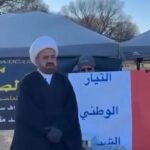
The most prominent story involved the Sadrist Movement, led by Muqtada al-Sadr (Post Impact: 100%), opening a “Mudhif Al-Sadr” (guest house) in Washington D.C. near the White House. Saleh Mohammed al-Iraqi (Post Impact: 57%), a close aide to al-Sadr, outlined ten messages behind this move, stating it shows Sadrist projects are not limited by time or place and that it serves as a humane response to Washington’s perceived hostility. He emphasized, “You are present in Iraq, and we are present near the White House with a humanitarian campaign.” Other figures like Qais al-Khazali (Post Impact: 65%) and accounts such as Haidar (Post Impact: 7%) also shared images and videos of the guest house, highlighting its symbolic location and purpose.
2. Iraqi Leaders Mourn Death of Ayatollah Hadi al-Sistani
The death of Ayatollah Hadi al-Sistani, brother of Grand Ayatollah Ali al-Sistani, prompted a wave of condolences from top Iraqi and Kurdish officials. Prime Minister Mohammed Shia’ al-Sudani (Post Impact: 29%) offered his deepest sympathies, praising the deceased for a life spent in research, teaching, and service to knowledge. Similarly, Kurdistan Region President Nechirvan Barzani (Post Impact: 15%) expressed his condolences to the Sistani family. The news was widely shared by figures like Ammar al-Hakim (Post Impact: 7%) and news-focused accounts like Haidar (Post Impact: 14%), all noting the significant loss to the religious and scholarly community.
3. Debate Over Potential US Military Strike on Iran
Tensions between the United States and Iran were a central topic, with numerous accounts discussing a potential US military attack and its apparent postponement. Dr. Hussein Al-Safi (Post Impact: 7%) provided a political analysis suggesting the strike was delayed for technical reasons, including securing targets and the loss of intelligence due to internet blackouts in Iran, but asserted that the strike is still likely. Dr. Ali Al-Jabiri (Post Impact: 8%) argued that the delay was tactical to achieve surprise and complete US and Israeli preparations. Others, such as Omar Abdulsatar (Post Impact: 8%) and Raad Hashim (Post Impact: 4%), shared content reinforcing the idea that the attack was postponed, not canceled.
4. Speculation on the Fall of the Iranian Regime
Concurrent with discussions of a US strike, many accounts speculated on the potential collapse of the Iranian government and its regional repercussions. Rusly Al-Maliki (Post Impact: 18%) repeatedly questioned what would happen to Iran’s allies in Iraq after the fall of Khamenei, asking, “Where will you go? And all of Iraq has a score to settle with you!?” Al-Maliki also shared a CNN report alleging that 5,000 Iraqi militiamen crossed into Iran to help suppress protests, warning them they would be hunted by the US later. Sufian Al-Samarrai (Post Impact: 8%) echoed this claim, stating US intelligence had information on these militias participating in what he called “the biggest massacres” in the region.
5. Show of Iraqi Solidarity with the Iranian Government
In response to the protests in Iran and the threat of US action, a counter-narrative of solidarity emerged. Sabereen News (Post Impact: 5%) called for a supportive rally for the “steadfast Iranian people” in front of the Iranian embassy in Baghdad. Ahmad Abdulsada (Post Impact: 5%) posted photos from the rally, describing solidarity with Iran as solidarity with the “fortress of dignity.” Amir Mousawi (Post Impact: 8%) used hashtags like #Iraq_and_Iran_cannot_be_separated to express support. Dr. Hussein Al-Safi (Post Impact: 9%) expressed confidence that the “cultured Iranian people” would not be a “toy in America’s hands.”
6. Criticism of Neighbors and Calls for Iraqi Unity
A theme of discontent with neighboring countries and internal Iraqi identity was prominent. Mustafa Al-Dulaimi (Post Impact: 25%) heavily criticized a “bad neighbor,” contrasting them with Gulf countries like Qatar and the UAE from whom he claims to have never heard insults. He accused this neighbor of exploiting “naive” people with slogans of Arabism. This sentiment was linked to internal dynamics by Haidar (Post Impact: 11%), who stated, “Neither the Sunnis have a homeland other than Iraq, nor do the Shiites have support and backing other than Iraq,” urging Iraqis to learn from past lessons. Zainab Al-Ghanem (Post Impact: 8%) commented on what she described as despair among Iraqi Sunnis after Arab nations appeared to align with Iran.
7. Donald Trump’s Public Statements on the Iran Crisis
Statements from former US President Donald Trump regarding the Iran crisis were widely circulated and analyzed. Zaid Benjamin (Post Impact: 4%) posted a direct quote from Trump stating, “No one convinced me not to strike Iran, I convinced myself.” Haidar (Post Impact: 8%) shared the same statement. Separately, Rafid Jaboori (Post Impact: 8%) noted Trump’s seemingly contradictory messages, pointing out that he also thanked the “Iranian leadership” for halting executions, promising to analyze the conflicting signals.
8. Circulation of Foreign Media and Intelligence Reports
Iraqi social media accounts actively shared and commented on reports from international media outlets concerning the situation in Iran and the region. Rusly Al-Maliki (Post Impact: 11%) cited a CNN report alleging that 5,000 Iraqi militiamen entered Iran to suppress protests. Mujtahid Al-Iraq (Post Impact: 9%) shared a report from Fox News claiming a massive US military mobilization towards the Middle East aimed at achieving objectives agreed upon with Israel and Iranian opposition forces. Zaid Benjamin (Post Impact: 4%) provided a lengthy translation of a Wall Street Journal article detailing the violent crackdown on Iranian protesters that occurred during an internet blackout.
9. Discussions on Iraqi Governance and Corruption
Several posts addressed issues of domestic governance, political maneuvering, and corruption. Dr. Zaid Abdulwahab Al-A’adhami (Post Impact: 8%) highlighted a claim by economist Dr. Nabil Al-Marsoumi that an Iraqi oil field was invested in by a “Ukrainian hairdresser.” Dr. Ghalib Al-Da’ami (Post Impact: 7%) questioned government priorities, asking whether it was better to cut university service allowances or eliminate dual salaries for officials. Meanwhile, Hussam Alhaj (Post Impact: 6%) criticized the Coordination Framework for its lack of consistent standards in political dealings, accusing it of applying principles selectively.
10. Controversial Statements by Analyst Amir Mousawi
Statements made by political analyst Amir Mousawi generated considerable discussion. Shaho Al-Qaradaghi (Post Impact: 13%) shared a quote attributed to Mousawi in which he claims, “Saddam Hussein was not Iraqi but rather a British spy whose goal was to destroy the Iraqis.” In a separate post, Wasn Al-Sheikhli (Post Impact: 7%) shared a video clip where Mousawi responds to a question about whether he hated Iraq after his family was deported, framing it as a “strong response.” These posts highlighted Mousawi’s contentious views on Iraqi history and identity.