2025-09-30: Rival Shia Leaders Showcase Public Support

An analysis of 532 X / Twitter posts trending in Iraq on September 30, 2025, by Miqrab AI reveals a landscape dominated by intense political and religious polarization. The most prominent narratives involved visual displays of power by rival Shia leaders, a severe controversy sparked by politician Faig al-Sheikh Ali’s inflammatory remarks against Grand Ayatollah Ali al-Sistani, and widespread backlash against his statements. Concurrently, discussions were rife with speculation about escalating regional tensions, focusing on potential US military action against Iran, the repositioning of American forces in Iraq, and varied reactions to Donald Trump’s proposed plan for the Gaza conflict. Internal Iraqi politics were also a key focus, with coverage of condolences for Ayatollah Sistani’s late wife, an order from Muqtada al-Sadr for his followers to stand down, and criticism directed at the conduct of militia leaders.
Table Of Content
- 1. Rival Shia Leaders Showcase Public Support
- 2. Faig al-Sheikh Ali’s Attacks on Sistani Incite Backlash
- 3. Speculation on Regional War and US Military Moves
- 4. Criticism Directed at Militia Leader Qais al-Khazali
- 5. Varied Reactions to Donald Trump’s Gaza Peace Plan
- 6. Condolences for Ayatollah Sistani’s Late Wife
- 7. Muqtada al-Sadr Orders Followers to Cease Protests
- 8. Accounts Discuss Iran’s Shifting Foreign and Military Strategy
- 9. Protesters with Disabilities Expel Politician in Najaf
- 10. Sufian al-Samarrai Highlights Anti-Immigrant Sentiment Abroad
Today’s Top 10 X (Twitter) Trends in Iraq:
1. Rival Shia Leaders Showcase Public Support
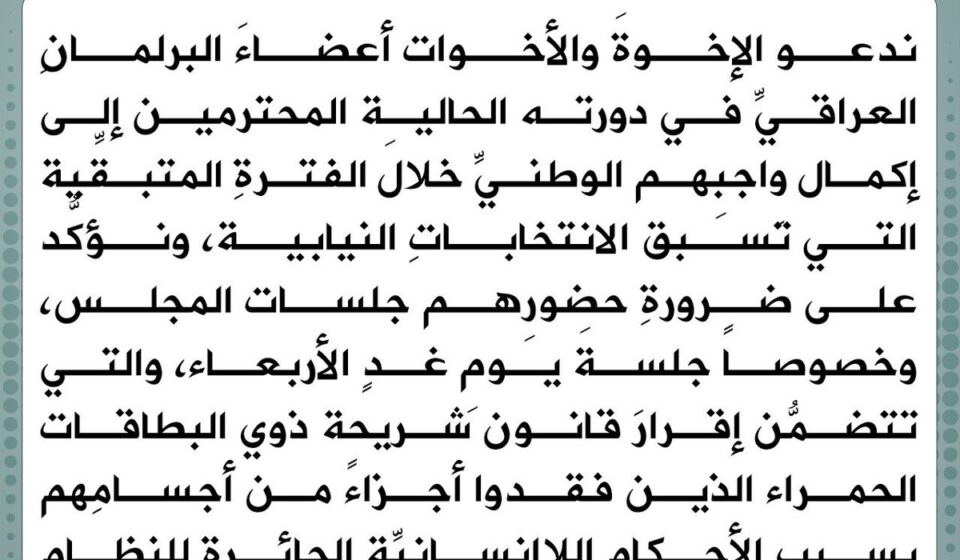
The most impactful posts of the day came from two of Iraq’s most prominent rival Shia leaders, who shared images of massive crowds without any accompanying text. Qais al-Khazali (Post Impact: 100%), leader of Asa’ib Ahl al-Haq, and Saleh Mohammed al-Iraqi (Post Impact: 89%), a key mouthpiece for Muqtada al-Sadr, both published photos depicting large-scale gatherings of their respective followers. These posts are interpreted as powerful, non-verbal statements and visual demonstrations of their influence and popular support base amidst the country’s ongoing political tensions.
2. Faig al-Sheikh Ali’s Attacks on Sistani Incite Backlash
Politician Faig al-Sheikh Ali (Post Impact: 53%) ignited a major controversy with a series of highly inflammatory posts targeting Grand Ayatollah Ali al-Sistani and his late wife. In one post, he made offensive comparisons between the wives of the Prophet Mohammed and Sistani’s wife. These remarks triggered a furious backlash across the platform. Ahmad Al_thawaq (Post Impact: 21%) threatened to launch a counter-campaign against him, while Mazen Al-Zaidi (Post Impact: 9%) called for his arrest, labeling him a “rabid, Zionist dog.” Ahmad Al-Ziyadi (Post Impact: 9%) described his language as “decadence and vulgarity that only comes from a tongue accustomed to decline,” stating that attacking a national symbol like Sistani reveals moral decay, not freedom of opinion.
3. Speculation on Regional War and US Military Moves
Multiple accounts fueled speculation about an impending regional conflict and significant US military movements. Mustafa al-Dulaimi (Post Impact: 12%) noted that dozens of US refueling aircraft were heading to the Middle East, speculating about a deal where a ceasefire in Gaza would be exchanged for action against Iran. This was echoed by Raad Hashim (Post Impact: 6%). Meanwhile, Haidar (Post Impact: 4%) and Dr. Zaid Abdul-Wahab al-A’adhami (Post Impact: 4%) reported on a statement from a US official that the Trump administration would soon announce a “repositioning” of American forces in Iraq, interpreting it as preparation for a new strategic objective.
4. Criticism Directed at Militia Leader Qais al-Khazali
Qais al-Khazali, leader of Asa’ib Ahl al-Haq, was the subject of sharp criticism in posts that described his behavior as inappropriate. Shaho Al-Qaradaghi (Post Impact: 24%) posted a video of Khazali, accusing him of “strange, childish movements” and of leading a faction that “loves chaos and works to turn its country into an arena of conflict.” Similarly, Sufian al-Samarrai (Post Impact: 21%) shared a video of Khazali with Kurdish leaders and commented, “Take off your Joker glasses, without childish moves please. You are in the presence of the Kurdish leadership and the father leader.”
5. Varied Reactions to Donald Trump’s Gaza Peace Plan
Donald Trump’s proposed plan to end the conflict in Gaza prompted a range of reactions. Kurdistan Region President Nechirvan Barzani (Post Impact: 10%) welcomed the plan, commending Trump’s leadership and encouraging all parties to engage constructively. Conversely, journalist Muna Sami (Post Impact: 6%) vehemently rejected the plan, calling it “nothing but the legitimization of the occupation” and a way to manage “a prison called Gaza.” Meanwhile, Salim al-Jumaili (Post Impact: 6%) argued that Hamas fighters have done their duty and should accept the deal, stating that global recognition of a Palestinian state would be the greatest victory.
6. Condolences for Ayatollah Sistani’s Late Wife
The passing of Grand Ayatollah Ali al-Sistani’s wife drew condolences from prominent regional figures and sparked discussions about political dynamics at the funeral. The account Haidar (Post Impact: 14%) shared a rare photo of Lebanese Speaker of Parliament Nabih Berri meeting with Ayatollah Sistani in 2019 and also reported on a message of condolence sent by Hezbollah’s Deputy Secretary-General Naim Qassem. In contrast, Hiba al-Nayib (Post Impact: 5%) shared a video allegedly showing Muqtada al-Sadr being expelled from the condolence gathering by Sistani’s son, Mohammed Redha, a claim promoted by what she called “pro-militia” accounts.
7. Muqtada al-Sadr Orders Followers to Cease Protests
Muqtada al-Sadr issued a direct order for his followers to de-escalate their activities, as reported by multiple accounts. Safaa al-Asadi (Post Impact: 5%) posted the full text of Sadr’s statement, which explicitly prohibits “all armed displays even by Saraya al-Salam” and forbids “gatherings and demonstrations, even peaceful ones, unless by our direct order.” The statement also instructs supporters not to respond to verbal attacks from “the corrupt.” Hisham Ali (Post Impact: 5%) also reported on the directive, highlighting that Sadr is preventing both armed activities and peaceful gatherings by his movement.
8. Accounts Discuss Iran’s Shifting Foreign and Military Strategy
Several accounts focused on Iran’s diplomatic and military posture amid rising regional tensions. Najah Mohammad Ali (Post Impact: 16%) reported that a high-level Iranian diplomatic plane made a sudden trip to Minsk and Moscow, and in another post, claimed that Iran’s leadership favors a stronger military response in any future conflict to “change the rules of the game.” In contrast, Aayad Al-Twfan (Post Impact: 15%) advised Iran’s leadership that negotiations with the West are futile and urged them not to concede their military capabilities. Meanwhile, Ziad al-Hashimi (Post Impact: 5%) reported that China is set to sanction Iran’s shadow fleet of oil smuggling ships, a move that could severely impact Iran’s economy.
9. Protesters with Disabilities Expel Politician in Najaf
A protest by people with special needs in Najaf gained attention after participants were shown expelling a politician who tried to join them. Hiba Al-Nayib (Post Impact: 8%) shared a video of the incident, stating that a group of people with special needs expelled a female parliamentarian belonging to the Asa’ib Ahl al-Haq movement who wanted to “market herself” during their demonstration. The same event was covered by Ahmed Salim (Post Impact: 8%), who posted a video of the protesters chanting “get out, get out” and wrote, “What do you think? That all people are afraid of your gangs?”
10. Sufian al-Samarrai Highlights Anti-Immigrant Sentiment Abroad
The analyst Sufian al-Samarrai (Post Impact: 8%) posted twice to highlight a theme of growing anti-immigrant and anti-refugee sentiment in developed countries. In one post, he shared a video of a demonstration in Japan calling for the expulsion of illegal refugees after they “tampered with the land of Japan.” In another post, he criticized a young man in Germany, part of “Generation Z,” for protesting against the country that provided him with free food, education, and healthcare after he had fled an Islamic regime. He suggests that stories about oppression are used to manipulate Western nations.