2025-08-03: Vandalism of Qais al-Khazali’s Posters Sparks Reaction

Based on an analysis of 518 X / Twitter posts by Miqrab AI on August 3, 2025, the primary narratives in Iraq revolve around escalating internal political tensions, particularly involving militia leaders and their supporters. Key discussions centered on the public defacement of posters of Asa’ib Ahl al-Haq leader Qais al-Khazali, sharp criticism of large motorcades associated with Sadrist Movement leader Muqtada al-Sadr, and US diplomatic pressure against new legislation aimed at strengthening the Popular Mobilization Forces (PMF). The 11th anniversary of the Yazidi genocide was also a major topic, prompting statements from political figures across the spectrum. Concurrently, themes of systemic corruption, public discontent over political handouts, and debates among prominent political figures about Iraq’s past and present were highly prevalent across the platform.
Table Of Content
- 1. Vandalism of Qais al-Khazali’s Posters Sparks Reaction
- 2. Criticism of Muqtada al-Sadr’s Large Motorcades
- 3. Debate Between Faig al-Sheikh Ali and Salem al-Jumaili
- 4. US Voices Concern Over New PMF Legislation
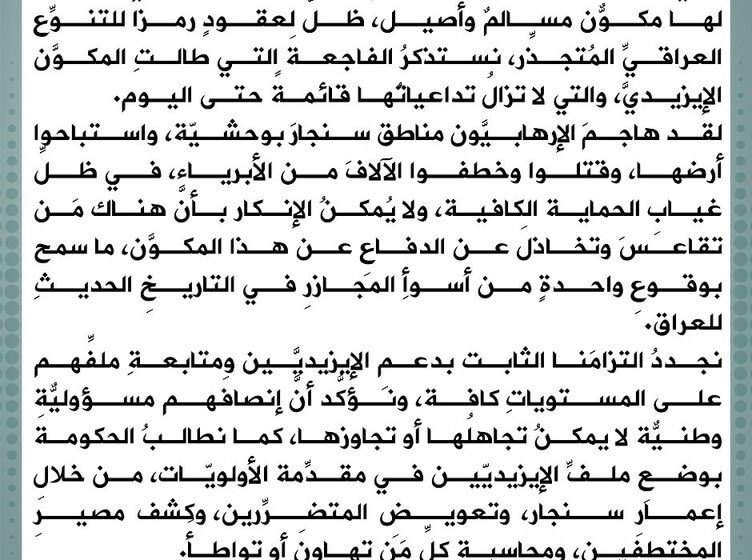
- 5. Iraq Commemorates 11th Anniversary of the Yazidi Genocide
- 6. Iran’s Military Posturing and Regional Tensions
- 7. Public Discontent Over Political Handouts
- 8. Kuwait Revokes Citizenship of Former Amiri Guards
- 9. Corruption Allegations in Ministry of Higher Education
- 10. Ayatollah Sistani’s Office Forbids Use of His Image by Politicians
Today’s Top 10 X (Twitter) Trends in Iraq:
1. Vandalism of Qais al-Khazali’s Posters Sparks Reaction
Posts about the tearing down of posters featuring Qais al-Khazali, the leader of Asa’ib Ahl al-Haq, dominated the conversation. Qais al-Khazali (Post Impact: 100%) himself posted an image of one of his vandalized posters. His supporters, such as Sarah Khalaf (Post Impact: 10%), condemned the act, blaming it on those who want to “drag the country into a swamp of chaos” and whose “approach is sabotage.” Conversely, other accounts like Omar Abdul Sattar Mahmoud (Post Impact: 5%) shared footage showing unidentified individuals tearing down the posters in the al-Za’faraniyah area of Baghdad, highlighting the act itself without assigning blame.
2. Criticism of Muqtada al-Sadr’s Large Motorcades
A video showing a massive convoy of Chevrolet Tahoe vehicles sparked widespread criticism directed at the Sadrist Movement. Rusly Al-Maliki (Post Impact: 70%) shared the video, noting it was filmed in the presence of Sadrist leader Muqtada al-Sadr and pointedly asked: “Where did these people get the Tahoe cars from?” The display of wealth and power was also commented on by Shaho Al-Qaradaghi (Post Impact: 8%), who sarcastically remarked that the owner of the “modest convoy” is also on the list of candidates to become an ambassador for Iraq abroad, suggesting a continuation of serving the nation with such displays.
3. Debate Between Faig al-Sheikh Ali and Salem al-Jumaili
A public exchange unfolded between politician Faig al-Sheikh Ali (Post Impact: 46%) and former intelligence officer Salem al-Jumaili (Post Impact: 33%). The discussion appears to stem from al-Jumaili’s comments in an interview with “The Black Box” program. In response to al-Sheikh Ali’s reaction, al-Jumaili issued a formal apology, clarifying that he holds al-Sheikh Ali in high regard for his stances against the “corrupt political process” and Iranian interference. Al-Jumaili stated that his lack of knowledge about al-Sheikh Ali before 2003 was due to his specific role in intelligence and was not meant to diminish his opposition activities, adding that he later learned from colleagues about al-Sheikh Ali’s “distinguished media role in attacking the former regime.”
4. US Voices Concern Over New PMF Legislation
The U.S. government’s position on proposed laws concerning the Popular Mobilization Forces (PMF) was a significant topic. The U.S. Embassy Baghdad (Post Impact: 23%) account stated that its Chargé d’Affaires met with the First Deputy Speaker of Parliament, Mohsen al-Mandalawi, to express concern that the new laws would “institutionalize Iranian influence and strengthen armed terrorist groups, threatening Iraq’s sovereignty.” In contrast, pro-PMF accounts like Abbas Al-Ardawi (Post Impact: 11%) announced that the “Popular Mobilization Forces Law was included in today’s session, God willing.” Rafid Jaboori (Post Impact: 6%) specified that the U.S. objects to two laws: one related to pensions and another that would significantly expand the PMF’s authority.
5. Iraq Commemorates 11th Anniversary of the Yazidi Genocide
On the 11th anniversary of the Yazidi genocide by ISIS, numerous political figures and commentators shared messages of remembrance and solidarity. Kurdistan Region Prime Minister Masrour Barzani (Post Impact: 19%) described the massacre as a “deep wound in the history of the Kurdish people and all of humanity.” Similarly, Ammar Al-Hakim (Post Impact: 9%) pledged to “build a safe Iraq for all.” Other accounts, like Haydar (Post Impact: 15%) and Ahmad Abdulsada (Post Impact: 8%), reflected on the tragedy, with Abdulsada claiming that “no component feels the pain of the Yazidis… more than the Shiites,” arguing both groups were victims of terrorism from the same source.
6. Iran’s Military Posturing and Regional Tensions
Discussions about Iran’s internal changes and their potential military implications were prominent. Analyst Rafid Jaboori (Post Impact: 24%) shared a video report with the stark comment, “Changes in Iran in preparation for war!” Similarly, Omar Abdul Sattar Mahmoud (Post Impact: 11%) posted a political analysis segment titled “The strict change of the Iranian regime,” suggesting that recent shifts within Tehran’s leadership are significant and could be linked to escalating regional conflicts.
7. Public Discontent Over Political Handouts
The practice of distributing small gifts to citizens by political factions drew sharp criticism. Rusly Al-Maliki (Post Impact: 24%) posted a message arguing that accepting handouts like blankets or chicken leads to self-devaluation, stating, “When you took the falafel sandwich, tomorrow they will give you a bone like a dog… because you did not value yourself.” This sentiment was echoed by Mustafa al-Dulaimi (Post Impact: 6%), who shared a photo of food distribution with the caption, “the value of the Iraqi citizen in the eyes of the parties,” adding the proverb, “You are ruled as you are.”
8. Kuwait Revokes Citizenship of Former Amiri Guards
Journalist Zaid Benjamin (Post Impact: 54%) reported that Kuwaiti authorities revoked the citizenship of 57 people, including two former members of the Amiri Guard, Hassan Hamdan al-Shammari and Zaid Salem al-Harbi. The post explains they were injured during a failed assassination attempt against the Emir of Kuwait, Sheikh Jaber Al-Ahmad, in 1985, an attack that Iran was accused of orchestrating due to Kuwait’s support for Iraq during the war. They had been granted citizenship in 2005 under the “glorious deeds” clause for their role in the incident.
9. Corruption Allegations in Ministry of Higher Education
A video clip circulated showing the son of MP Alaa al-Haidari allegedly threatening the Dean of the College of Administration and Economics at Basra University. Rusly Al-Maliki (Post Impact: 17%) shared the video, directing criticism at the ministry of Naim al-Aboudi and using the hashtag #YouWontBecomeAState. The incident was also highlighted by Dr. Zaid Abdulwahab Al-A’adhami (Post Impact: 6%), who called it a “public blackmail scandal” that exposes how political families are “swallowing the state.”
10. Ayatollah Sistani’s Office Forbids Use of His Image by Politicians
Several accounts shared a statement from the office of Grand Ayatollah Ali al-Sistani rejecting the use of his image by political parties. Husham Ali (Post Impact: 7%) and Yasser Eljuboori (Post Impact: 4%) posted the text of the statement, which noted that some political and service entities were using the Grand Ayatollah’s photos on banners, especially on the Arba’een pilgrimage routes. The statement reaffirmed its “rejection of this behavior” and urged all to avoid it. Commentators like Salam al-Husseini (Post Impact: 6%) interpreted the move as a “huge slap to the entire system of the Coordination Framework parties,” whom he described as the only political entity trading on the Marja’iyya’s name.