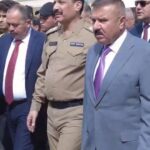
2025-04-29: Outrage Over Assault on Employee at Najaf Airport

Miqrab AI’s analysis of 498 trending X/Twitter posts in Iraq on April 29, 2025, reveals a social media landscape dominated by intense sectarian political discourse, regional conflicts, and scrutiny of the government’s foreign and domestic policies. The most engaged-with topics included outrage over an assault on an Iraqi employee by Iranian nationals at Najaf airport, escalating clashes between Druze and Islamist factions in Syria, and heated debates over the sectarianism of Iraqi politicians, fueled by a leaked audio recording attributed to Khamis al-Khanjar. Other significant conversations revolved around a series of explosions in Iran, historical revelations from Gamal Abdel Nasser’s conversations about Arab states, and Iraq’s efforts to modernize its military through foreign contracts.
Table Of Content
- 1. Outrage Over Assault on Employee at Najaf Airport
- 2. Druze Clash with Islamist Groups in Jaramana, Syria
- 3. Heightened Sectarian Political Tensions in Iraq
- 4. Historical Tapes of Nasser Reveal Views on Arab States
- 5. Series of Explosions and Fires Reported Across Iran
- 6. Hezbollah Allegedly Seeks Chinese Support After Israeli Strike
- 7. Iraq’s Foreign Policy and Military Modernization Efforts
- 8. Capture of ISIS Terrorist Linked to Captain Al-Sudani’s Death
- 9. Saudi Investment Deal for Industrial Complex in Anbar
- 10. Leaked Audio of Khamis al-Khanjar Fuels Political Controversy
Today’s Top 10 X (Twitter) Trends in Iraq:
1. Outrage Over Assault on Employee at Najaf Airport
A video circulating on X / Twitter depicts an incident at Najaf airport where two Iranian travelers allegedly assaulted a female Iraqi employee. According to Rusly Al-Maliki (Post Impact: 100%), the travelers verbally abused the employee before striking her and removing her hijab. The post expresses strong condemnation, sarcastically congratulating Iraqis on their humiliation and referring to them as “slaves of the senile Khamenei,” suggesting this is the outcome of their subservience. This singular, high-impact post drove a significant narrative of national indignation and resentment over perceived foreign disrespect on Iraqi soil.
2. Druze Clash with Islamist Groups in Jaramana, Syria
A major topic of discussion was the escalating conflict in Jaramana, Syria, between local Druze communities and Islamist factions. Sufian Al-Samarrai (Post Impact: 96%) called for the intervention of what he termed the “Arab Druze Israeli army” to defeat “gangs of Al-Qaeda, ISIS, and Al-Nusra,” whom he described as agents of Qatar, Turkey, and Iran. Other posts from Sufian Al-Samarrai (Post Impact: 53%) and Huruf Sumeria (Post Impact: 33%) showed videos of fighters reportedly arriving from As-Suwayda to defend the city. In contrast, Ahmad Abdulsada (Post Impact: 21%) argued that the pretext for the attack—an audio recording of a Druze sheikh allegedly insulting the Prophet—was fabricated by these groups to justify an assault on the Druze population. This was echoed by Mahdi Majeed (Post Impact: 20%), who claimed the recording was AI-generated to incite civil war.
3. Heightened Sectarian Political Tensions in Iraq
Sectarian discourse featured heavily in today’s trends, focusing on the actions and statements of various political figures. Dr. Hussein Al-Safi (Post Impact: 93%) posted a poll asking users to identify the “most sectarian politician in Iraq’s history” from a list including Khamis al-Khanjar, Adnan al-Dulaimi, and Osama al-Nujaifi. Hassan Al-Kaabi (Post Impact: 87%) shared a post stating that “ISIS is not an American or Israeli creation, but rather a product of Sunni takfiri thought.” Adding to the sectarian narrative, Shaho Al-Qaradaghi (Post Impact: 71%) quoted Judge Wael Abdul-Latif as saying that Shiites are “more entitled to rule” and could run the country without Sunnis and Kurds. These posts reflect a climate of deep political division and mistrust framed along sectarian lines.
4. Historical Tapes of Nasser Reveal Views on Arab States
Journalist Zaid Benjamin (Post Impact: 61%) shared several archival audio clips of a 1970 conversation between former Egyptian President Gamal Abdel Nasser and Libyan leader Muammar Gaddafi, sparking discussion on historical Arab politics. In the clips, Nasser expressed frustration with other Arab nations’ roles in the conflict with Israel. He claimed that Iraq and Saudi Arabia sought to maintain the status quo to provoke an “internal explosion” in Egypt, which was bearing the brunt of the fighting. In other shared clips, Nasser alleged that Algeria “did not provide us with anything” in the 1967 war, as posted by Zaid Benjamin (Post Impact: 51%), and relayed a story from Abu Dhabi’s Sheikh Zayed, who feared the British would remove him from power if his financial contributions to Egypt became public, also from Zaid Benjamin (Post Impact: 36%).
5. Series of Explosions and Fires Reported Across Iran
Multiple accounts reported on a series of explosions and fires at sensitive locations in Iran, fueling speculation about their cause. Rusly Al-Maliki (Post Impact: 49%) reported on an explosion in Isfahan at a facility for manufacturing explosives belonging to Iran’s National Security Council. Omar Abd Al Sattar Mahmoud (Post Impact: 36%) also highlighted the Isfahan explosion as part of a series of recent incidents. Another significant event discussed was a massive fire at Bandar Abbas port. Aayad Al-Twfan (Post Impact: 36%) shared an analysis suggesting the port incident was a sophisticated Israeli operation involving booby-trapped equipment. Adding to the reports, Shaho Al-Qaradaghi (Post Impact: 27%) noted that a fire at Rajai port had been burning for four days.
6. Hezbollah Allegedly Seeks Chinese Support After Israeli Strike
A post with high engagement from Sufian Al-Samarrai (Post Impact: 71%) claimed that Hezbollah is seeking Chinese assistance following a recent Israeli strike on a precision missile facility in Beirut. The post points to the landing of a Chinese military aircraft in Beirut as evidence of this new development. Al-Samarrai suggested that this move indicates China may be shifting its strategy from sending equipment covertly through Iraq and Syria to establishing a more direct presence in the region, marking a significant potential escalation in regional geopolitics.
7. Iraq’s Foreign Policy and Military Modernization Efforts
Several posts focused on Iraq’s foreign relations and military procurement. Haidar (Post Impact: 31%) reported that Iraq is in advanced negotiations with France to purchase 12 Rafale F4 fighter jets for $3 billion, a deal that includes a comprehensive support package. This move suggests Iraq is prioritizing the French aircraft over previous plans to buy JF-17s from Pakistan. Meanwhile, Haidar (Post Impact: 28%) shared a statement from Kata’ib Hezbollah rejecting Kuwait’s sovereignty over the Khor Abdullah waterway and stating that Syrian leader al-Jolani is unwelcome in Baghdad. In a related post, Thabit Muhammad Al-Abbasi (Post Impact: 9%), the Iraqi Minister of Defense, confirmed his official visit to France to discuss security cooperation and military contracts.
8. Capture of ISIS Terrorist Linked to Captain Al-Sudani’s Death
Security developments were highlighted with news of the arrest of a key ISIS operative. Fadhil Abu Ragheef (Post Impact: 23%) announced that the National Security Service had captured the terrorist known as “Abu Suleiman.” This individual was described as the direct handler of Captain Harith Al-Sudani, an Iraqi officer who infiltrated ISIS and was later martyred. Abu Suleiman was reportedly responsible for equipping and deploying suicide bombers and car bombs in Baghdad and southern Iraq. A corresponding post from Abu Darandish Al-Askari (Post Impact: 22%) shared a photo of the captured terrorist, identifying him as the killer of the celebrated captain.
9. Saudi Investment Deal for Industrial Complex in Anbar
Economic news focused on a new investment agreement between Iraq and Saudi Arabia. Both Issam Hussein (Post Impact: 23%) and Haidar (Post Impact: 21%) reported that an agreement was signed with the Saudi company Ajyal to establish a large-scale industrial complex in Anbar province. The project will reportedly rely on silica as a primary raw material. Hussein framed the development as a counter-narrative to claims of marginalization against Sunni-majority areas, highlighting it as a significant step towards economic revitalization in the region.
10. Leaked Audio of Khamis al-Khanjar Fuels Political Controversy
A leaked audio recording attributed to politician Khamis al-Khanjar continued to generate significant political controversy and calls for investigation. Dr. Qusay Shafiq (Post Impact: 33%) questioned why figures in the Shiite Coordination Framework were allegedly attempting to “cover up” the incident and urged them to let the judiciary decide the matter. In another post, Dr. Qusay Shafiq (Post Impact: 16%) claimed that “great pressure is being exerted against the heroes of forensic evidence” to influence the outcome of the analysis. Similarly, Issam Hussein (Post Impact: 11%) announced that the Karkh Third Investigation Court had initiated an investigation into the recording, calling for the exclusion of figures who promote sectarianism from the political scene.