2026-02-04: US-Iran Nuclear Talks Collapse and Then Resume

Based on an analysis of 563 X / Twitter posts trending on February 4, 2026, Miqrab AI found that the primary narratives in Iraq revolve around escalating regional tensions and domestic political maneuvering. The most dominant conversation concerns the volatile status of US-Iran nuclear negotiations, which reportedly collapsed before being revived, fueling widespread speculation about a potential military conflict. Domestically, significant attention was given to the United States’ explicit opposition to a potential return of former Prime Minister Nouri al-Maliki to power. Other key topics included historical reflections on the 1991 Sha’aban Intifada, praise for Iran’s diplomatic tactics, and controversies surrounding Iraqi political figures and media freedom in the Kurdistan Region.
Table Of Content
- 1. US-Iran Nuclear Talks Collapse and Then Resume
- 2. US Warns Against Nouri al-Maliki’s Return to Power
- 3. Heightened Fears of US Military Action Against Iran
- 4. Saddam’s Crimes in 1991 Sha’aban Intifada Recalled
- 5. Iran’s Diplomatic Strategy in US Negotiations Praised
- 6. Nouri al-Maliki’s Controversial Political Overtures
- 7. Kurdish Authorities Shut Down NRT News Channel Offices
- 8. Commemorating Ayatollah Sistani’s Anti-ISIS Fatwa
- 9. Reports Surface on Assad Regime’s Alleged Duplicity
- 10. Trump’s Connection to Epstein Scandal Discussed
Today’s Top 10 X (Twitter) Trends in Iraq:
1. US-Iran Nuclear Talks Collapse and Then Resume
X / Twitter was dominated by rapidly changing reports about nuclear negotiations between the United States and Iran. The topic gained immense traction, highlighted by a post from Qais Al-Khazali (Post Impact: 100%). Accounts like Rafid Jaboori (Post Impact: 24%) and Haidar (Post Impact: 11%) initially announced the cancellation of the talks, attributing it to Iran’s refusal to discuss non-nuclear issues and its insistence on moving the venue from Istanbul to Muscat. Rusly Al-Maliki (Post Impact: 30%) shared a quote from an American official via Axios stating, “We told Iran the choice is this or nothing, so they replied, then nothing.” However, the narrative shifted when Steven Nabil (Post Impact: 16%) later reported that the Iranian Foreign Minister announced the talks were back on for Friday morning, following urgent intervention from Arab and Muslim leaders to save the negotiations from collapse.
2. US Warns Against Nouri al-Maliki’s Return to Power
A significant discussion centered on the United States’ position regarding the potential candidacy of former Prime Minister Nouri al-Maliki. Steven Nabil (Post Impact: 25%) shared a direct statement from a US State Department official who quoted President Trump, warning that if Maliki were elected, “the United States of America will not continue to help Iraq.” The official added that the US is prepared to use its “full range of tools to implement the President’s policy.” This sentiment was echoed by Ali Farhan (Post Impact: 12%), who highlighted the US warning about ignoring Trump’s “veto” against Maliki. Adding a domestic perspective, Salim Aljomaili (Post Impact: 17%) asserted that Sunni Iraqis would not permit Maliki to become prime minister again.
3. Heightened Fears of US Military Action Against Iran
Alongside diplomatic news, there was intense speculation about an imminent military conflict between the US and Iran. Aayad Al Twfan (Post Impact: 15%) reported that the US sent a rare RC-135U Combat Sent spy plane to the region, describing it as a tool to disable Iranian air defenses and asserting that “the decision for war on Iran has been made.” David Yassin (Post Impact: 15%) stated that the “air option is on the table” and that “the strike is coming.” In a similar vein, Najah Mohammed Ali (Post Impact: 11%) framed the negotiations as a deception, declaring that “war is inevitable.”
4. Saddam’s Crimes in 1991 Sha’aban Intifada Recalled
Several accounts commemorated the 1991 Sha’aban Intifada, focusing on the brutal crackdown by Saddam Hussein’s regime. Haidar (Post Impact: 19%) described Saddam’s decision to drain the Iraqi Marshes as one of the largest acts of intentional environmental destruction in history, carried out as a punitive measure against Shia civilians. Another post from the same account highlighted the regime’s shelling and destruction of the holy shrines of Imam Hussein and Abbas in Karbala. Ammar Al-Hakim (Post Impact: 11%) described the uprising as a “bright page in Iraq’s modern history” that weakened the former regime and paved the way for its downfall, calling for its history to be taught in schools.
5. Iran’s Diplomatic Strategy in US Negotiations Praised
Iran’s handling of the negotiations with the United States was framed by some accounts as a masterful display of diplomatic strength. Sheikh Thair Al-Bayati (Post Impact: 26%) analyzed Iran’s move to change the negotiation venue from Turkey to Oman and limit the participants to just Washington and Tehran, calling it a “diplomatic slap” to other countries and a lesson in the “art of humiliating mediators.” Similarly, Najah Mohammed Ali (Post Impact: 9%) provided a detailed explanation for Iran’s preference for Oman, citing its neutrality and secrecy, and its insistence on bilateral talks to maintain sovereign control over the nuclear file without external political agendas.
6. Nouri al-Maliki’s Controversial Political Overtures
The political maneuvering of former Prime Minister Nouri al-Maliki drew criticism and commentary. Posts by Rusly Al-Maliki (Post Impact: 14%) and Ali Farhan (Post Impact: 11%) highlighted Maliki’s apparent outreach to Sunni figure Ahmed al-Sharaa, pointing out the perceived hypocrisy given that pro-Iran factions had previously labeled Sharaa a terrorist. In contrast, Najah Mohammed Ali (Post Impact: 15%) defended Maliki for describing Sharaa as a “brother,” arguing that this term is used in the Quran in diplomatic contexts and that Maliki, as a deep-rooted Islamic advocate, understands its significance.
7. Kurdish Authorities Shut Down NRT News Channel Offices
Multiple users reported on the closure of NRT news channel’s offices in the Kurdistan Region. According to Haidar (Post Impact: 10%) and Rusly Al-Maliki (Post Impact: 10%), Kurdish security forces raided the channel’s offices in Erbil and Dohuk, confiscating equipment and halting its operations. NRT stated that the action was a “party decision, not a judicial one” and was taken because the channel blurred an image of Mustafa Barzani. Dr. Arafat Karam Stuni (Post Impact: 7%) condemned the channel’s action as a “foolish step” against a “great symbol of the Kurdish nation,” arguing that closing the channel was insufficient and that those responsible should be held accountable.
8. Commemorating Ayatollah Sistani’s Anti-ISIS Fatwa
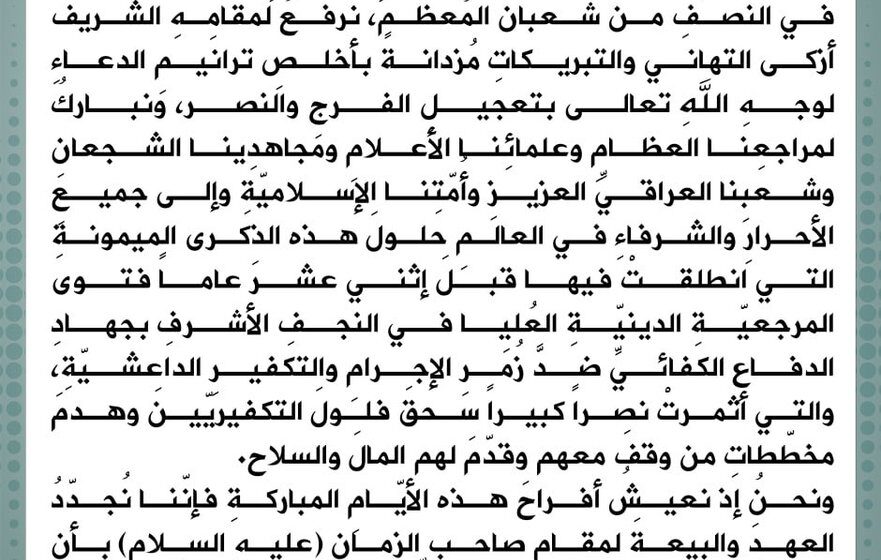
Several accounts marked the anniversary of Grand Ayatollah Ali al-Sistani’s fatwa of “Kifayi Jihad,” which led to the formation of the Popular Mobilization Forces (PMF) to combat ISIS. Ammar Al-Hakim (Post Impact: 10%) hailed the fatwa as a “pivotal moment in the modern history of Iraq” that protected the nation and showcased the people’s faith and patriotism. Emad Al Musafir (Post Impact: 7%) described the fatwa as a moment that “broke the project of collapse and saved the state from falling,” suggesting the day should be a national holiday. Abu Darandash Al-Askari (Post Impact: 7%) posted a video tribute with the caption, “On this day, the Hashd and its men were born.”
9. Reports Surface on Assad Regime’s Alleged Duplicity
Claims of deception by the Syrian regime of Bashar al-Assad circulated on X / Twitter. Ali Farhan (Post Impact: 32%) shared a “dangerous confession” attributed to political analyst Amir al-Moussawi, who allegedly claimed that Hezbollah’s Hassan Nasrallah purchased 1,800 ISIS fighters from the Assad government. Farhan suggested this indicates ISIS was used as a political tool to expand Iranian influence. In a separate post, Rusly Al-Maliki (Post Impact: 10%) shared a video of an Iranian politician describing how Assad allegedly scammed Iran out of billions of dollars invested in Syria, leaving Iran with no proof of its financial rights.
10. Trump’s Connection to Epstein Scandal Discussed
The scandal involving Jeffrey Epstein and his connections to prominent figures, including former US President Donald Trump, was a topic of discussion. Ezzat Alshabandar (Post Impact: 12%) referenced the “scandals of (the Devil’s) island of Jeffrey Epstein” and questioned whether anyone in Iraq or elsewhere should still fear the threats of a “hero” involved in it. Similarly, Amir Al-Moussawi (Post Impact: 16%) posted an image related to the US-Iran negotiations and included the hashtag #Epstein_Trump_scandals, linking the international affair to the ongoing scandal.